
150 YEARS STRONG

‘The Spiritual High Point’: The Dr. MLK Holiday Observation and Sunrise Celebration

One fixture of the American Library Association’s (ALA) Midwinter Meeting—and later the LibLearnX conference—was the Dr. Martin Luther King, Jr. Holiday Observation and Sunrise Celebration. (It is now held virtually.) The event celebrates the life and legacy of Dr. King, featuring a keynote speaker, representatives from National Associations of Librarians of Color, the ALA President, and the singing of “We Shall Overcome.” The celebration started in 2000, but efforts to observe the MLK Jr. Holiday during the Midwinter Meeting started long before.

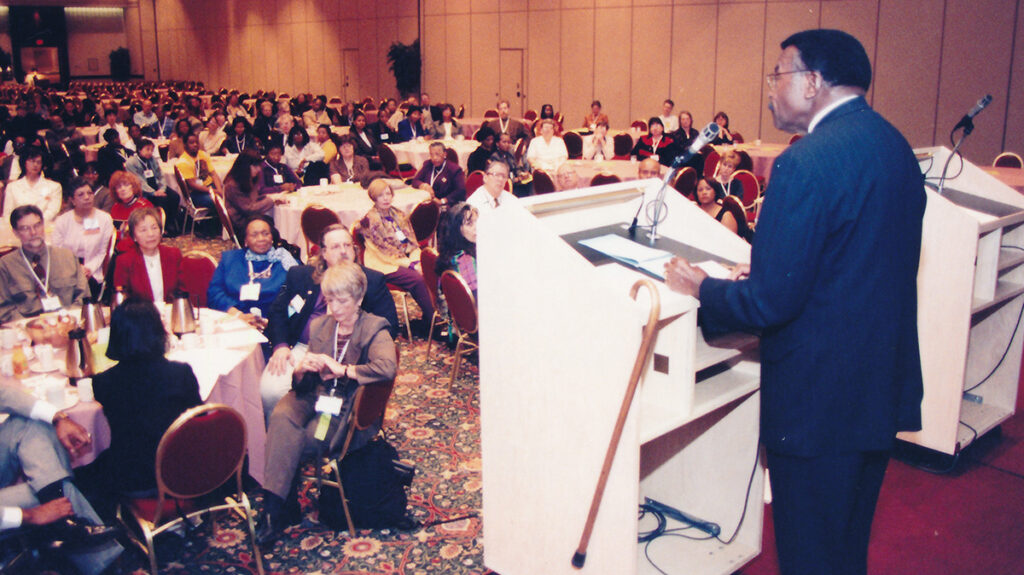
Keynote speaker E.J. Josey speaking at the Martin Luther King, Jr. Holiday Observation and Sunrise Celebration at the 2000 ALA Midwinter Meeting in San Antonio.

Activist, librarian, and former ALA President E.J. Josey credited Dr. Marva L. DeLoach for bringing up the topic of observing the MLK Holiday during the Midwinter Meeting to ALA Council as a Council member and president of the Black Caucus of the American Library Association (BCALA). Dr. DeLoach was concerned that nothing was being done to recognize Dr. King during the Midwinter Meeting, which often occurred during or close to the holiday.(1) A resolution on observing the holiday was voted on and passed by Council in 1987–1988, directing ALA to “initiate an activity and set aside appropriate time during the Midwinter Meeting to honor the accomplishments of Dr. Martin Luther King, Jr.” (2)

While the holiday was observed during the Midwinter Meetings, a more permanent and consistent celebration came in the form of the Dr. Martin Luther King, Jr. Holiday Observation and Sunrise Celebration. The Sunrise Celebration came from the combined efforts of the Social Responsibilities Round Table’s (SRRT) Martin Luther King, Jr. Holiday Task Force (MLKTF) and ALA’s Office of Library and Outreach Services (OLOS). The MLKTF has its origins in the National Library Involvement Committee of the Martin Luther King, Jr. Federal Holiday Commission. The committee became a part of ALA in 1985 during Josey’s presidency and in February 1999, committee chair Virginia Bradley Moore proposed that it become a task force of the Social Responsibilities Round Table. (3)

With more than 10 signatures supporting Moore’s proposal, as required by SRRT’s constitution, SRRT approved a probationary task force. The probationary status was lifted during the SRRT Action Council meeting in June 1999. Shortly after the establishment of the Task Force, Satia Marshall Orange, the director of OLOS, scheduled the first MLK Sunrise Celebration for the following Midwinter Meeting. (4)

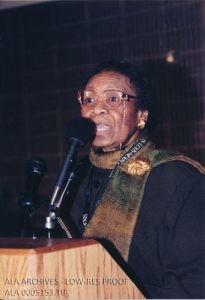
Virginia Bradley Moore, chair of the SRRT Dr. Martin Luther King, Jr. Holiday Task Force, speaking at the Martin Luther King, Jr. Holiday Observation and Sunrise Celebration at the 2001 ALA Midwinter Meeting in Washington, D.C.
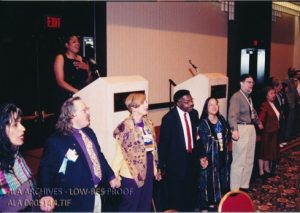
Speakers joining hands and singing “We Shall Overcome” at the Martin Luther King, Jr. Holiday Observation and Sunrise Celebration at the 2000 ALA Midwinter Meeting in San Antonio.

The celebration was held during the 2000 Midwinter Meeting in San Antonio. The event, starting at 6:30am, was an immediate success as it drew an audience of over 200 people attending to celebrate the life and legacy of Dr. King. Activist, librarian, and former ALA President, EJ Josey was the first keynote speaker, sharing his personal interaction with Dr. King, who told Josey that, “we need our libraries open to all so that the students can prepare themselves for the 21st century.” (5) The event was bookended with the audience and participants joining hands and singing “We Shall Overcome.” American Libraries described the celebration as “the spiritual high point of Midwinter.” (6)

For more than 20 years, the celebration has continued to draw large audiences for the early morning event. Sponsorship of the event has also grown through the years, including BCALA, World Book, Inc., Random House, Beacon Press, and OCLC. The MLK Holiday Observation and Sunrise Celebration has remained a constant on the conference schedule, featuring words from scholars and authors, and ending in song.

Watch the 27th Annual Dr. Martin Luther King, Jr. Holiday Observance and Sunrise Celebration, held January 15, 2026, below.


  1. EJ Josey, “ALA Celebration of the Dr. King Holiday,” January 17, 2000. https://alair.ala.org/handle/11213/9640
  2. “1987-88 ALA Council Voting Record,” American Libraries, Vol. 19, No. 7 (July-August 1988): 600.
  3. Social Responsibilities Round Table Action Council Minutes, January 30 & February 1, 1999. https://alair.ala.org/handle/11213/16172
  4. Virginia B. Moore, “A History of the Martin Luther King, Jr. Holiday Task Force,” SRRT Newsletter, Issue 169 (December 2009). https://alair.ala.org/handle/11213/11839
  5. EJ Josey, “ALA Celebration of the Dr. King Holiday,” January 17, 2000. https://alair.ala.org/handle/11213/9640
  6. “Midwinter Meeting: ALA Finds Sunny San Antonio ‘Muy Simpático’,” American Libraries, 31, no. 3 (March 2000): 56.

150 YEARS STRONG

THE OFFICIAL ANNIVERSARY BLOG

Henry and Edith Carr

Henry and Edith Carr, ALA’s Golden Couple

With Valentine’s Day approaching, we remember possibly the most famous ALA couple of all time, Henry and Edith Wallbridge Carr. Married for 43 years and active in ALA for even longer, the Carrs were well-known within the library community of the late 19th and early 20th century. Where did their romance begin? At an ALA conference, of course!

detail of 1976 ALA conference program logo

A Short History of the ALA Logo

The first American Library Association (ALA) logo appeared as the Association launched its Library War Service during World War I, with many more iterations following over the course of almost 100 years.

detail of Richmond ALA COnference program

Librarians, Segregated: The 1936 ALA Annual Conference

Stanley J. Kunitz, editor of the Wilson Bulletin, called it the “The Spectre at Richmond” —but the racial discrimination at the 1936 American Library Association Annual Conference was no ghostly apparition

Detail of letter from Virginia Hamilton to Anne Izard, February 24, 1972.

Newbery: Letters from the Authors

For more than a century, the American Library Association has honored children’s authors with the John Newbery Medal. From the earliest years of the award, its prestige was not lost upon the authors who received it. Letters written by awardees to the Newbery Medal Committee chairs reveal their excitement upon receiving the news.

Agenda for the Children’s Librarians Section on June 27, 1922, including the first presentation of the John Newbery Medal.

Newbery: The First Medal

In 1921, Frederic Melcher, a publisher, bookseller, and chairman of the Children’s Book Week Committee, proposed the idea of a medal to be awarded in recognition of children’s literature and for it to be named after John Newbery, an 18th century British bookseller and children’s books publisher. With a growing audience for children’s books, more librarians being trained in children services, and the emergence of children’s book departments in publishing companies, the time seemed right for such an award and the idea gained traction.

Caldecott Award Seal

The Caldecott Medal: ‘A Hasty Idea Thrown Out’

The Caldecott Medal is of one of the most prestigious children’s book awards in the world. Established in 1937 to recognize the most distinguished American picture book for children, the first medal was awarded in 1938 to Dorothy P. Lathrop for the book, “Animals of the Bible.” However, the idea was first presented in 1935 in a letter by Frederic G. Melcher.