Sponsored by the National Book Committee, Inc., and in cooperation with the American Library Association (ALA), the first National Library Week was launched on March 16–22, 1958. Citing a 1957 survey showing that only 17% of Americans polled were reading a book, the inaugural National Library Week slogan was “Wake Up and Read!”
The National Library Week initiative was the first nationwide effort to promote literacy for personal and national improvement, to celebrate the role of libraries in making reading materials accessible to everyone, and to highlight the varied career opportunities available within the library profession.[1]
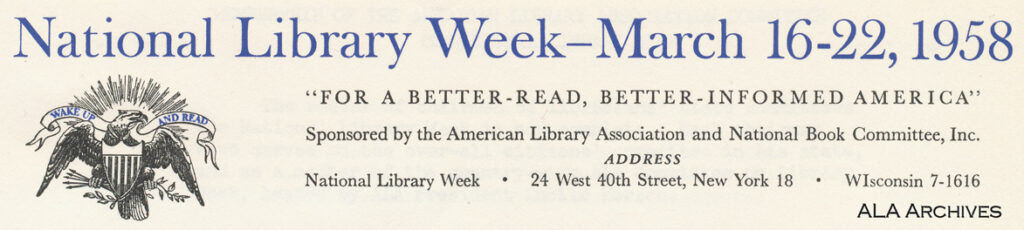
Although there had been previous local events celebrating libraries, such as the 1937 “Library Week” in Youngstown, Ohio, the 1949 “Know Your Library Week” in Jackson, Mississippi, and the 1952 statewide “California Library Week,” with the sponsorship of the National Book Committee and the ambitious direction by John S. Robling, former advertising and promotion director of the McCall Corporation’s (Clothing) Pattern Division, national attention to libraries had never been greater.[2] The first National Library Week engaged more than 5,000 communities throughout the country. Hundreds of local and state communities and librarian committees engaged in public relations, promotion, and advertising campaigns to encourage reading and the use and support of libraries.[3] National magazines carried 22 articles reaching 68,000,000 readers; 14 radio and television network shows reaching another 170,000,000 homes, and more than $800,000 in broadcasting was donated for National Library Week. Newspapers published 11,607 major stories in just three weeks—a record in itself.[4]
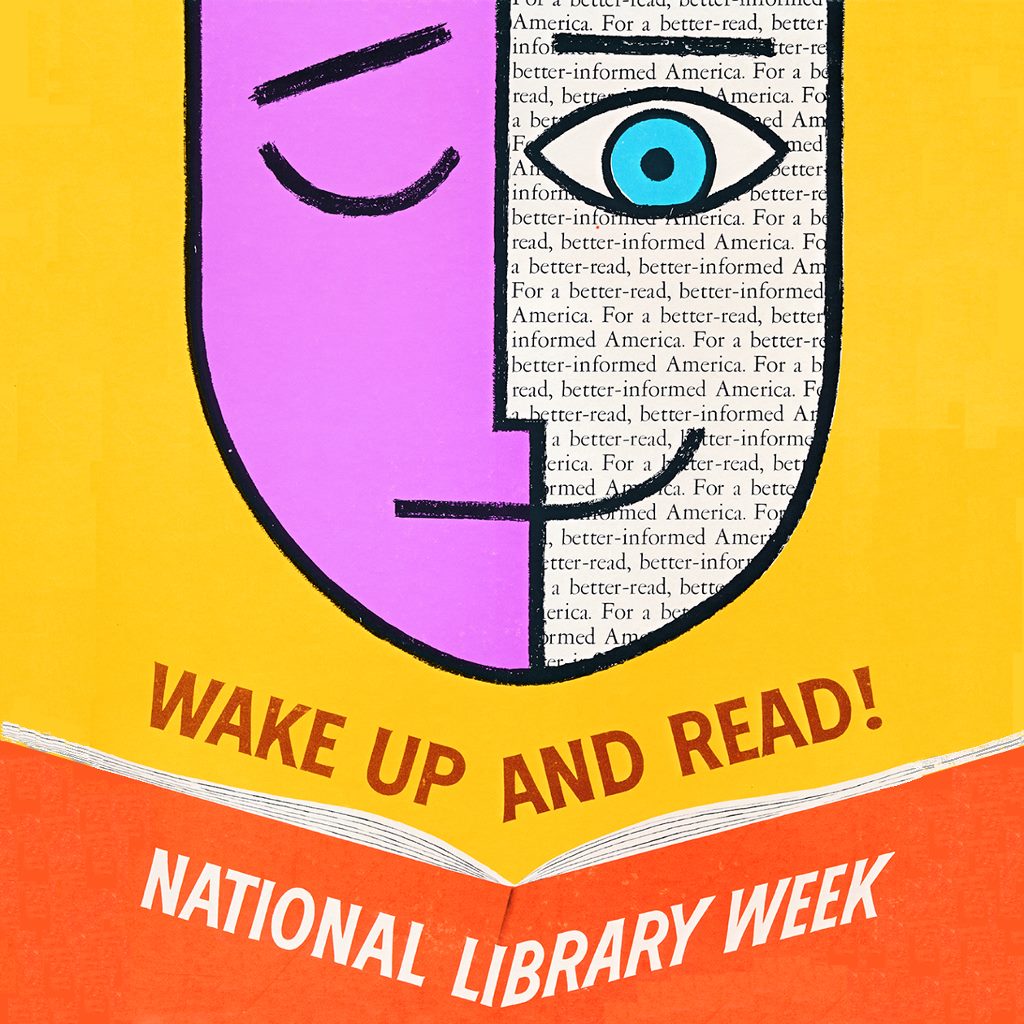
In a summary of the first National Library Week printed in the ALA Bulletin, Robling noted: “What impressed us most—indeed what almost overwhelmed us were two things—the vigor, originality, and skill with which state and local committees, sparked by librarians, originated and carried through programs of amazing variety and effectiveness, and the warm and instant response to the aims of National Library Week we found everywhere—among broadcasters, newspapermen, magazine editors, civic leaders, educators, businessmen, everyone.” On reflecting upon lessons learned for future celebrations, “the most important thing it can learn—and has learned—is the tremendous strength that friends of libraries and books and reading have when they act together. I don’t think any of us a year ago could have believed the response that was to come to this year’s effort. And this is only the beginning.”[5]
Upon the continued success of the following National Library Week in 1959, ALA Council voted to continue the annual celebration. When the National Book Committee disbanded in 1974, ALA assumed full sponsorship.[6]
This year’s National Library Week will be celebrated April 19-25, 2026.
Citations:
[1] quoted from “March 16-22 — National Library Week” The Advertising Council, Inc. Radio-TV Bulletin, March-April 1958, Record Series 74/1/5, Box 1, Folder: “Publicity and Promotional Ads, 1958-1961”
[2] “National Library Week, March 16-22, 1958” broadside, found in Record Series 12/1/5, Box 5, Folder: “National Library Week – Memos & Releases.”
[3] “April 12-18 — National Library Week” The Advertising Council, Radio-TV Bulletin, March-April 1959, Record Series 74/1/5, Box 1, Folder: “Publicity and Promotional Ads, 1958-1961”
[4] Handbook for National Library Week, April 12-18, 1959, p. 7, Record Series 18/1/56, Box 29, Folder: “National Library Week, 1955-1959”
[5] Robling, John S. “Here’s What Happened.” ALA Bulletin. vol. 52, no. 6, June 1958. p. 431-435.
[6] “National Library Week Fact Sheet.” American Library Association. <http://www.ala.org/news/mediapresscenter/factsheets/nationallibraryweek>.
This story by Lydia Tang first appeared on the ALA Archives blog on April 10, 2015.