
150 YEARS STRONG

The Library War Service: ALA’s Book Campaigns in World War I

“Decent, but not too highbrow.” That’s how one volunteer described the kind of fiction he and his colleagues solicited from their Hibbing, Minnesota, neighbors for the second of three book collection campaigns the American Library Association (ALA) sponsored for servicemen during World War I.

ALA established its Library War Service in 1917 to provide books and library services to U.S. soldiers and sailors both in training at home and serving in Europe, raising $5 million from public donations and holding three book drives—one in September 1917, one in March 1918, and one in January 1919. This second book drive generated 3 million books, many going overseas, others ending up on the shelves of 36 training-camp libraries erected through Carnegie Corporation funding and managed by ALA volunteers across the country. To help public librarians with the campaign, an ad hoc ALA Library War Council issued a pamphlet titled “How to Conduct the Campaign for Libraries for Our Soldiers and Sailors.”

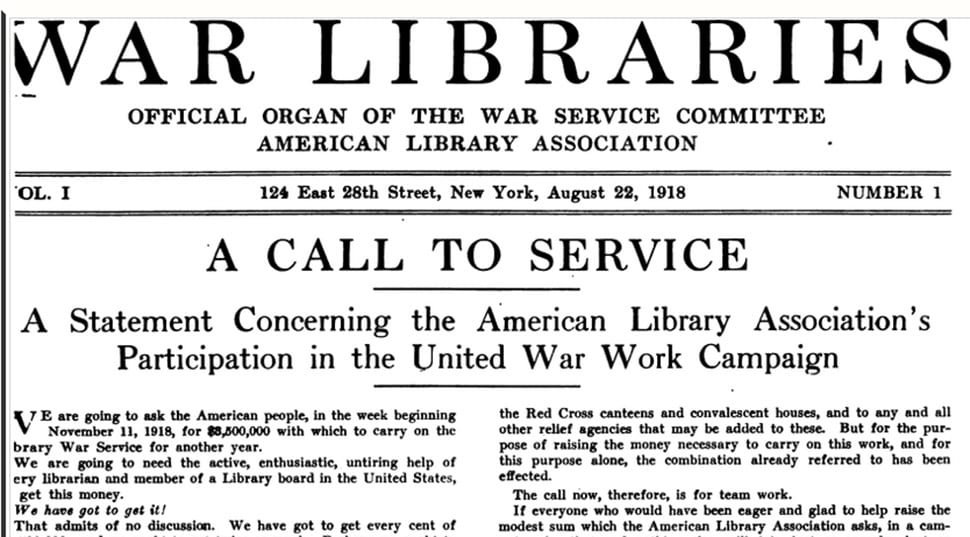
First page of War Libraries: Official Organ of the War Service Committee, American Library Association, 1918.

The collecting activities ALA monitored demonstrate some of the same professional creativity we see among libraries today.

  • The Millville (N.J.) Public Library sponsored a movie benefit. Each person buying a ticket was also asked to bring a book for soldiers. The library sold out four performances and collected several hundred books.
  • Boy Scouts in Milwaukee commandeered wheelbarrows and baby carriages to move books they collected door-to-door.
  • The St. Louis Public Library hosted numerous events in the main library and branches across town. The Crunden branch conducted a dance in the reading room, where a Filipino orchestra whose members wore native costumes played music from behind the circulation desk. Dancers paid an admission fee (which ALA used to buy books for the campaign) or donated a book. The Carondelet branch hosted a chaplain from a nearby training camp to lecture on camp life and the soldier’s need for reading materials.
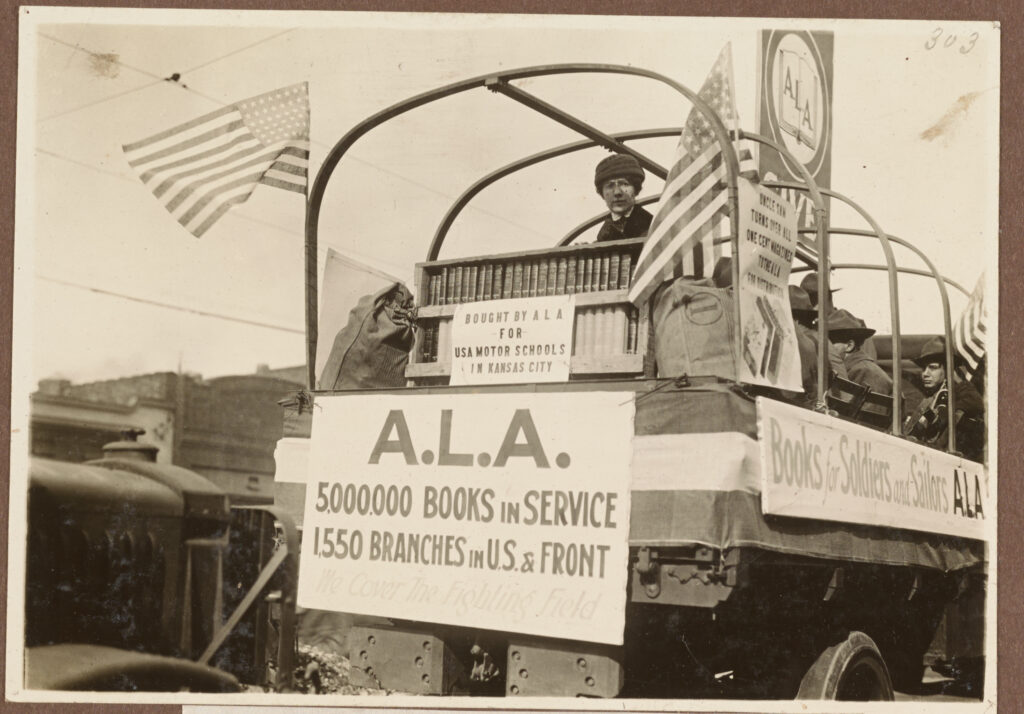
American Library Association parade float with servicemen riding inside for the United War Work Campaign; Kansas City, November 9, 1918.
American Library Association parade float with servicemen riding inside for the United War Work Campaign; Kansas City, November 9, 1918, from the ALA Archives.

For publicity value, however, few outdid 12-year-old Rachel Ashley, daughter of Frederick William Ashley, who was the superintendent of the Library of Congress main reading room at the time. In February 1918, Rachel dropped off ALA leaflets at homes in her Washington, D.C., neighborhood, to which she attached her phone number and slips noting: “I shall be glad to call on Saturday, February 23, for any books that you may wish to give to the soldiers and sailors thru the American Library Association.” Within an hour of returning home she began getting calls. That Saturday morning she and two friends pulled a child’s “express wagon” from house to house, and by noon they collected 121 books. “Little Ashley’s example is to be followed by hundreds of other school girls,” ALA’s War Library Bulletin noted.

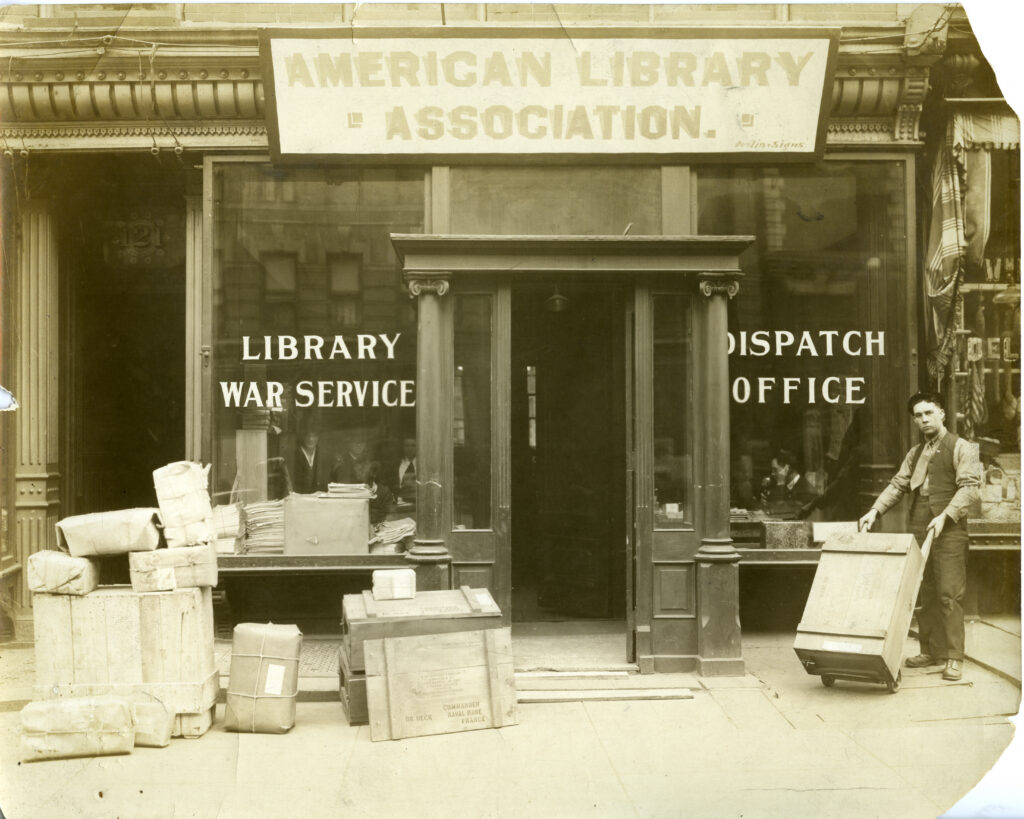
The exterior of the American Library Association dispatch office in Brooklyn, circa 1918. From the ALA Archives.

During the war, tens of thousands of servicemen spent much of their free time reading in those camp libraries and near the European battlefronts. By poring over “decent but not too highbrow” fiction, many improved their literary skills beyond the merely functional. The affinity they developed for these services often carried over into postwar use and support of public libraries. The definitive work on this subject is Arthur P. Young’s “Books for Sammies: The American Library Association and World War I” (Pittsburgh: Beta Phi Mu, 1981).

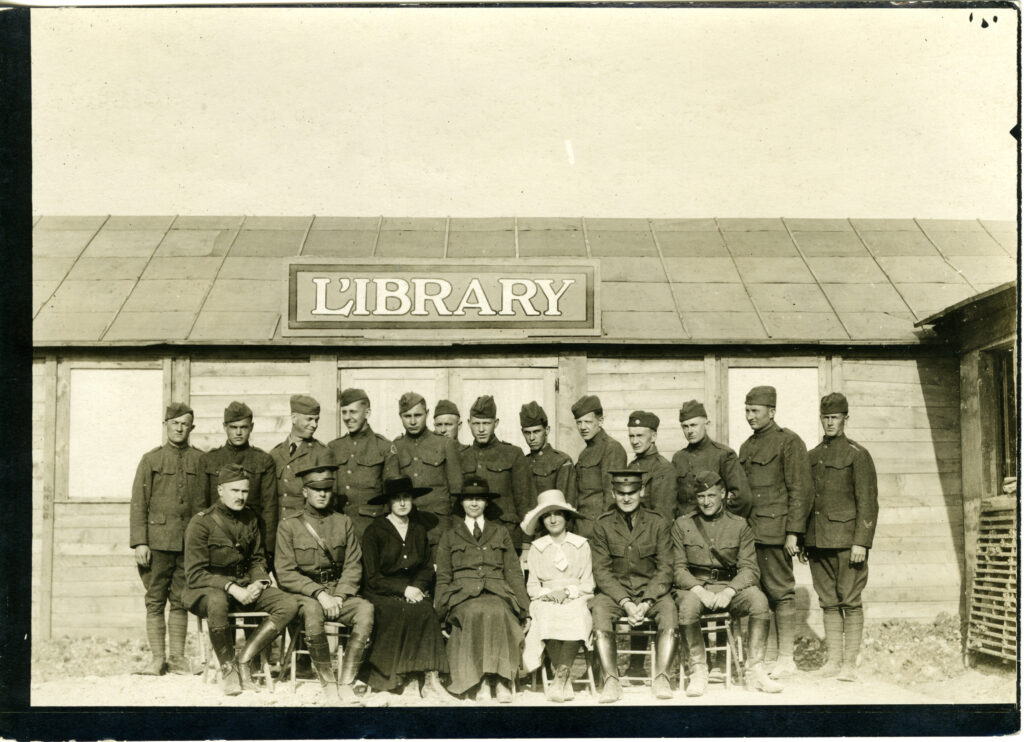
Servicemen and camp librarians, including Harriett Long, in front of a American Library Association camp library in Le Mans, France. 1918. From the ALA Archives.
Servicemen and camp librarians in front of a American Library Association camp library in Le Mans, France. 1918. From the ALA Archives.

ALA’s participation in the nation’s World War I effort served as a capstone to the public library movement that was made possible during the previous 20 years because of the philanthropy of Andrew Carnegie and other benefactors, as well as the professional practices ALA had fostered and libraries had adopted. Combined, they all helped to make the public library an essential institution in local American communities, a position it has never relinquished.

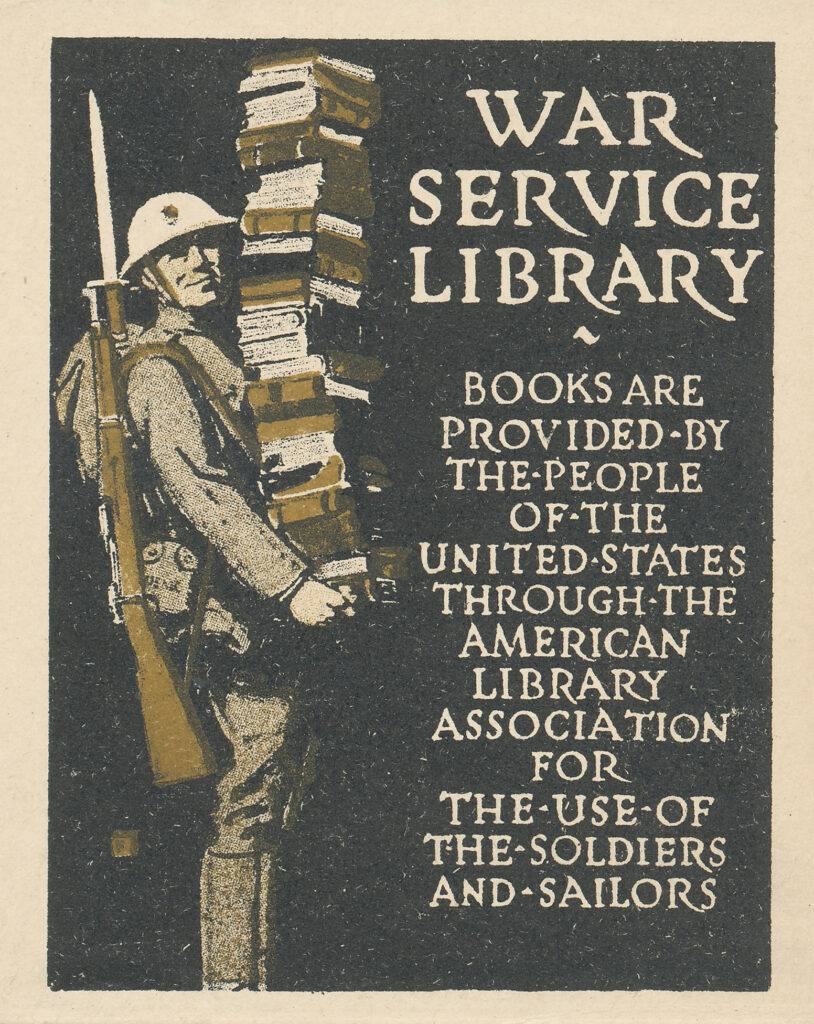
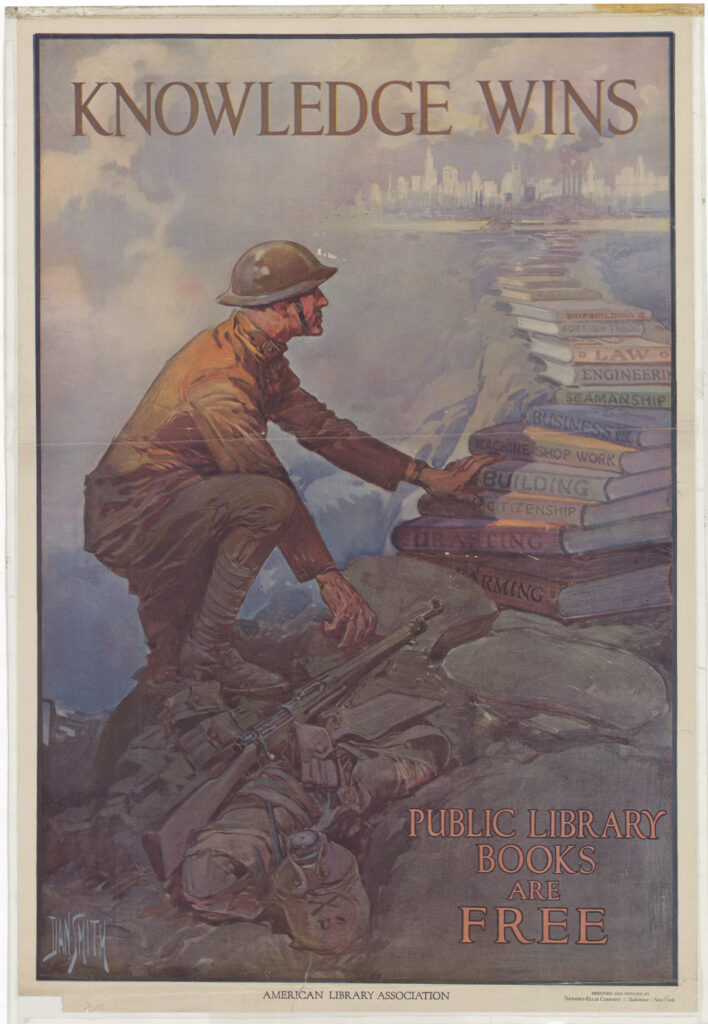
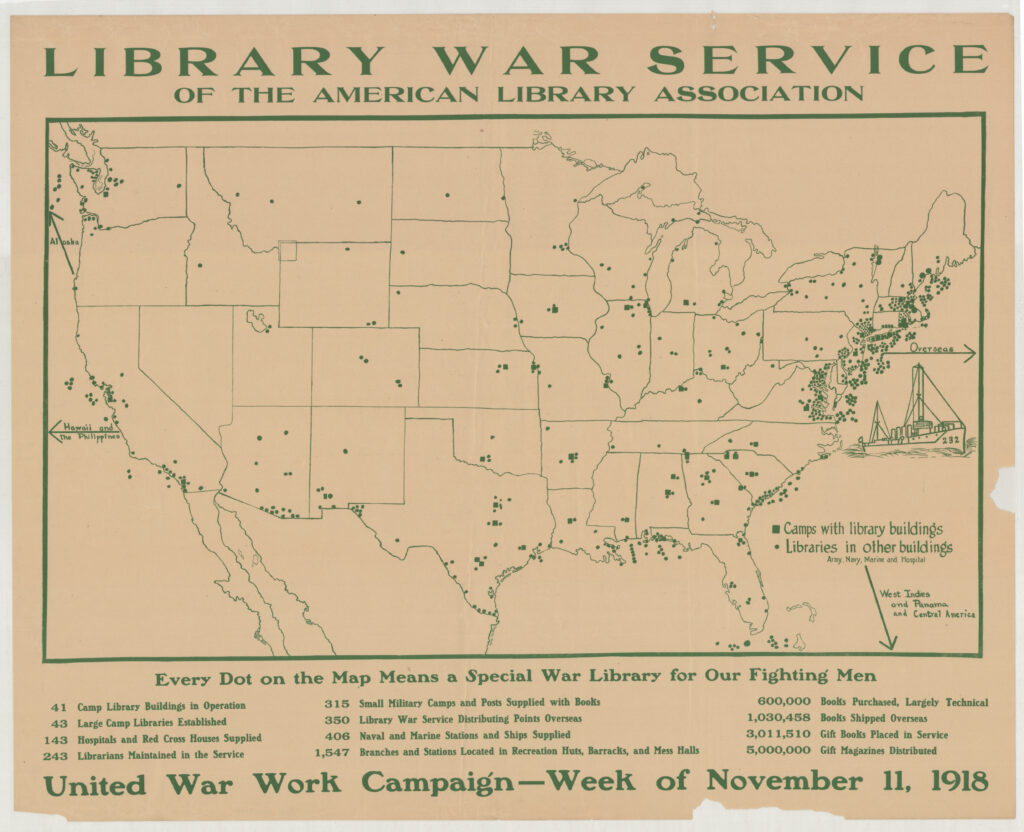
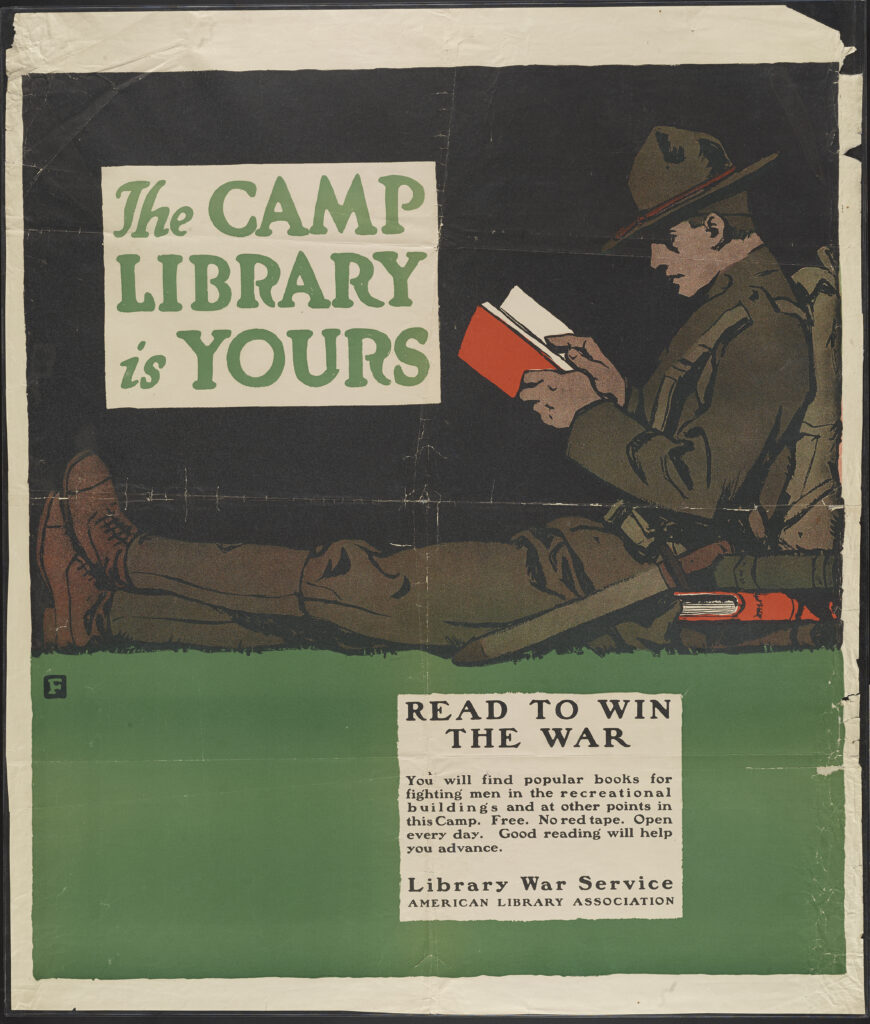
A collection of Library War Service posters

The bookplate used by the Library War Service during World War I in camp libraries.
The bookplate used by the Library War Service during World War I in camp libraries, circa 1918. From the ALA Archives.
World War I poster with a soldier climbing a mountain of books. Dan Smith credited as artist and printed by Thomsen-Ellis Company (Baltimore, New York), circa 1918.
World War I poster with a soldier climbing a mountain of books. Dan Smith credited as artist and printed by Thomsen-Ellis Company (Baltimore, New York), circa 1918. From the ALA Archives.
World War I poster with map of the United States with a dot for every war library, circa 1918. From the ALA Archives.
World War I poster with a soldier sitting on the ground and reading, advertising camp library services, circa 1918. From the ALA Archives.

To learn more about ALA’s Library War Service during WWI, visit the ALA Archives blog and ala.org.


This story was first published in American Libraries on February 18, 2016.

150 YEARS STRONG

THE OFFICIAL ANNIVERSARY BLOG

Detail of letter from Lynn Blaylock to the Intellectual Freedom Committee.

‘Nothing Could Have Astonished Me More’: The Challenge of Consumer Reports

Due to communist hysteria before and after World War II, many organizations and publications were under suspicion of being affiliated with or promoting the Communist party, including Consumers Union, publisher of Consumer Reports, the product testing and consumer advocacy magazine. As a result, Ohio schools banned the use of Consumer Reports in the classroom. While the ban was short-lived, the questions about it were not and the ALA Intellectual Freedom Committee noticed the attempts to ban the publication.

A detail from the Library Bill of Rights, 1967.

The History of the LeRoy C. Merritt Humanitarian Fund

To financially support librarians who have been denied employment rights or discriminated against on the basis of gender, sexual orientation, race, color, creed, religion, age, disability, or place of national origin or denied employment rights because of their defense of intellectual freedom, ALA created the LeRoy C. Merritt Humanitarian Fund, named in honor of a staunch defender of intellectual freedom and editor of ALA’s Newsletter on Intellectual Freedom.

A Seat at the Table feature graphic

A Seat at the Table: Reflections from Eight ALA Trailblazers

For 150 years, the American Library Association has shaped the landscape of libraries and the profession itself—but its leadership has often reflected the racial and gender biases of society at large. American Libraries spoke with eight barrier-busting Association leaders about their struggles, triumphs, breakdowns, and breakthroughs. The stories and lessons they share reveal how diversity fuels and transforms the power of libraries everywhere.

The School of Economy at Columbia College in New York City, class of 1888. Photo: ALA Archives

55 Moments That Redefined Librarianship

As the American Library Association (ALA) celebrates 150 years, we’re drawing inspiration from key events since its 1876 founding: from the first conventions and library schools, through wartime and the fight for civil rights, to seismic technological advancements and the existential threats of the current moment. Though not a comprehensive timeline of library history, the milestones collected here demonstrate lasting impact and how libraries and the profession are intertwined with the American story itself—as repositories of memory, arenas of debate, and enduring instruments of democratic life.

Keynote speaker and author Phoebe Eng signing books

Shared Visions: The National Conference on Asian/Pacific American Librarians

In 2001, the Asian/Pacific American Librarians Association and the Chinese American Librarians Association partnered to host the first and only National Conference on Asian/Pacific American Librarians. The theme, Shared Visions: Heritages, Scholarship, Progress, was chosen “with a sincere commitment to representing the rich diversity of East, South and Southeast Asian and Pacific American ethnicities, cultures and communities.”