
150 YEARS STRONG

Out of the Closet and Onto the Shelves

The American Library Association’s (ALA) Rainbow Round Table (RRT) is a group with a lot of firsts. Formed in 1970 as the Task Force on Gay Liberation, under ALA’s Social Responsibilities Round Table, they were the first profession-based gay organization. [1]

In 1970, Janet Cooper and Israel Fishman met at the ALA Annual Conference in Detroit at the Social Responsibilities Round Table session and decided to form an official gay and lesbian caucus at ALA. The Task Force on Gay Liberation would be the first of its kind in any national professional organization. It formed in a climate of social and political protest including the anti-Vietnam War movement, the civil rights movement, the women’s liberation movement, and the gay liberation movement in the wake of the Stonewall Riots in 1969.

Barbara Gittings, a self-described “full-time gay activist,” got involved in the Task Force early and began compiling the first Gay Bibliography, a list of gay-positive books and information resources, in 1970.

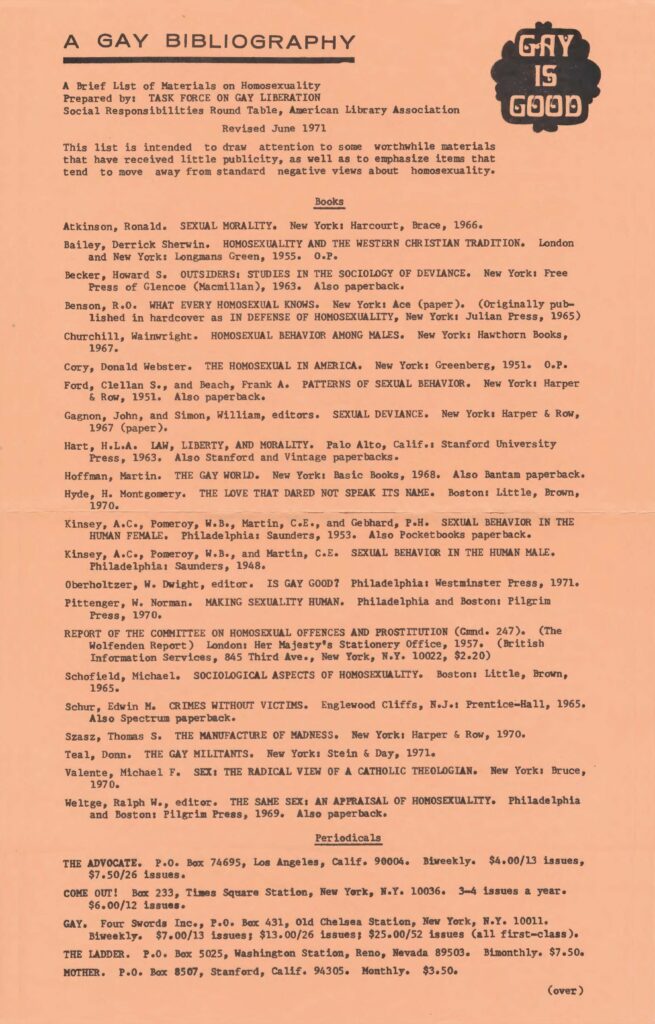
The first bibliography was a single legal-sized sheet of orange paper, printed front and back, with only 48 books and pamphlets listed. It was distributed by asking interested people to send a self-addressed stamped envelope to get a free copy. [2] The bibliography was revised several times over the years, and other specific bibliographies were produced, such as ones for gay teachers, lesbians, and other groups. They later produced an even smaller bibliography than their first one, called Core Materials for Libraries, which was aimed at smaller libraries with limited budgets. [3] Their bibliographic work now lives on as the Rainbow Book List for children and teens, and the Over the Rainbow Book List for adults.

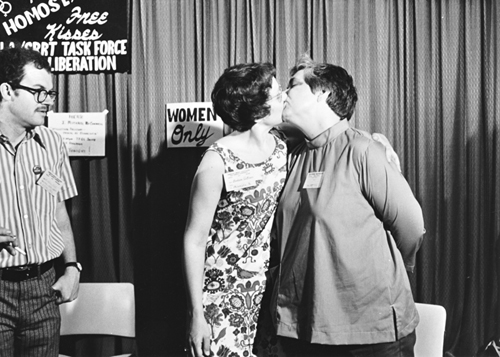
Barbara Gittings and author, Isabel Miller (Alma Routsong), kiss at the Task Force on Gay Liberation's kissing booth at the ALA Annual Conference in Dallas 1971. From the ALA Archives.
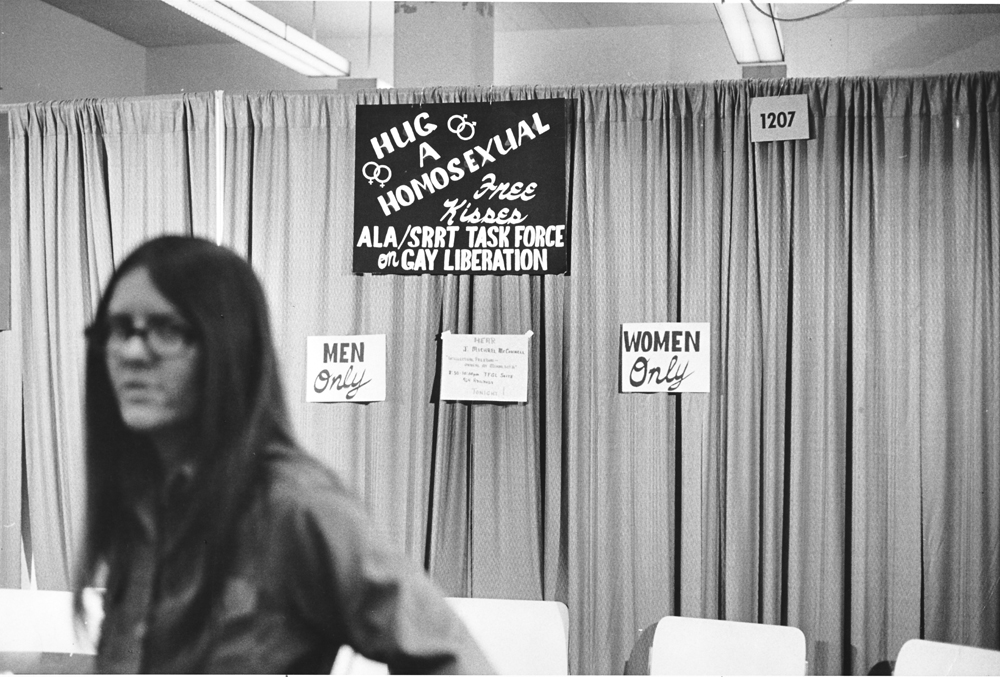
Sign for the "Hug a Homosexual" booth run by the Task Force on Gay Liberation at the 1971 Annual Conference in Dallas. From the ALA Archives.

In its early years the Task Force focused its efforts on improving library service and information access for gay and lesbian library users, and on the professional needs of gay and lesbian librarians including job discrimination. Gittings’ bibliography was part of this initial effort to improve patron access to gay information and materials that have a positive view on homosexuality. The Task Force also started the Gay Book Award in 1971, which would later become  the Stonewall Book Awards

To get attention for their new group, they hosted a “Hug a Homosexual” Booth, with a line for “Men only” and “Women only” at the 1971 Annual Conference in Dallas. After crowds were drawn with still no takers, Gittings, who was then coordinator for the group, shared a kiss with Isabel Miller, winner of the first gay book award, which was filmed and photographed and generated lots of news coverage. [4]

Also in 1971, the Gay Liberation Task Force immediately came out in support of J. Michael McConnell after his job offer from the University of Minnesota Library was rescinded after he filed a marriage application with his partner. The group was instrumental in getting ALA to address this case. [5]

The Task Force also worked to change the often-offensive wording and classification of gay books in the Library of Congress Classification (LCC) System. Their first change was the addition of Gay Liberation Movement as a heading. In 1972 the Library of Congress wrote to the group:

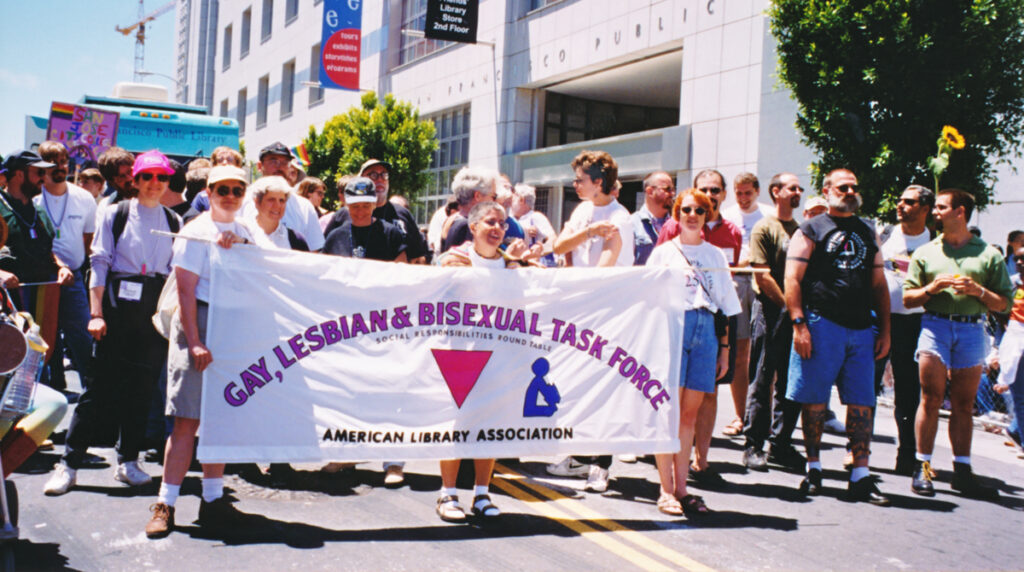
The Gay, Lesbian, and Bisexual Task Force marching in San Francisco's Pride Parade, June 1997. From the ALA Archives.

We have now reviewed our previous treatment of this subject, including the cataloging of the works cited in your letter, […]  and have concluded that your observations on our subject heading practice in this area are justified. Since works on the gay liberation movement do not concern themselves with the origin and nature of homosexuality, but rather with the efforts of homosexuals to achieve justice, Homosexuality is far too broad a subject heading to assign to such works. Therefore, we are establishing the more specific heading Gay Liberation Movement, corresponding to the heading Women’s Liberation Movement which we established last year. [6]

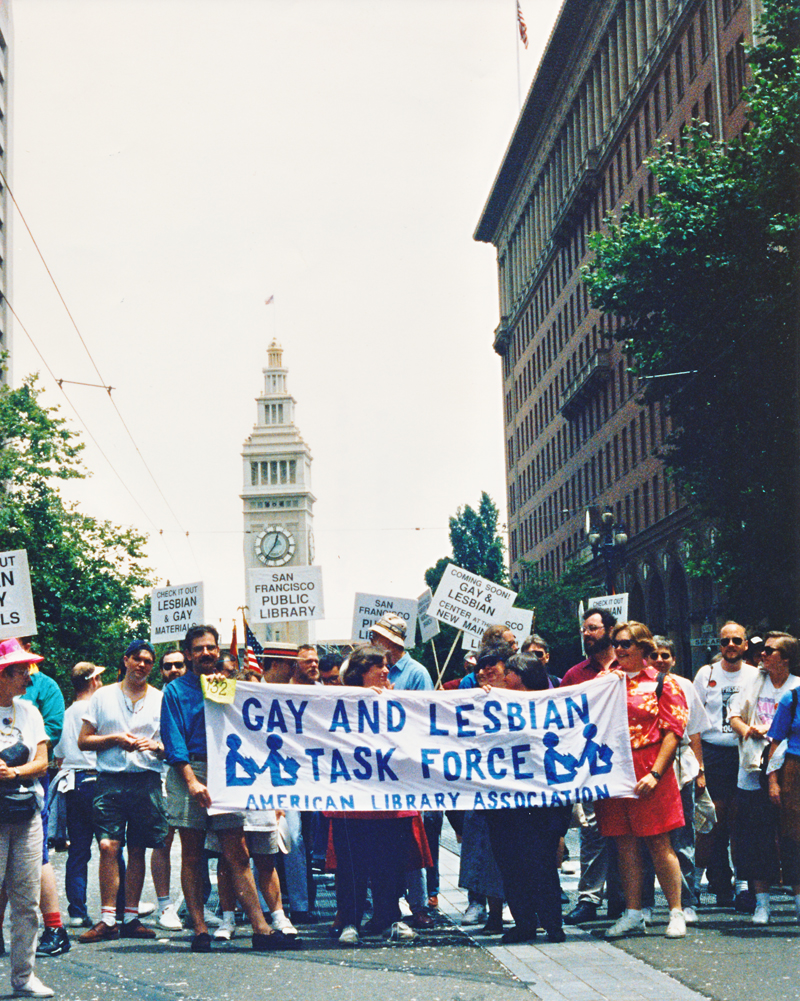
The ALA Gay and Lesbian Task Force marching in the San Francisco Pride March, 1992. From the ALA Archives.
The ALA Gay and Lesbian Task Force marching in the San Francisco Pride March in 1992. From the ALA Archives.

In June 1978, Sanford Berman’s article “Gay Access: New Approaches in Cataloging” was published in the Gay Teachers Association Newsletter and later reprinted in Gay Insurgent. Berman argued that the current methods of classification and subject headings for gay materials were largely insensitive or even homophobic, including the headings “Homosexuals” and “Homosexuals, Male.” Berman proposed new headings like “Gays” and “Gay Men,” and called for more consistent application of these subject terms to fiction and non-fiction materials to facilitate access and discovery. He also proposed expanding the Dewey Decimal Classification schedules to have more specific notation for different subject within gay materials.

The RRT has evolved and taken many names throughout its history.

In 1975, the Task Force on Gay Liberation changed its name to the Gay Task Force. Twenty-years later, the Task Force changed its name to the Gay, Lesbian, and Bisexual Task Force (GLBTF) and celebrated its 25th anniversary with a gala event at the ALA Annual Conference. In 1999, GLBTF was promoted to round table status and became the Gay, Lesbian, Bisexual, Transgender Round Table (GLBTRT). In 2019, GLBTRT was renamed the Rainbow Round Table (RRT).

"A Gay Bibliography," produced by the Task Force on Gay Liberation, June 1971.
"A Gay Bibliography," produced by the Task Force on Gay Liberation, June 1971. From the ALA Archives.

The records of the RRT provide a fascinating insight into the intersection of politics, human rights, and librarianship at a critical turning point in LGBT and American history. For more on their influential work, check out their website.

Sources: 

[1] TASK FORCE ON GAY LIBERATION, AMERICAN LIBRARY ASSOCIATION, August 1974. Found in the Office for Literacy and Outreach Services Subject Files, Record Series 10/6/2, Box 3, Folder “Gay Liberation Task Force, 1971-75.”

[2] A GAY BIBLIOGRAPHY, A Brief List of Materials on Homosexuality. Prepared by the TASK FORCE ON GAY LIBERATION, June 1971. Found in Subject File of the Gay Lesbian Bisexual Task Force (GLBTF), Record Series 49/35/1, Box 1, Folder “Gay Liberation SRRT 1972.”

[3] Gay Materials Core Collection List. 1980 Revision. Found in Subject File of the Gay Lesbian Bisexual Task Force (GLBTF), Record Series 49/35/1, Box 1, Folder “Gay Task Force 1980.”

[4]  News article: “Librarians get to ‘Kiss a Homosexual!’” by Erika Hastings. Published in GAY, Vol. 2, Issue 56, August 2, 1971.  Found in Subject File of the Gay Lesbian Bisexual Task Force (GLBTF), Record Series 49/35/1, Box 1, Folder “Gay Liberation SRRT 1972.”

[5] Press Release: AMERICAN LIBRARY ASSOCIATION VOTES TO INVESTIGATE U OF MINNESOTA. July 12, 1974. Found in the Office for Literacy and Outreach Services Subject Files, Record Series 10/6/2, Box 3, Folder “Gay Liberation Task Force, 1971-75.”

[6] Letter from  C. Sumner Spalding Assistant Director for Cataloging at the Library of Congress to Stephen H. Wolf of the SRRT Task Force on Gay Liberation, Feb. 10 1972. Found in Subject File of the Gay Lesbian Bisexual Task Force (GLBTF), Record Series 49/35/1, Box 1, Folder “Gay Liberation SRRT 1972.”

This story was compiled from two stories from the ALA Archives blog: “Out of the Closet & Onto the Shelves: Librarians and the Oldest Gay Professional Organization in the U.S.” and “‘Lots of Love (of both the revolutionary and non-revolutionary kind)’: the History of the ALA’s GLBT Round Table.”

150 YEARS STRONG

THE OFFICIAL ANNIVERSARY BLOG

The Gay, Lesbian, and Bisexual Task Force marching in San Francisco's Pride Parade, June 1997. From the ALA Archives.

Out of the Closet and Onto the Shelves

The American Library Association’s (ALA) Rainbow Round Table is a group with a lot of firsts. Formed in 1970 as the Task Force on Gay Liberation, under ALA’s Social Responsibilities Round Table, they were the first profession-based gay organization.

Jessie Carney Smith in 1965, her first year as a university librarian at Fisk University in Nashville.

Blazing Trails: Stories from Pioneering Black Librarians

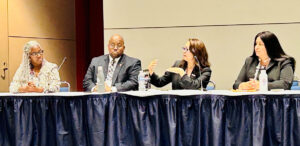
In 2018, American Libraries spoke with five leading African-American librarians about their careers, the changes they have witnessed over the decades, and the current issues in librarianship. While no two people have the same story, all five interviewees note inclusivity as an important theme. They discuss libraries as safe havens, the Black Lives Matter movement, and the history and future of the Association, as well as their legacies within the profession.

A Long Legacy

While ALA’s founding is technically in October, the staff at American Libraries put on their party hats early to celebrate ALA’s 150th year with a plethora of Association and library history-related stories in the magazine’s May 2026 issue.

ALA posters

Posters of Progress: Mapping ALA’s History Through Library Poster Art

From wartime appeals to celebrity-studded reading campaigns, library posters have long captured the evolving role of libraries in American life. This feature traces ALA’s history through some of its most iconic visuals. Together, these images chart a story of the profession’s unflinching ideals of access, literacy, and intellectual freedom, showcasing how libraries continue to reimagine their place in public life.

An index card tracking an ALA conference exhibition hall exhibitor from 1924-1947.

The Heartbeat of the Hall: 150 Years of Exhibitors Who Shaped Our Conference

Every year as the doors of ALA’s Annual Conference and Exhibition swing open, the exhibition hall comes alive. It is a ritual that has been repeated, refined, and reimagined throughout ALA’s 150-year history. And at the center of it all, providing the innovations, solutions, and partnerships that have propelled our profession forward, are the exhibitors. To mark this milestone, we look back at the rich history of exhibitors at the conference—where it began, how it grew, and why, 150 years on, the exhibition floor remains one of the most vital spaces in our professional world.

Librarian at the Reference Desk in Camp Johnston Library, from the ALA Archives.

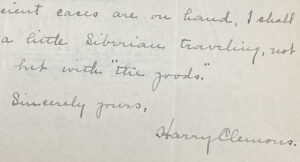
Charles R. Green at Camp Johnston: ‘We Can Find Such a Man’

During the summer of 1918, Charles Green, a librarian from the Massachusetts Agriculture College, served as the Acting Librarian for Camp Johnston in Jacksonville, Florida. While his tenure was brief, the Charles R. Green Papers in the American Library Association (ALA) Archives reveal Green’s rapid appointment and promotion. It also shows how quickly circumstances could change within the ALA’s Library War Service and the adaptability of its volunteers.