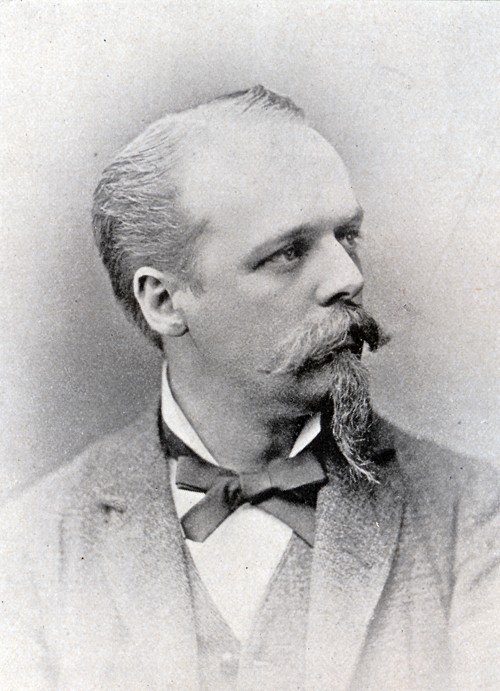
On April 28, 1892, the first librarian of the Milwaukee Public Library (MLP), Klas August Linderfelt, was summoned to a meeting with library trustees and Mayor Peter J. Somers. There, Linderfelt was accused of embezzling $4,000, to which he admitted guilt and was subsequently arrested.
Linderfelt’s arrest came as a shock to the library profession. Not only was he the head of the MLP, but he was also the president of both the American Library Association (ALA) and the Wisconsin Library Association (WLA). A longtime and active member of ALA, Linderfelt was well liked by his colleagues, leaving them reeling at his arrest. The news spread quickly in both the local and national press, with newspapers as far away as California, proclaiming, “Linderfelt in a Cell. The Public Librarian of Milwaukee Uses the City’s Cash.”[1]
Letters between ALA leaders reveal that Linderfelt’s resignation as ALA President was immediately on their mind. Newberry librarian, William F. Poole, an intimate friend of Linderfelt, wrote to Melvil Dewey on May 1, “I hope that Mr L[inderfelt] will send his resignation in the asso. before the 16th. That it will be quietly accepted and Mr. Fletcher be made full President.”[2] Dewey agreed with the idea and noted that it would be for the best if the topic of the “dreadful episode” was avoided at the ALA conference just weeks away.[3]
The ALA Executive Committee moved quickly on the matter and by May 2, convening at the house of the ALA Secretary, Frank P. Hill. There they would discuss “Mr. Linderfelt’s trouble.”[4] Weeks later, on May 22, Hill reported that he had received Linderfelt’s resignation and that it would “take effect from the time of election.” W. I. Fletcher, the librarian of Amherst College and an ALA vice-president, was then recorded as ALA President for the entire term 1891-1892 term, thus erasing Linderfelt’s presidency. Professor Wayne Wiegand observed that, “The matter was handled so expeditiously that it was apparent the committee had already decided on a course of action at its ‘unofficial’ May 2 meeting at Hill’s house.”[5] The consequences of these actions was that Linderfelt would not be documented as a past president and his name was stricken from ALA’s official records.
Linderfelt and his arrest were not brought up in the proceedings for the 1892 annual conference, an event he would have presided over. Though Fletcher, his replacement, alluded to the incident in his presidential address, “The peculiar circumstances under which I assume this position will, I am sure, be sufficient to excuse the desultoriness of the few remarks which, on so short notice, I have been able to throw together for your consideration this evening.”[6] In his address, he mentioned a couple times that he had only a few days to assume the duties as president, but otherwise did not bring up his predecessor. While ALA had washed their hands of Linderfelt, outside of association business, his librarian friends had not given up on him. Leaders in the profession wrote letters on his behalf that would later be used in his defense, and he was offered a position at Library Bureau, a company founded by Dewey, in Boston, if he was cleared of his charges.[7]
ALA wasn’t the only library association impacted by Linderfelt’s disgrace. He also left the WLA leaderless only a year into its founding and caused the WLA to skip holding annual conferences in 1892 and 1893, putting the association in crisis.[8]
That July, Linderfelt appeared in court for his embezzlement. However, despite his confession, he would see no prison time for stealing what ended up being over $9,000 (over $326,000 in 2026), over double what was previously estimated.[9] Instead, the judge gave him a suspended sentence and Linderfelt walked out of the courthouse as a free man. There was immediate outrage in Milwaukee over the lack of punishment and the District Attorney quickly moved to file new charges against Linderfelt.[10]
On July 16, Linderfelt was in Boston to take the job offered to him at Library Bureau.[11] A couple of days later, the order for his arrest was issued in Boston, but the librarian was nowhere to be found. By July 20, The Boston Globe was asking “Where is Linderfelt? Visited Public Library Saturday and Has Since Disappeared.”[12] Somehow, Linderfelt discovered the orders for his arrest and this time decided to flee the country to Europe.
With his flight from justice, Linderfelt disappeared from the lives of his librarian friends and, with his name stricken from the record, he also disappeared from the memory of the profession. Almost.
To be continued….
For a more detailed and the most rigorously researched account of Linderfelt’s trouble, read Wayne Wiegand’s “The Wayward Bookman” in American Libraries volume 8, issues 3 and 4 (March and April 1977).
Sources
[1] “Linderfelt in a Cell,” The San Francisco Examiner (San Francisco, California), April 29, 1892, p. 1.
[2] William F. Poole to Melvil Dewey, May 1, 1892, W.L. Williamson – William F. Poole Research Papers, Midwest-MS-Williamson, Box 5, Folder: 1892 Correspondence, The Newberry Library – Modern Manuscripts and Archives Repository.
[3] Melvil Dewey to William F. Poole, May 5, 1892, NL Archives 03/01/01/01, Box: 7, Folder: 414 – Dewey, Melvil. Newberry Library Archives, NL-Archives. The Newberry Library – Modern Manuscripts and Archives.
[4] Frank P. Hill to George W. Cole, April 30, 1892, George W. Cole Papers, series 2/3/20, Box 1, Folder: Correspondence, 1891-1893, American Library Association Archives.
[5] Wayne Wiegand, “The Wayward Bookman,” American Libraries 8, no. 3 (March 1977): 137.
[6] W. I. Fletcher, “President’s Address,” Papers and Proceedings of the Fourteenth General Meeting of the American Library Association (Boston: 1892): 1.
[7] Wayne Wiegand, “The Wayward Bookman, Part II,” American Libraries 8, no. 4 (April 1977): 198
[8] Larry T. Nix, “Disaster Strikes the News Created Wisconsin Library Association,” Wisconsin Library Heritage Center, March 24, 2016: https://heritage.wisconsinlibraries.org/entry/disaster-strikes-the-newly-created-wisconsin-library-association/
[9] Wiegand, 197.
[10] Ibid, 197-198.
[11] “May Come to Boston,” The Boston Globe, July 14, 1892, p. 4.
[12] “Where is Linderfelt?” The Boston Globe, July 20, 1892, p. 5.