“This isn’t a hoax, is it?”
That is what American Libraries editor, Arthur Plotnik, asked Professor Wayne Wiegand after receiving Wiegend’s unsolicited manuscript about disgraced and forgotten ALA President, Klas August Linderfelt.[1]
It was not a hoax. Wiegand became interested in Linderfelt’s story while researching his book, “The Politics of an Emerging Profession: The American Library Association, 1876-1917.”[2] Prior research on Linderfelt’s story was thin and incomplete, so Wiegand wrote a more vigorously investigated article. “The Wayward Bookman” ran in two parts in the March and April 1977 issues of American Libraries and remains one of the most complete histories of Linderfelt’s downfall.[3]
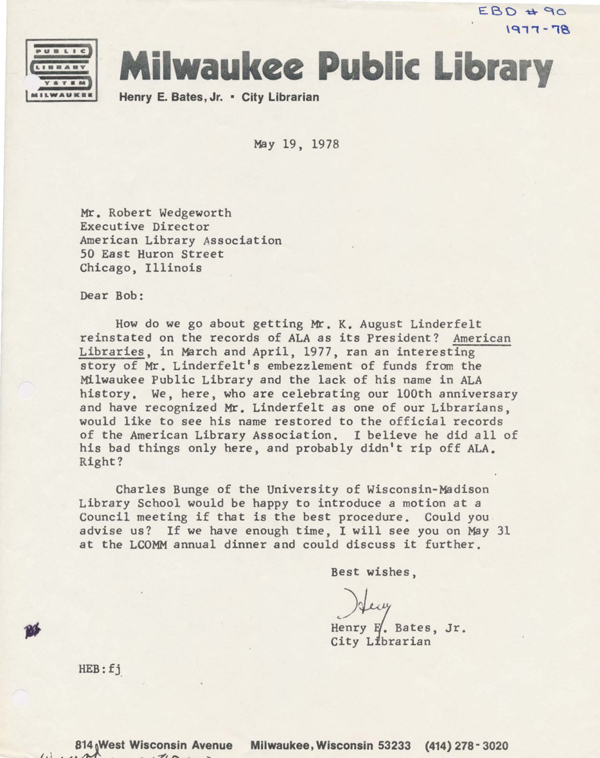
The article caught the attention of Milwaukee Public Library (MLP) staff, who came across Linderfelt’s name as they prepared to celebrate the library’s centennial. Henry E. Bates, Jr., City Librarian for the MLP, wrote to ALA Executive Director Robert Wedgeworth, asking how to restore Linderfelt’s name to the presidential listing. Citing Wiegand’s article, Bates wrote, “I believe he did all of his bad things only here, and probably didn’t rip off ALA. Right?”[4]
Bates was invited to speak at the ALA Executive Board meeting during the 1978 Annual Conference and on June 25, Bates presented Linderfelt’s history to the Executive Board. He emphasized again that Linderfelt’s crimes were against the MLP, “I don’t think he did anything wrong at ALA, he certainly did at Milwaukee,” and noted that despite his embezzlement, MLP still recognized him as one of their librarians. Bates urged that there be at least a footnote in the presidential listing noting Linderfelt’s presidency.[5]
Bates and the Executive Board, and in prior consultation with a library historian, believed that adding a footnote to the presidential listing would both be consistent with the original intent of the 1892 Executive Committee of removing Linderfelt’s name. At the same time the note would acknowledge that Linderfelt “in some way served the association.”[6] The decision and footnote was documented in the Board minutes:
Mr. Fletcher served as President 1891-1892 since on May 21, 1892 the Executive Committee accepted the resignation of K. August Linderfelt, who was elected October, 1891, with the stipulation that his name would be expunged from the presidential rolls.[7]
Starting in 1978, Linderfelt became a footnote to Fletcher’s fleeting presidency. Later, Wiegand would comment “[Linderfelt’s] name still sported an asterisk—kind of a permanent (and probably justified) mark against his place in ALA history.”[8] The note appeared in the ALA presidential listing printed in the ALA Membership Directory. At some point, presidential listing was transferred to the Handbook of Organization, where Linderfelt’s note remained. That is until ALA stopped printing the Handbook after 2008 and fully transferred its information to the Association’s website.
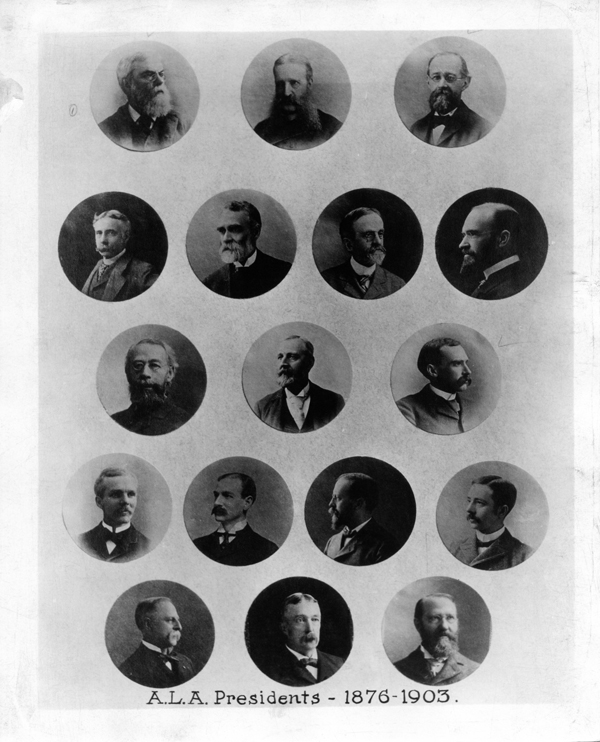
Then, in a twist of fate that the 1978 Executive Board could not have anticipated, Linderfelt’s footnote was completely left behind in the Handbook’s jump from print to digital, likely by clerical error.
Ironically, just as Linderfelt fell from ALA’s official record once more, the Wisconsin Library Association (WLA), who had also shunned him, furthered its embrace of Linderfelt’s legacy. During its centennial celebration in 1991, the WLA officially forgave him, with past presidents starting a ritual of passing on an urn used to represent Linderfelt in absentia. In 2009, the WLA honored Linderfelt by inducting him into the Wisconsin Library Hall of Fame, right after ALA stopped printing its Handbook.[9]
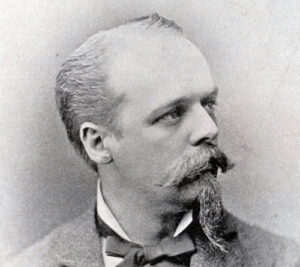
For nearly 15 years, Linderfelt was left forgotten for a second time. Then in 2023, Linderfelt’s name came up in a reference inquiry at the ALA Archives. A researcher was searching for a photograph of Linderfelt. Unfamiliar with Linderfelt’s story, research led the ALA Archivist to Wiegand’s article and records within the archives relating to Linderfelt’s partial restoration. The archivist then realized that Linderfelt was missing from the current presidential listings.
The archivist contacted the ALA Library and related the story to the staff, requesting, “would it be possible to add Linderfelt to ALA’s presidents list? Or at least the note about his term and resignation?”[10] ALA staff, who were also in the dark about Linderfelt’s story, responded positively. The shame felt by the 1892 Executive Committee was long gone and like the 1978 Executive Board, ALA staff were highly amused by the odd history.
By the start of 2024, Linderfelt was restored to the ALA presidential listing and for the first time his name was listed amongst the ALA past presidents and not as only a footnote.[11] There is currently an asterisk next to both Linderfelt and Fletcher’s names and subtle change to the footnote written in 1978:
* Mr. Fletcher is listed as serving as President 1891-92 since on May 21, 1892, the Executive Committee accepted the resignation of K. August Linderfelt who was elected in October 1891, with the stipulation that his name would be expunged from the presidential rolls. Please see Executive Board minutes cumulated index, volume 47, or reach out to the ALA Archives.
More than 130 years after his resignation, Linderfelt has finally taken his place in ALA’s official record as a past president.
Sources
[1] Wayne Wiegand, “This Month, 109 Years Ago,” American Libraries 32, no. 5 (May 2001): 94.
[2] Wayne Wiegand to Cara Bertram, email, July 9, 2024.
[3] Wayne Wiegand, “The Wayward Bookman,” American Libraries 8, no. 3 (March 1977) and American Libraries 8, no. 4 (April 1977).
[4] Henry Bates, Jr. to Robert Wedgeworth, May 19, 1978, Library Vertical File, record series 18/1/56, Box 7, Folder: Linderfelt, K. A., ALA Archives.
[5] “Tape 4,” (Annual Conference 1978), Executive Board Tapes, record series 2/1/61, Box 1, ALA Archives.
[6] Ibid.
[7] Meeting of the Executive Board, June 25, 1978, record series 2/1/1, v 47 (Annual Conference/Fall Meeting, 1978): 200.
[8] Wiegand, “This Month, 109 Years Ago,” 94.
[9] Larry T. Nix, “Klas August Linderfelt (1847-1900),” Wisconsin Library Heritage Center, October 5, 2009: https://heritage.wisconsinlibraries.org/entry/klas-august-linderfelt-1847-1900/
[10] Cara Bertram to Colleen Barbus and Hannah Weinberg, email, May 24, 2023.
[11] “ALA’s Past Presidents,” American Library Association: https://www.ala.org/aboutala/history/past.