In 1962, the American Library Association (ALA) walked into the Seattle World’s Fair and showed the world what a library could become. Library 21, as the exhibit was called, imagined a future of networked knowledge, instant retrieval, and universal access. It was visionary, celebrated, and remembered.
Forty years later, a faculty member at the University of Arizona quietly built a piece of that future. Nobody funded it at the scale it needed. And twenty years after that, few remember it.
ALA is 150 years old this year. The knowledge infrastructure is under greater pressure than at any point in that history. The question that forgotten project raises — what happens when a profession’s stated values and its institutional choices diverge at a technological inflection point? — is worth illuminating.
What dLIST was
It began with two people who were curious.
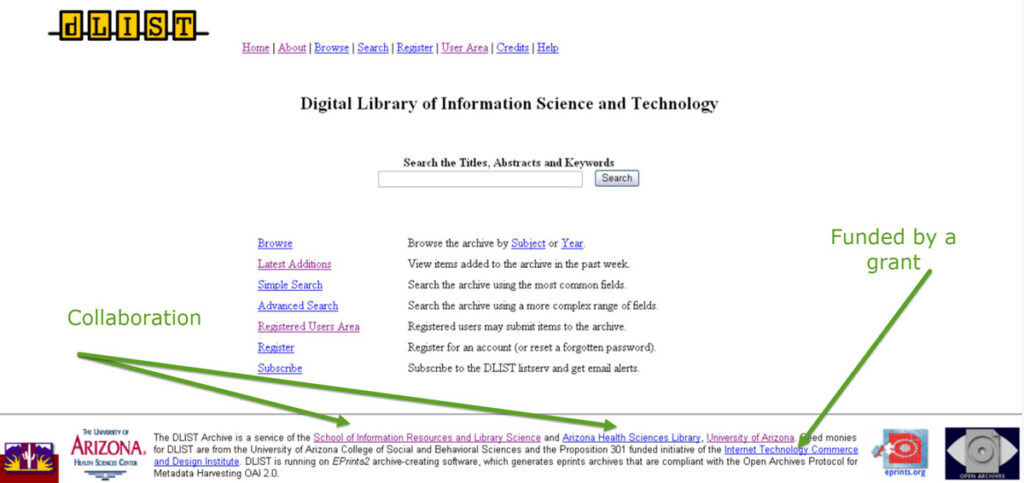
In 2001, while building a curriculum reader for one of my LIS courses, I ran into something that stopped me: My library had to pay to include my own peer-reviewed article. Around the same time, a graduate LIS student named Mark Kelly wanted to understand the relationship between open source software and scholarly communication. I supervised Kelly’s independent study, “Revitalizing the Academic Commons.” After that spring semester ended, in the summer of 2002, I launched dLIST—the Digital Library of Information Science and Technology—the field’s first open access disciplinary repository for Library and Information Science scholarship.
dLIST was built on three convictions that were, in 2002, either ahead of their time or simply unheard.
The first was about content. Open access in 2002 meant journal articles, the prestige outputs of research universities. dLIST was built around a broader conviction: that the knowledge ecosystem of a field includes everything its practitioners and educators and researchers produce. Syllabi. Datasets. Instructional materials. Preprints. Practice-based guides. If open access was going to serve Library and Information Science—a field spanning academic research, professional practice, and public service—it needed to hold all of it.
The second conviction was about infrastructure. dLIST was designed not as a silo but as a node in a network. Think of it as a library system that lets researchers find scholarship across dozens of separate collections without leaving the room. We built DL-Harvest, an open access aggregator that drew on dLIST and 13 other compliant archives, so that a search in any one repository could surface relevant work held across all of them, with no single institution controlling the results. Before social media, before the iPhone, dLIST implemented RSS feeds and anticipated the push model of information delivery that would later become ubiquitous.
The third conviction was about values. dLIST was built because the field was shifting from Graduate Schools of Library and Information Science to iSchools, from a profession with a clear ethical core to a discipline increasingly defined by technology, data, and market relevance. dLIST was an attempt to hold the values of the intellectual commons together: to say there is a disciplinary core here, it has a research tradition, and that conversation deserves a public and open infrastructure.
Who built it
dLIST was not built by an institution. It was built by a community.
I wrote the first grant as a summer project and received $5,000 to buy the server. It was a labor of love. I pestered my faculty mentor, Cheryl Knott, and we came up with the name. The server lived in my office, while I looked for partners among the university librarians. Then Paul Bracke, who was moving from the main University Library to the Arizona Health Sciences Library, offered to become project manager and server administrator and moved it there—a librarian finding a way.
Two key faculty colleagues joined me early on from an ASIS&T conference: Marija Dalbello at Rutgers and Kristin Eschenfelder at Wisconsin-Madison. Marija, a book history scholar, brought dLIST to the attention of SHARP-EU. Kristin helped draw Social Informatics scholars to deposit their work. Later, they’d also help me organize a key symposium debating institutional versus disciplinary repositories.
Competitive internal grants eventually freed me from routine administration and allowed me to hire graduate students from Electrical and Computer Engineering, and Computer Science: Gaurav Gupta, Karthik Subramaniam, Joseph Roback, who built and rebuilt the open source software iteratively, each improving on the last. I reached out to my MLIS advisor in India, Professor K.S. Raghavan, secretary of the Sarada Ranganathan Endowment in Library Science, who gave us permission to digitize and host several Ranganathan classics. Cheryl Malone became an official partner and project coordinator for dLIST Classics. Michael Gorman, then incoming President of the American Library Association and author of ”Our Enduring Values,” and Julia Blixrud, then Assistant Executive Director of the Association of Research Libraries, agreed to serve on the first dLIST advisory board.
dLIST had already attracted other then-junior faculty (Paul Marty) and senior librarians (Charles Bailey, Michael May) as subject editors. Paid LIS graduate assistants Youfen Su, JingFeng Xia, Shawn Nelson, and Susan Ditch received training in deposits, digitization, metadata creation, and intellectual property. They catalogued copyright transfer agreements from 150 LIS journals so scholars could understand their self-archiving rights. Alumna Lisa Bunker designed the dLIST logo.
One day an email arrived out of the blue: Dominika Sokol, a graduate student from Charles University Prague, offered her help. She wrote the marketing strategy and presented it at BOBCATSSS 2007. Meanwhile, closer to home, across my office in the old courtyard motel, AI, cybersecurity and intelligent systems pioneer Hsinchun Chen’s modern server-filled Artificial Intelligence Lab at Arizona became an unofficial partner when he had most of his research papers deposited—genuinely interdisciplinary pedagogy before the iSchools made it a slogan. He remains the top depositor in dLIST, followed by contributions from the Society for the History of Authorship, Reading and Publishing, thanks to Marija Dalbello. The core faculty team eventually extended across Arizona, Rutgers, Wisconsin, Florida, and Texas, with an advisory board that reached Denmark, India, and Singapore.
By 2005, dLIST had 500 registered users and was being used globally. Through the dLIST Classics project, I especially remember Michael May, an adult services librarian at Carnegie-Stout Public Library in Dubuque, Iowa, digitizing the first text: the “Five Laws of Library Science.” A public librarian in Iowa made the profession’s most foundational text freely available to anyone with an internet connection.
That is what the commons looks like when it works.
What the profession chose
In 2007, I received a Library Journal Mover & Shaker award. Three months later, I resigned from the University of Arizona. I was burned out and facing severe health challenges. Five years after that, dLIST closed to new submissions in 2013—the same year ALA announced its own institutional repository.
When dLIST closed, it wasn’t just a repository that went dark, it was a collective project that had outlived the conditions that made it possible. Marija Dalbello, when I contacted her while preparing this essay, wrote she still uses materials from dLIST and reflected: “I think we thought from within a different IP regime than it is now. It’s incredible how paradigms change.” She’s not alone: Even last week I heard from another LIS faculty member who still uses dLIST material in her teaching and research.
I used to view what happened as my failure. Then ChatGPT launched in 2023, and watching the new disruption gave me a different lens: dLIST didn’t fail because of me. It failed because of a series of institutional choices that taken together added up to this: Someone else will build this.
The NSF grant was rejected in 2003. The IMLS proposal that Cheryl and I submitted in 2005 brought all three convictions together at their highest moral stakes: It asked whether the field that champions open access would open access its own intellectual history. IMLS declined. In its first five years, the project ran on far less than $50,000 in state technology funding, including the $5,000 seed grant. Faculty volunteered; only the students were paid. Service in the public interest.
Meanwhile, Clifford Lynch’s influential 2003 ARL report declared institutional repositories “essential infrastructure for scholarship in the digital age.” When CNI and SPARC lined up behind that IR vision, the disciplinary repository model was effectively foreclosed. The field invested in institutional repositories. Meanwhile libraries also went with Google Books, which asked no permissions, built no community governance, and extracted value at a scale dLIST could never match.
The conversation about what the field owed its own scholarly commons was deferred. It has never quite resumed. The recent merger of UNC-Chapel Hill’s School of Information and Library Sciences into a new School of Data and Information Sciences is only the latest signal that the fracturing dLIST was built to resist has not stopped, and that the institutions with the resources to build the alternative are still choosing otherwise.

I promised illumination, so consider the Harvard fire of 1764. When lightning struck Harvard Hall during winter break, the library burned. Almost everything was lost, except the books that had been checked out. Knowledge survived not inside the institution but in circulation. Harvard at that time drew the wrong lesson: tighter controls, restricted access, safer enclosures. Now, the question dLIST raises is whether ALA, at its 150th anniversary, is prepared to draw the right one.
The through-line to now
In August 2025, Anthropic settled claims that it had trained its AI on pirated copies of roughly 500,000 copyrighted books. In early 2026, major publishers began restricting the Internet Archive’s access to their content. Libraries found themselves blamed for AI scraping they didn’t authorize and couldn’t control.
The parallel to 2002 is structural. Then, Big Tech and the commercial open access market moved faster than the commons-based alternative and locked in the model we’re still living with. Now, the commercial AI market is doing the same thing at greater speed and scale. AI systems are trained on vast shared libraries of text—what researchers call training corpora—and the question of who owns, governs, and benefits from those libraries is exactly the question dLIST was built to answer for a different moment of disruptive technological development. The extraction model is becoming the default because the alternative hasn’t been built. Major publishers and aggregators are already positioned to dominate the next frontier of information discovery, where AI surfaces a single answer (zero-click searches) and the sources behind it disappear from view.
The three GRAs who built dLIST’s infrastructure are now at the frontier of the AI infrastructure those convictions were anticipating—at AWS, NVIDIA, and Samsara. The LIS graduates went on to careers in open access, academic libraries, and public library social media.
But the foundation they laid didn’t disappear. It’s still there, waiting for someone to build on it.
What are we building now?
The grassroots answer, in 2026 as in 2002, is still yes.
Institutional repositories have proliferated. ALAIRT, CALA, and others carry some of what dLIST imagined forward. New efforts to build rights-respecting AI training corpora are underway. The people who built dLIST didn’t just create a repository; they built proof that a different model was possible. That proof still stands. But it is fragile as even dLIST’s own record in the global COAR-IRD shows: The University of Arizona Libraries has continued to host dLIST on its own IR but they lack the manpower, it appears, to even verify the record (as I am finding). Libraries everywhere have reported that IRs are being scraped by bots and threatened by publishers.
The dLIST Working Bibliography and Community Record is now publicly available, documenting the people and publications of that community for the historical record.
The question in 2026 is the same as in 2002: Who builds the LIS commons infrastructure, on whose terms, and toward what values?
Library science is not one subfield among many in the information landscape. It is the ethical soul of the field; the tradition that asks not only what information systems can do, but what they should do, who they serve, and what values they encode. That is what Ranganathan meant by the library as a growing organism. It is what Michael Gorman meant by enduring values. It is what the ALA Core Values mean when they name intellectual freedom, privacy, and the public good in the same breath.
The profession that has spent 150 years building the infrastructure of the information commons is the profession best positioned to build the ethical infrastructure of the AI age.
But only if it makes the institutional choices now that it didn’t make in 2002. Only if it funds what needs to be funded, sustains what needs to be sustained, and names the commons-based alternative before the extraction model locks in again.
dLIST was ahead of its time. The open training corpus, the federated discovery layer, the disciplinary identity, the rights-respecting digitization of the profession’s own intellectual heritage—all of it is much needed still. The window for building the alternative is open, but not indefinitely.
ALA at 150 has a chance to draw the right lesson from the Harvard fire. Not tighter controls. Not safer enclosures. Not someone else will build this.
The library is a growing organism, experiencing growing pains, yes but growing. Ranganathan’s Fifth Law, is what I’ve come to think of as Coleman’s Corollary. Knowledge in circulation. The information commons, actively stewarded by librarians who know what they are for: The people who nurture curiosity and wonder with integrity, and empower flourishing for all for the next 150 years.
For full citations and community documentation, see the dLIST Working Bibliography and Community Record: https://infophilia.codeberg.page/infophilia-tools/dlist-bibliography.html
Acknowledgements: I’m indebted to Gaby Stephenson (SJSU) for verifying many of the details and Mark Kelly (Pacifica Graduate Institute), Gaurav Gupta (AWS), and Marija Dalbello (Rutgers) for their input. Any mistakes that remain are mine, of course.
Anita Coleman PhD, is an adjunct lecturer at the University of Illinois Urbana-Champaign School of Information Sciences. Coleman is the publisher of Infophilia: A Positive Psychology of Information, a weekly publication and lab developing adaptive infophilia, her integrative theory for unifying library and information sciences.