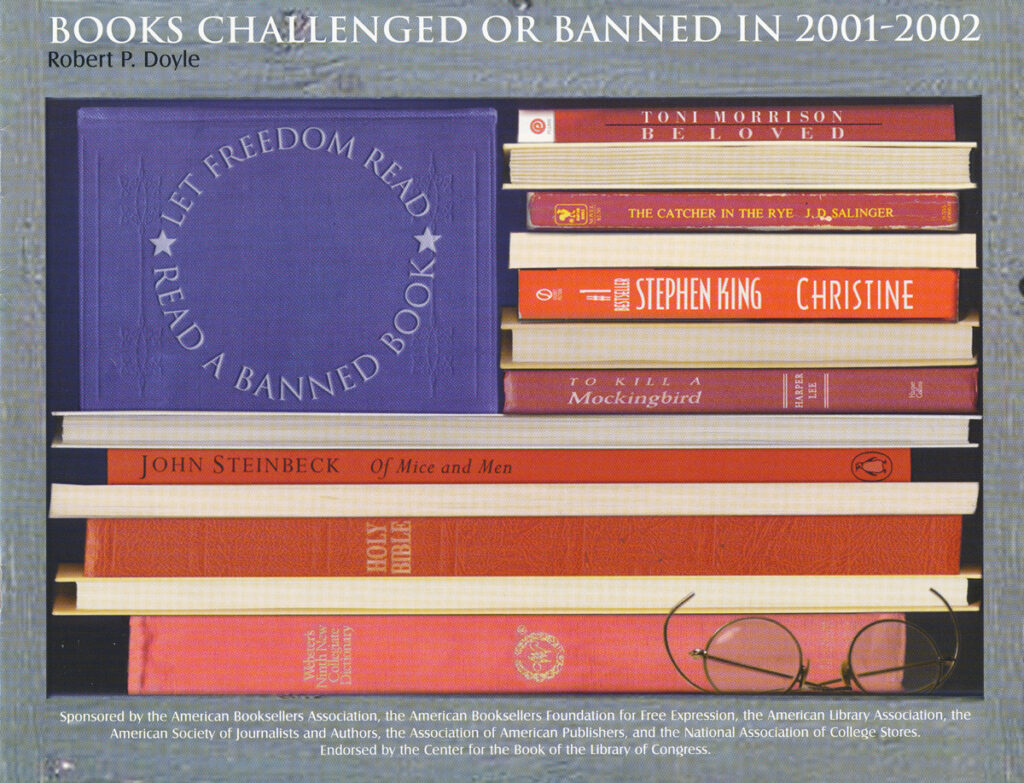
Shortly after the American Library Association (ALA) was founded, it became clear that libraries needed a voice in government. Libraries and library professionals deserved enduring support that would allow them to succeed at providing equitable access to information for all. During eras of political unrest and social panic, intellectual freedom principles have required similar support to protect intellectual privacy and the right to read. These principles were recognized in 1939 when ALA approved the first Library Bill of Rights, establishing that libraries should provide information freely and protect privacy.[1] Similarly, in 1953 ALA adopted the Freedom to Read Statement, asserting that the freedom to read is essential in a democracy and opposing censorship.[2]
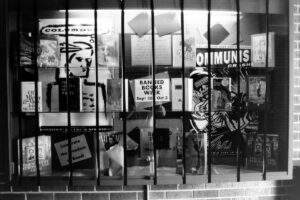
These principles, which form the cornerstones of communities committed to intellectual freedom, grew out of early attempts to restrict access to books and other information including everything from the novel “Grapes of Wrath”[3] to Consumer Reports. Today, libraries and library professionals are once again facing challenges to intellectual freedom, and they need someone to fight for them now more than ever. We are doing that work together.
The ALA Public Policy and Advocacy Office (established as the Washington Office in 1945[4]) and the ALA Office for Intellectual Freedom (founded in 1967[5]) are intertwined, not just in member leadership, activities and staffing, but in our values and our daily efforts. Access, equity, intellectual freedom and privacy, public good, and sustainability are at the heart of everything we do—whether it is answering a call from a library worker in distress, monitoring laws that impact intellectual freedom, or hosting coalition meetings and talking with legislators on Capitol Hill.
Our offices directly support librarians facing challenging situations by providing guidance and community. We help facilitate Intellectual Freedom Helplines in states across the country so library workers have someone to turn to when facing pressure to remove books from their shelves. We provide opportunities through our Law for Librarians program and storytelling workshops where library workers can share best practices and resources to protect intellectual freedom in their communities.
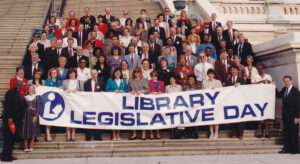
We bring the library community together to advocate for intellectual freedom. We track state level legislation,[6] including bills that could see librarians face criminal penalties for doing their jobs[7] and laws that protect the freedom to read. Through ALA’s State Intellectual Freedom Network[8] and monthly state legislation meetings, we keep library workers up to date on what’s happening in their states. We also convene forums for state chapter leaders to meet and invite library workers to join us in the halls of Congress on National Library Legislative Day.[9]
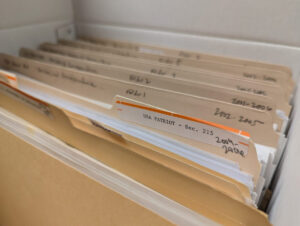
Our advocacy extends to protecting library patron privacy. For example, following the September 11 attacks in 2001 ALA strongly opposed the provision in the USA Patriot Act that required librarians to turn over patron data if requested and allowed law enforcement to secretly monitor electronic communications coming from libraries.[10]
Our offices also help coordinate efforts to protect intellectual freedom more widely. Though our partnerships with authors, publishers, booksellers, and freedom to read advocates we help ensure that library workers have a supportive safety net that stretches beyond our profession. Over the past several years ALA has drawn together more than 200 partner organizations and tens of thousands of individual supporters under the Unite Against Book Bans (UABB) coalition[11] to collectively advocate for the right to read and to defeat attempts to censor reading material.
These opportunities give librarians a voice and ensure they have support in their communities and in the halls of government. They also provide the chance to learn new things, get involved, grow as professionals and educators, build bonds with their peers that will last throughout their careers, and enrich their communities.
If advocacy is a system of muscles, then the more frequently we advocate, the stronger we get. Each muscle in that group is one of our partners, our community members, people who care just as much as we do about the importance of libraries and the freedom to choose what we read.
To learn more about the history of ALA’s Office for Intellectual Freedom, please visit “Fighting Censors and Book Bans: Establishing the ALA Office for Intellectual Freedom” here at ALA150.
Lisa Varga is chief advocacy officer of ALA’s Public Policy and Advocacy Office. Sarah Lamdan, executive director of ALA’s Office for Intellectual Freedom, is co-author.
[1]https://www.ala.org/tools/first-library-bill-rights
https://en.wikipedia.org/wiki/Library_Bill_of_Rights
[2]https://americanlibrariesmagazine.org/2016/03/15/freedom-to-read/
[3] www.npr.org/2008/09/30/95190615/grapes-of-wrath-and-the-politics-of-book-burning
[4] https://ia903208.us.archive.org/24/items/ala-wo-chronology-first-50-years/ALA%20WO%20Chronology%20First%2050%20Years_text.pdf
[5] https://ala150.org/fighting-censors-and-book-bans-establishing-the-ala-office-for-intellectual-freedom/
[6] https://www.ala.org/advocacy/adverse-legislation-states
[7] For example: https://jgrj.law.uiowa.edu/news/2026/03/iowa-legislatures-2026-agenda-locking-librarians
[8] https://www.ala.org/aboutala/offices/oif/sifnet
[9] https://www.ala.org/advocacy/nlld
[10] https://americanlibrariesmagazine.org/2016/05/31/baseless-hysteria-patriot-act/