During the summer of 1918, Charles Green, a librarian from the Massachusetts Agriculture College, served as the Acting Librarian for Camp Johnston in Jacksonville, Florida. While his tenure was brief, the Charles R. Green Papers in the American Library Association (ALA) Archives reveal Green’s rapid appointment and promotion. It also shows how quickly circumstances could change within the ALA’s Library War Service and the adaptability of its volunteers.
Camp Johnston presented unique challenges for a librarian. Not only was it a large base, but it was also a school that taught technical, engineering, and scientific subjects to servicemembers. These challenges led the camp’s librarian, L. W. Josselyn, to send a distressed letter to ALA. His letter from May 18, 1918, opened with, “A crisis has come in the work here which will have to be met within the next ten days at the very latest. I shall try to put the whole problem before you.

“First I want to say that for the past five months I have been working day and night and that I feel the best in me has been into the services … I have not made reports as I should, I have not ordered all the books necessary for our work, I have not helped headquarters as I should in my correspondence … the reason being that the daily work had to be done, and the needs to some extent had to be anticipated, and I was physically unable to do more. I feel today that I am skating on thin ice and that a rest is absolutely necessary …”
He laid out the tasks that consumed his time. The first being the regular circulation of books through the main library and its eleven branches and providing general reference services. The second was providing reference services to 40 to 50 faculty members at the camp, along with supplying materials to the students.
Josselyn added that he needed a reference librarian: “By this I mean a man capable of doing the reference as I would do it, a man who will live on the job and make it BIG, a man who will work happily with me and be in it heart, soul and brain. We can find such a man, we must find him if we are to do this work.”

This call for a reference librarian set off a rapid chain of events. At the end of May, ALA sent a plea to Charles Green: “We greatly need you in charge of reference work [at the] Camp Johnston Library … for the summer beginning at once … This is one of the most important positions for technical work you can accept.”
Green accepted and, on June 3, ALA urged him to start as soon as possible. Three days later, a letter was sent to confirm Green’s appointment as an assistant to the camp librarian. On June 8, a press bulletin was released to announce Green as the new technical reference librarian at the camp. By June 11, ALA sent Green a telegram to inform him that Josselyn was going on furlough and was turning the library over to Green, making him Acting Librarian.
Within the span of a few weeks, Green was offered a position, appointed, his position announced, and then promoted before he ever set foot in the camp.
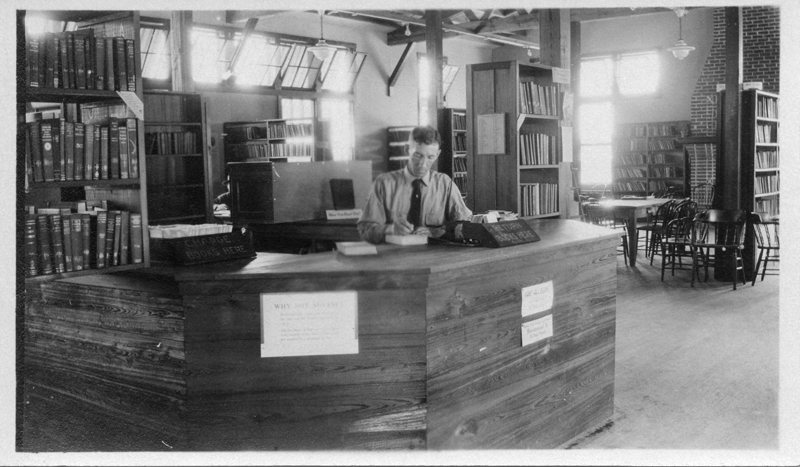
Green’s papers don’t reveal much about his work at Camp Johnston, but a letter to ALA Headquarters described him as an effective librarian, who took great pleasure in his work. Towards the end of his time at Camp Johnston, Green wrote contently about the camp library. He described it as “entirely different from that at any other camp … The library work consequently is quite like [a] real college library … I found the work intensely interesting and I am sure the Camp Library was of real service to a large number of people. In fact, I am positive that the work of the Quartermaster’s School could not have been carried on without the Library maintained and operated by the ALA.”
Source:
Charles R. Green Papers, 1918-1919, Record Series 89/1/24, American Library Association Archives. https://digital.library.illinois.edu/collections/ea63df90-912b-013b-44b6-02d0d7bfd6e4-4
This story first appeared on the ALA Archives blog on March 31, 2023.