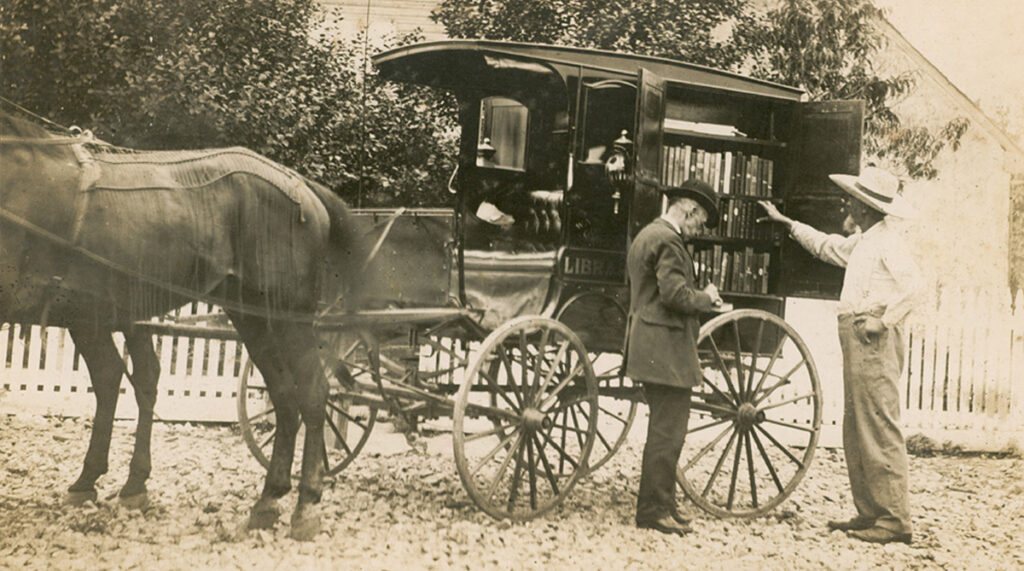
In 1904, the Washington County Free Library in Hagerstown, Maryland, outfitted a wagon with bookshelves to serve as a mobile library unit to reach people who could not normally make it to the library. A few times a week, the book wagon was able to reach rural areas of the county and deliver books to residents.
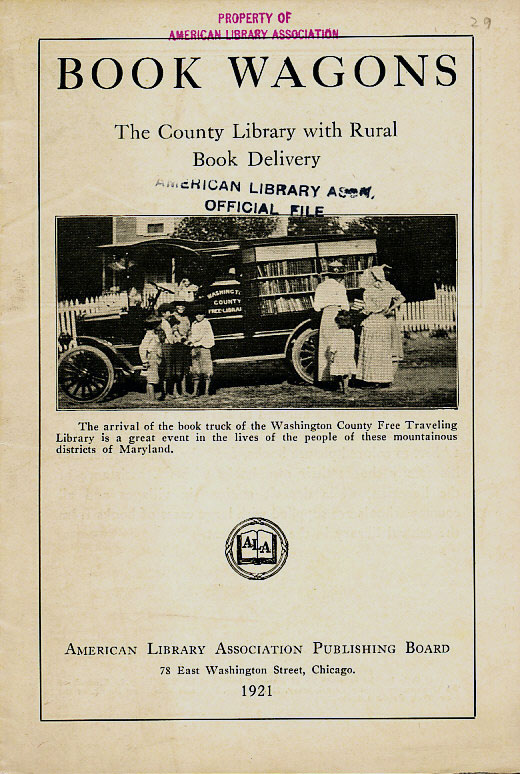
The Washington County Free Library book wagon would meet a tragic end in 1910 when it was struck by a freight train at a railway crossing. This event would suspend the county’s library extension service as there were no funds to purchase a new wagon. However, in 1912, a generous donation of $2,500 by William Kealhofer, Esq. allowed the library to replace the book wagon. Instead of getting another horse drawn wagon, the library purchased a truck that could be fitted with shelves to hold 300 books.[1] The truck allowed the library to extend its reach by being able to add more routes.
The idea spread to other parts of the country. In Evanston, Illinois, a book wagon served the town as poor transportation made it difficult to reach the library. This provided many immigrant families with access to the library. Hibbing, Minnesota, had an automobile that could carry a thousand books and even had its own librarian desk. The bookmobile made rounds that included mining camps, where one man from the camp stated that he walked three miles to get to the bookmobile.[2]
The ALA supported the concept of a mobile library unit after it was introduced to the ALA during the 1909 Annual Conference by Mary Titcomb.[3] Afterwards the ALA produced pamphlets and other educational materials on how to setup book wagons and short case studies of its success. By 1929 the ALA Committee on Library Extension reported that there were at least 56 bookmobiles in operation in the country. The committee even wrote up specifications for a bookmobile, including the make of the vehicle, how to install bookshelves, and even where to store a spare tire.[4]
The simple idea of bringing the library to the people had a significant impact. People, who only had sporadic access to the library or none at all, were suddenly able to browse through hundreds of books via the bookmobile. As Mary Titcomb said at the 1909 Annual Conference, “The book goes to the man. We do not wait for the man to come to the book.”[5]
Additional information on the beginnings of the bookmobile can be found in Angela Jordan’s post, “Have Books, Will Travel,” on the ALA Archives blog.
Citations
[1] “Book Wagons: The County Library with Rural Delivery,” 1921, Bookmobile Publications, Record Series 29/7/4, American Library Association Archives, University of Illinois at Urbana-Champaign.
[2] Ibid.
[3] Papers and Proceedings of the Thirty-First Annual Meeting of the American Library Association, (Chicago, 1909), pg. 150, Record Series 5/1/2, American Library Association Archives, University of Illinois at Urbana-Champaign.
[4] “Tentative Specifications for Book Automobiles,” 1929, Bookmobile Publications, Record Series 29/7/4, American Library Association Archives, University of Illinois at Urbana-Champaign.
[5] Papers and Proceedings of the Thirty-First Annual Meeting of the American Library Association, (Chicago, 1909), pg. 151, Record Series 5/1/2, American Library Association Archives, University of Illinois at Urbana-Champaign.
This story first appeared on the ALA Archives blog on May 22, 2014.