Although women had been employed in libraries previously, the six young women hired by Melvil Dewey (1851-1931) in 1883 to work at Columbia College library captured the imagination of 20th-century library historians as groundbreaking fore-mothers of female employment and/or the beginnings of low-paid exploitation of women in the library workforce, but never as six young individuals at the beginning of six full lives. In fact, five of the six would leave Columbia within two years, and most left library work behind.
Columbia’s trustees at the end of the 19th century were expanding their small sleepy college into a university, and in 1883 were building a new library building in which to combine existing collections from the College, the law school, and the nascent school of political science, and grow a collection suitable to support graduate studies. Dewey was making a name for himself with his classification system (first edition, 1876), his work for the American Library Association, and the Library Bureau. Columbia was his first library directorship; a proving ground for his theories on library economy.
The budget Dewey asked for included a large salary for himself, decent salaries for men to run departments and interact with the male students, and six meager salaries for women to do the technical services work. When he couldn’t find women with library experience willing to take the salary he was offering, Dewey turned to Alice Freeman (1855-1902), president of Wellesley College, who found six graduating seniors to work at Columbia.
The Six Women
Alice Whipple Ayers (1861–1950)
Alice worked on accessions at Columbia from 1883 to 1884. She taught high school in her hometown of Oakham, Massachusetts, then in Mankato Minnesota, until she married Benjamin Dayton Smith in 1892. She had two children, a boy and a girl.
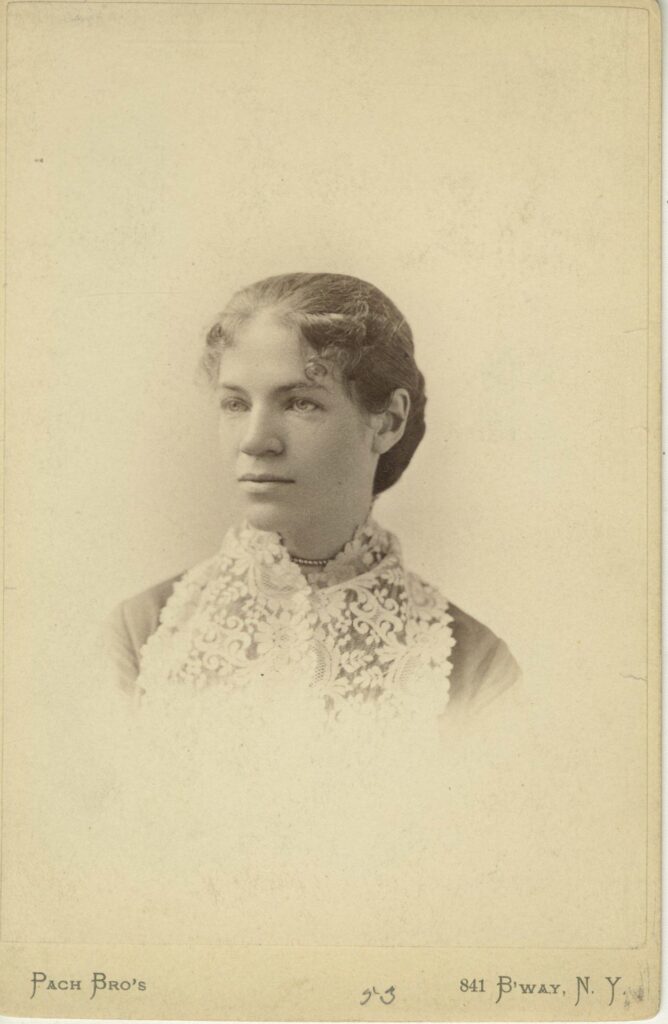
Mary Matilda DeVeny (1860–1953)
Mary was the first of the six to sign on to work at Columbia and, from 1883 to 1885, she was the bookkeeper and assistant to Dewey. In 1885, she took on a more remunerative teaching post at Mrs. Reed’s school in New York City, then taught math at the Bryn Mawr school in Baltimore until 1889. In 1890, she married Edmund A. Wasson, an Episcopal Church minister, whom she had met at Columbia. He had positions in New York, Montana, Jamaica, Canterbury (England), and Rome, but they lived most of their married life in Newark, New Jersey. Two sons survived childhood, diplomat Thomas C. Wasson and and magic mushroom evangelist R. Gordon Wasson.
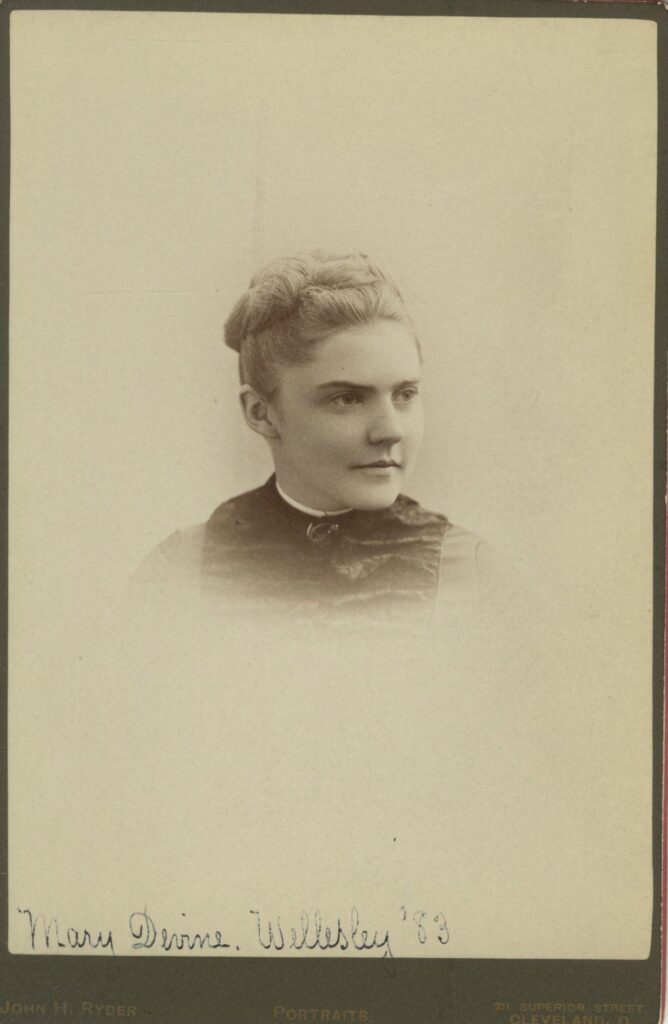
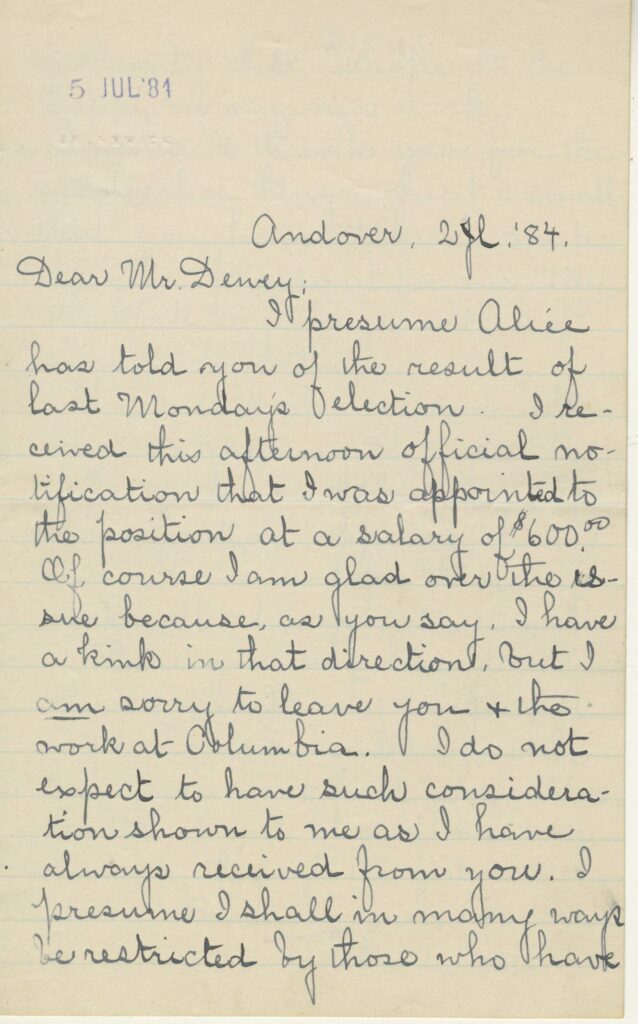
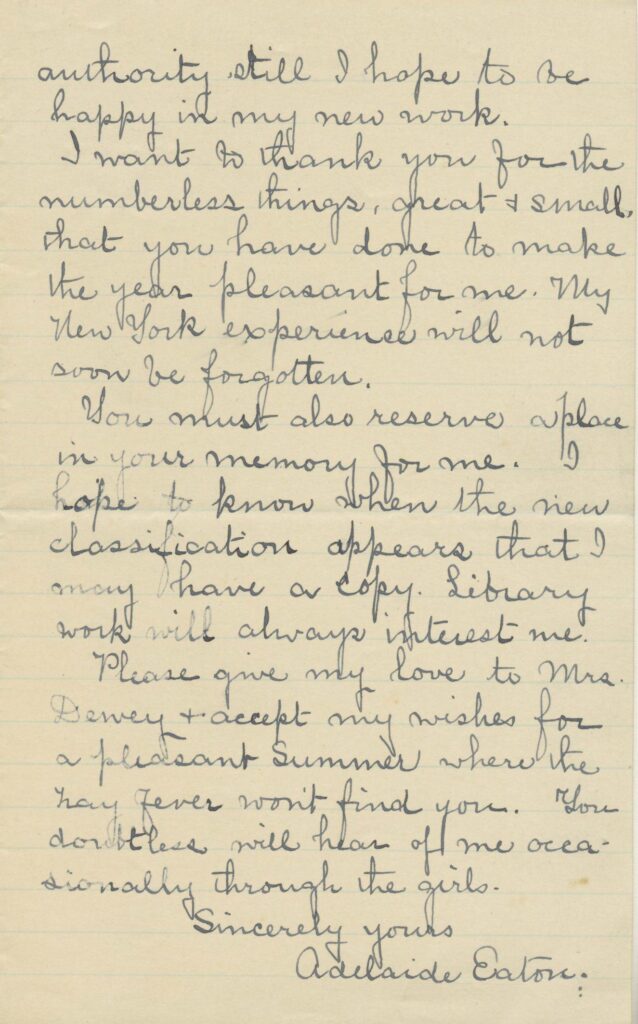
[Louisa] Adelaide Eaton (1860–1941)
Adelaide was a cataloger at Columbia from 1883 to 1884. Her father, who taught at Phillips Academy, died in 1865, and her mother then took in borders. She taught at Fitchburg (Mass.) High School from 1884 to 1888, when she married Alanson J. Abbe, M.D. They lived in Fall River, Massachusetts, and had one daughter and one son.
![[Louisa] Adelaide Eaton, 1883](https://ala150.org/wp-content/uploads/2026/05/AdelaideEaton1883-658x1024.jpg)
Louise Langford (1861–1890)
Louise’s family moved from Utica, New York, to Minnesota in 1867. After her father’s death of consumption in 1869, Louise and her mother moved back to her mother’s family in Catskill, New York. When Louise took the job at Columbia, her mother joined her and her coworkers living in a boarding house in New York City. Louise stayed at Columbia, shelflisting and cataloging, until her early death in 1890.
Alice Ayers wrote to Dewey in 1929: “What good times and what profitable times we had in New York. It was an unusually congenial group of girls and the presence of Mrs. Langford added much to our happiness at the house, and then you made conditions so pleasant at the Library that our first year in “business” was a delightful one. I have a heart pang every time I think of the passing of our sweet Louie. I was very fond of her.”
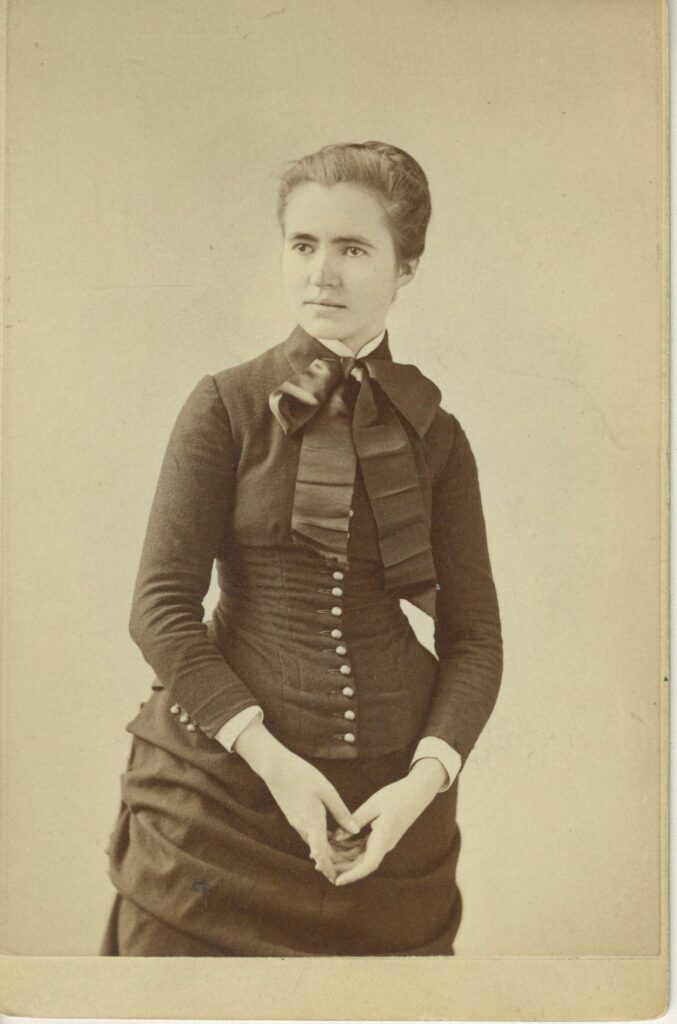
Helen “Nellie” Page (1860–1933)
Born in Rockford, Illinois, Nellie worked at Columbia in shelflisting and cataloging from 1883 to 1885. At Columbia, she met Walter Gillette Bates, and they she married in 1887. They traveled the U.S., seeking a healthful spot for him while pursuing their studies and trying to find a job teaching or in a library. Walter died in 1893, and Nellie fulfilled their joint dream by getting a PhD in economics from the University of Wisconsin in 1896. She was the first American woman to earn her PhD in economics. (Claire H. Hammond, “American Women and the Professionalization of Economics” Review of Social Economy, 51:3 (Fall 1993), pp. 347-370, esp. 358-360.)
Page was Professor of Economics and History, Rockford College from 1896 to 1898, then worked at Hull House and other settlement houses. After a degree from the New York School of Philanthropy in 1902, she was Sociological Librarian at the New York State Library from 1902 to 1905, and librarian at the Russell Sage Foundation Library from 1905 to 1913. Then she went to the University of California, in a variety of positions, including librarian in the Departments of Economics and Political Science (1925–1930), and the Bureau of Public Administration and Library of Economic Research (1930–1932).
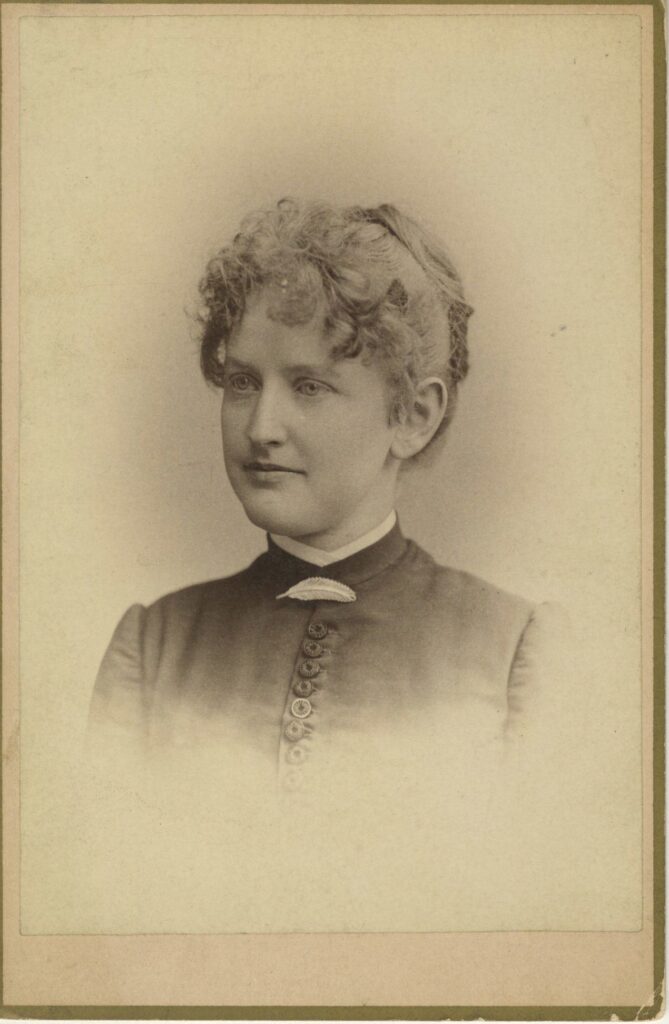
Martha Goddard Tyler (1861–1933)
Marth was born May 7, 1861, in Natal, South Africa, now known as KwaZulu-Natal, to missionary parents. She returned to the U.S. in 1877 and attended Wellesley from 1878 to 1883. After working for Columbia in charge of binding and duplicates from 1883 to 1885, she moved to St. Johnsbury, Vermont, where one of her brothers lived and her father retired to in 1889. In 1890, she became the curator of the museum of natural history built by Franklin Fairbanks of St. Johnsbury. In 1897, she married Matthew Henry Buckham (1832–1910), president of the University of Vermont, from 1871 to 1910. Martha lived with Buckham in Burlington, Vermont, and served as a member of the Vermont board of library commissioners among other civic duties. She had one daughter, Laura Buckham (1903–1981), who had a PhD from Radcliffe and taught French at Sweet Briar.
Bibliographical notes
On Dewey’s work at Columbia: Henry R. Tedder, “Mr. Melvil Dewey’s Work at Columbia College,” “The Library Chronicle,” vol. 1, Nov-Dec 1884, p. 186-191. Collection statistics from Winifred Lindeman, “History of the Columbia University Library, 1876-1926” (New York, Columbia PhD thesis, 1959), p. 118. Henry Watson Kent, [Address on the early days of the Columbia College School of Library Economy], 5 January 1937, typed manuscript, 9 pages. Rare Book & Manuscript Library, Columbia University Libraries, Columbiana Manuscripts, Series II, box 8, folder 12, includes a view of the Half-Dozen at work.
Dewey’s correspondence with Alice Freeman is in box 31, Melvil Dewey Papers, Rare Book & Manuscript Library, Columbia University Libraries. Correspondence with all the Half-Dozen except for Louise Langford is in box 18. Additional biographical data is largely from Findagrave.com, Ancestry.com, and the “Wellesley College Record, 1875-1912” (Wellesley, Massachusetts, The college, 1912). More detail will be available later this year on my blog, Women in the Stacks.
Jane Rodgers Siegel is the Rare Book Librarian at Columbia University’s Rare Book and Manuscript Library.