150 YEARS STRONG

Newbery: The First Medal

In 1921, Frederic Melcher, a publisher, bookseller, and chairman of the Children’s Book Week Committee, proposed the idea of a medal to be awarded in recognition of children’s literature and for it to be named after John Newbery, an 18th century British bookseller and children’s books publisher. With a growing audience for children’s books, more librarians being trained in children services, and the emergence of children’s book departments in publishing companies, the time seemed right for such an award and the idea gained traction.(1) Melcher paid to have the medal struck, while the Children’s Librarians Section (predecessor to the Association for Library Service to Children) organized the selection of the first winner through a vote of children’s librarians from across the country.
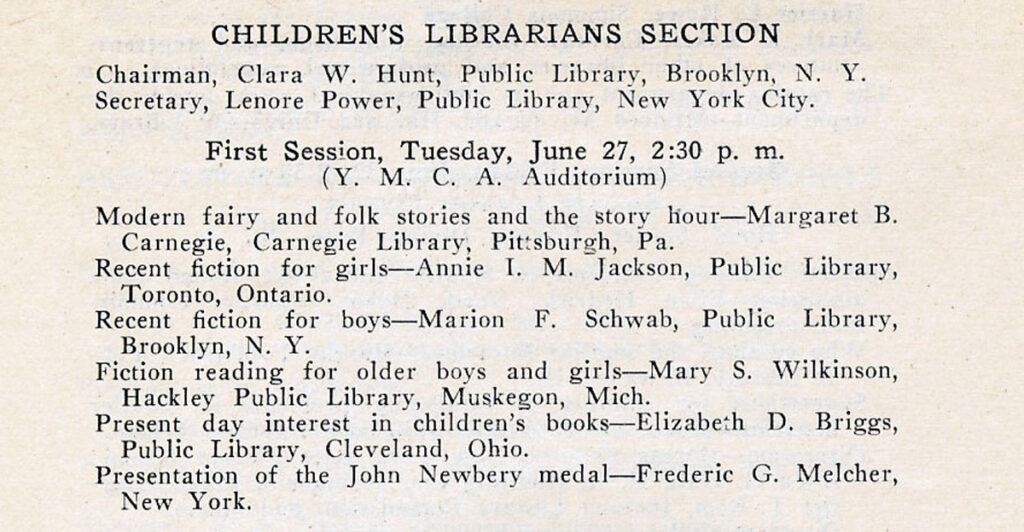
Agenda for the Children’s Librarians Section on June 27, 1922, including the first presentation of the John Newbery Medal.

The first John Newbery Medal was awarded to Hendrik Willem van Loon for his book, “The Story of Mankind,” in 1922 at the ALA Annual Conference in Detroit, Michigan. While the ALA Archives unfortunately does not have many records from the early days of the Newbery Medal, conference records provide an insight into how the first award ceremony went.

The Newbery was presented on June 27, 1922, during the Children’s Librarians Section’s session at the conference and was listed as the last item on the section’s agenda for the day. Despite the lack of a banquet or formal event, the presentation drew a crowd. The conference proceedings on the event open with: “Interest in awarding the John Newbery medal brought a big audience to the first session of the Children’s Librarians Section. The hall was full to capacity, many people were turned away.”(2)

At the ceremony, Clara W. Hunt, chair of the Children’s Librarians Section, expressed the gratitude of the section to Melcher for his donation of the medal:

“I would I had the ability to express adequately the gratitude which we children’s librarians feel for the inspiration which prompted you to make this gift to the cause we love … We feel strong and powerful because you believe in us and you are putting in our hands a weapon, one of the most potent of our times—publicity of the best kind.”(3)

The description of the event closes with: “The enthusiastic applause which greeted Dr. Van Loon gave evidence of the appreciation and interest of the large audience.”(4) As seen from the conference proceedings, the Newbery was instantly well regarded, and the excitement of children’s librarians was obvious. Its initial acclaim was well deserved as the Newbery Medal has proven to be an enduring honor.
150 YEARS STRONG

THE OFFICIAL ANNIVERSARY BLOG

Henry and Edith Carr

Henry and Edith Carr, ALA’s Golden Couple

With Valentine’s Day approaching, we remember possibly the most famous ALA couple of all time, Henry and Edith Wallbridge Carr. Married for 43 years and active in ALA for even longer, the Carrs were well-known within the library community of the late 19th and early 20th century. Where did their romance begin? At an ALA conference, of course!

detail of 1976 ALA conference program logo

A Short History of the ALA Logo

The first American Library Association (ALA) logo appeared as the Association launched its Library War Service during World War I, with many more iterations following over the course of almost 100 years.

detail of Richmond ALA COnference program

Librarians, Segregated: The 1936 ALA Annual Conference

Stanley J. Kunitz, editor of the Wilson Bulletin, called it the “The Spectre at Richmond” —but the racial discrimination at the 1936 American Library Association Annual Conference was no ghostly apparition

Detail of letter from Virginia Hamilton to Anne Izard, February 24, 1972.

Newbery: Letters from the Authors

For more than a century, the American Library Association has honored children’s authors with the John Newbery Medal. From the earliest years of the award, its prestige was not lost upon the authors who received it. Letters written by awardees to the Newbery Medal Committee chairs reveal their excitement upon receiving the news.

Agenda for the Children’s Librarians Section on June 27, 1922, including the first presentation of the John Newbery Medal.

Newbery: The First Medal

In 1921, Frederic Melcher, a publisher, bookseller, and chairman of the Children’s Book Week Committee, proposed the idea of a medal to be awarded in recognition of children’s literature and for it to be named after John Newbery, an 18th century British bookseller and children’s books publisher. With a growing audience for children’s books, more librarians being trained in children services, and the emergence of children’s book departments in publishing companies, the time seemed right for such an award and the idea gained traction.

Caldecott Award Seal

The Caldecott Medal: ‘A Hasty Idea Thrown Out’

The Caldecott Medal is of one of the most prestigious children’s book awards in the world. Established in 1937 to recognize the most distinguished American picture book for children, the first medal was awarded in 1938 to Dorothy P. Lathrop for the book, “Animals of the Bible.” However, the idea was first presented in 1935 in a letter by Frederic G. Melcher.