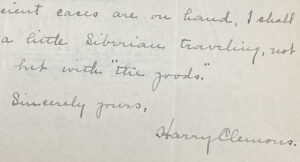
For more than a century, the American Library Association (ALA) has honored children’s authors with the John Newbery Medal. From the earliest years of the award, its prestige was not lost upon the authors who received it. Letters written by awardees to the Newbery Medal Committee chairs reveal their excitement upon receiving the news.
In 1934, author Cornelia Meigs was selected for the Newbery for her book “Invincible Louisa.” Meigs wrote to the selection committee chair, Siri Andrews, and was delighted to have her book honored, acknowledging that the “Invincible Louisa” was in good company:
Your letter, with its very delightful and astonishing news, has given me much pleasure. The Newbery Medal is an award for which everyone has the most profound respect, so that I am fully sensible of what good fortune it is to me to have it offered to “Invincible Louisa.” Some such extraordinarily fine books have been on your list in the past that it seems a very impressive thing have an invitation extended to join that distinguished company.(1)
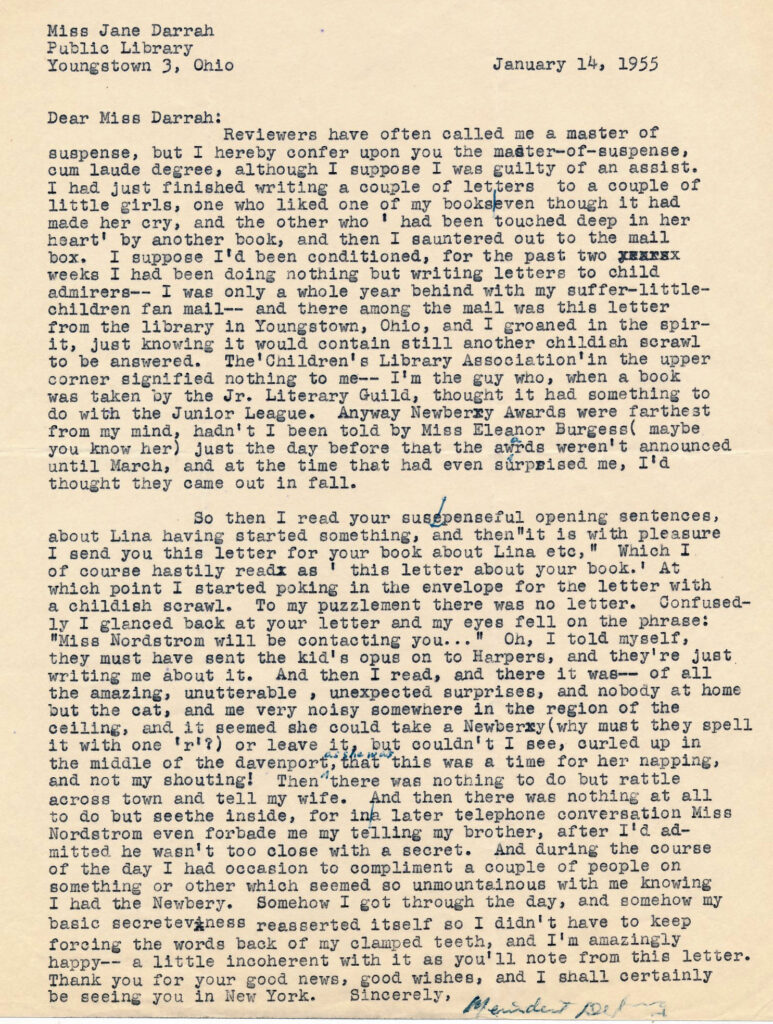
Author Meindert De Jong, awarded for his book “The Wheel on the School,” could not conceal his excitement in his 1955 letter to chair, Jane Darrah. The only thing that dampened De Jong’s joy was the fact that no one was home when he received the news, except for an uninterested cat: “… and there it was—of all the amazing, unutterable, unexpected surprises, and nobody at home but the cat … and it seemed she could take a Newbery … or leave it, but couldn’t I see … that this was a time for her napping, and not my shouting! Then there was nothing to do but rattle across town and tell my wife.”(2)
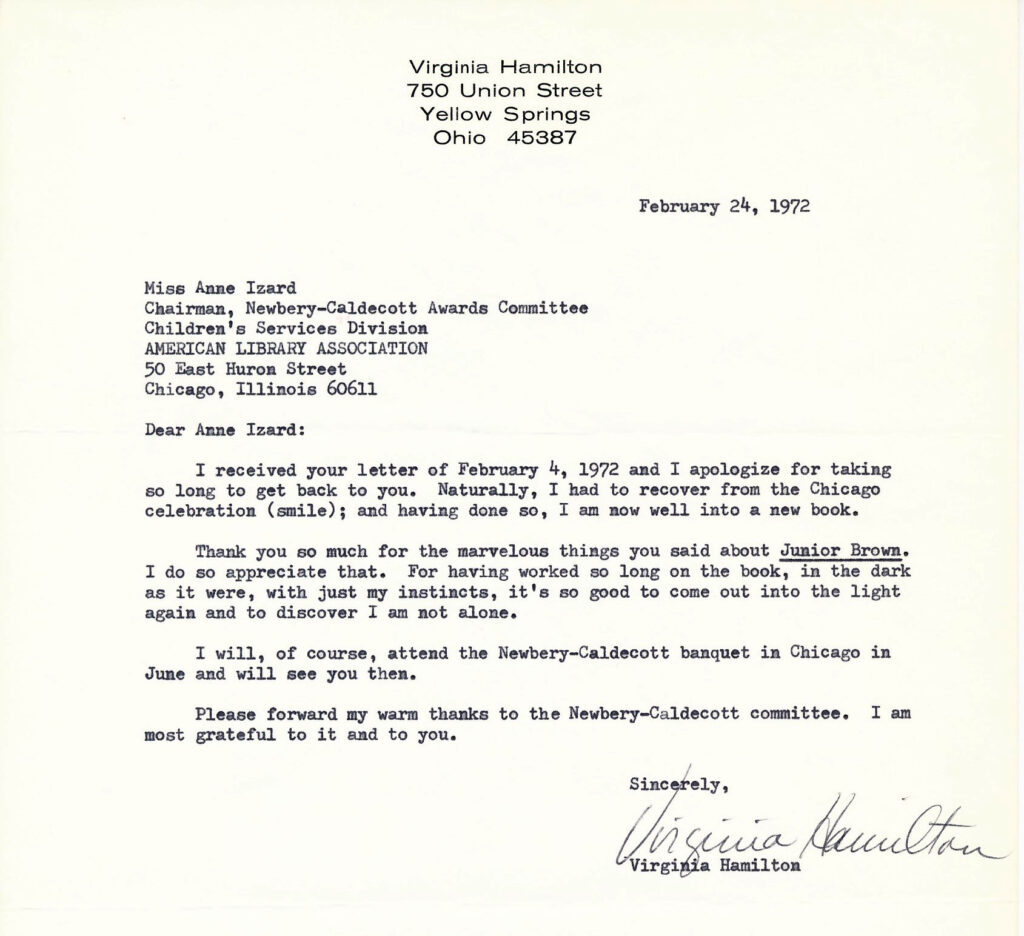
Upon receiving a Newbery Honor for “The Planet of Junior Brown” in 1972, Virginia Hamilton was reflective about the recognition that her hard work received. She wrote to the committee chair, Anne Izard, “Thank you so much for the marvelous things you said about Junior Brown. I do so appreciate that. For having worked so long on the book, in the dark as it were, with just my instincts, it’s so good to come out into the light again and discover I am not alone.”(3) Three years later, Hamilton became the first black author to receive the Newbery Medal for her book “M. C. Higgins, the Great.”
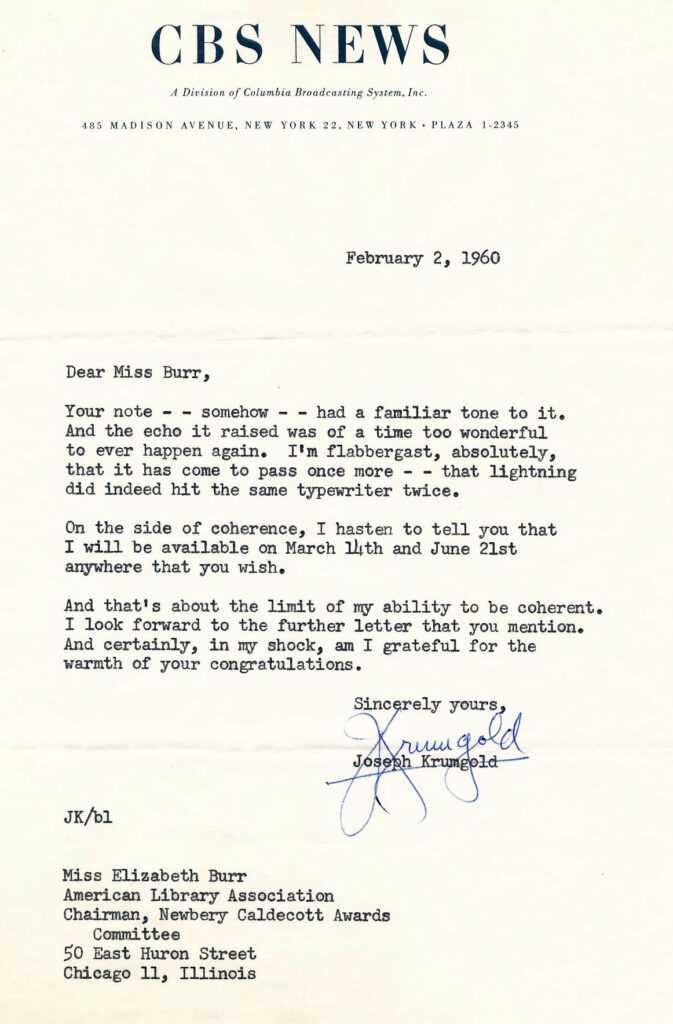
In 1960, Joseph Krumgold was the first author to be awarded the Newbery a second time, receiving it for his book “Onion John.” His astonishment was evident in his letter to the committee chair, “I’m flabbergast, absolutely, that it has come to pass once more – that lightning did indeed hit the same typewriter twice.”(4) Only five other authors have received the Newbery twice in the medal’s 100 year history.
These letters, along with many others, are available for research at the American Library Association Archives.
If you’d like to listen to interviews with Newbery winners from the 1940s to the present, head over to ala.org where you can find acceptance speeches ranging from Erin Entrada Kelly (2025 Newbery winner) and Beverly Cleary (1984 Newbery winner) to Robert Lawson (1945 Newber winner) and Madeleine L’Engle (1963 Newbery winner).
1. Cornelia Meigs to Siri Andrews, May 21, 1934, Awards File, 1934-2009, Record Series 24/2/8, Box 3, Folder: Newbery Medal, 1934, American Library Association Archives.
2. Meindert De Jong to Jane Darrah, January 14, 1955, Newbery-Caldecott Committee Correspondence, 1954-2007, Record Series 24/42/5, Box 1, Folder: Correspondence with Winners, 1954-55, American Library Association Archives.
3. Virginia Hamilton to Anne Izard, February 24, 1972, Newbery-Caldecott Committee Correspondence, 1954-2007, Record Series 24/42/5, Box 1, Folder: Newbery Caldecott Committee, 1971-72, American Library Association Archives.
4. Joseph Krumgold to Elizabeth Burr, February 2, 1960, Newbery-Caldecott Committee Correspondence, 1954-2007, Record Series 24/42/5, Box 1, Folder: Correspondence with Winners and Runners Up, 1960, American Library Association Archives.