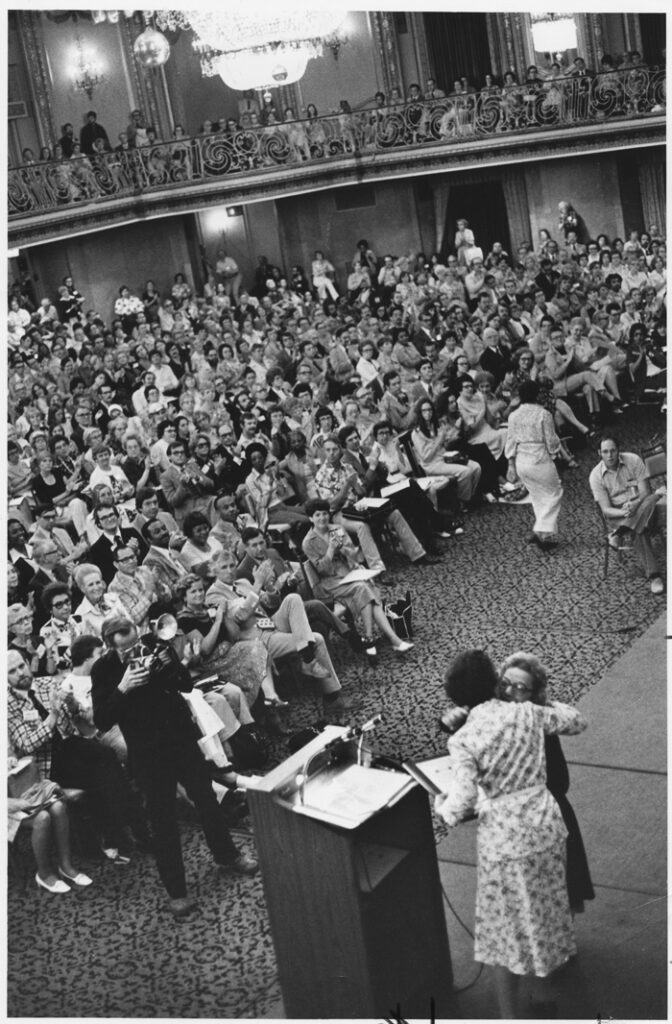
During the 1975 American Library Association Annual (ALA) Conference, Clara Stanton Jones was announced as the vice president and president-elect of ALA. Her term as president would start during the ALA’s 1976 Centennial Conference, a fitting celebration for the first African American president of the Association.
Her experience as director of the Detroit Public Library and personality made her well suited for the position of ALA president. E. J. Josey noted that: “Her years of service in the trenches in Detroit before being appointed director of the library system provided her with management skills as well as a desire to love and serve her fellow human beings.”[1] Jones’ career took her all over the world, but most of her activities were community driven, working on the revitalization and cultural development of Detroit.[2]
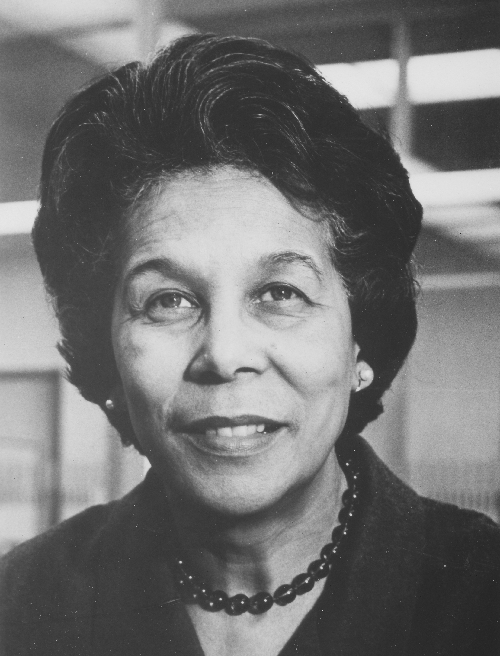
Jones’ presidency saw the passing of the ALA’s “Resolution on Racism and Sexism Awareness.” However, it was asked to be rescinded during the 1977 Midwinter Meeting over concerns that it conflicted with the Library Bill of Rights. Jones felt that “wisdom prevailed” when the request for rescinding the resolution was changed to studying it with the input of all ALA units. Later, Jones wrote that “[t]he spirit of the ‘Resolution on Racism and Sexism Awareness’ is not burdened with repression; it is liberating. If the resolution is imperfect, try to make it perfect, but not by destroying it first!”[3] She was not frustrated by the criticism of the resolution and was open to improvements, but felt strongly against getting rid of it completely.
During the 1977 Detroit Annual Conference, Jones passed on the presidency to ALA Vice President Eric Moon. Moon said that his year as ALA’s vice president was one of “learning from [Jones’] warmth, humanity, courage, and style.”[4] His words reflected the impact Jones had on her colleagues and would continue to have for years to come.
In 1978, Jones retired from the Detroit Public Library, but her contributions to the profession did not end there. She was appointed to the National Commission on Libraries and Information Services by President Jimmy Carter, which she served from 1978 to 1982.[5] By the end of her career, Jones had received nine honorary doctorates and an ALA Honorary Membership, the highest honor of the Association.
Citations
1. “To Be Black and a Librarian: Talking with E. J. Josey,” American Libraries, vol. 31, no. 1 (January, 2000), p. 82.
2. News Release, 1975. Biographical Information, 1963-1998, Record Series 12/1/4, Box 1, Folder: Jones, Clara Stanton. American Library Association Archives.
3. Clara Stanton Jones, “Liberating, Not Repressive: ALA President Views the Racism/Sexism Resolution,” American Libraries, vol. 8, no. 5 (May, 1977), 244-245.
4. “In the News,” American Libraries, vol. 8, no. 8 (Sep., 1977), pp. 405-407, 413.
5. “Library Mentor and Pioneer Clara Stanton Jones Dies,” American Libraries, October 3, 2012, http://americanlibrariesmagazine.org/blogs/the-scoop/library-mentor-and-pioneer-clara-stanton-jones-dies/.
This story first appeared on the ALA Archives blog February 26, 2016.