In the midst of the Civil Rights era in America, librarians were battling for and against segregated libraries in the South, however they were also battling over integration within their own ranks. Integration of the library profession was a long process that started in the early 20th century.
Black librarians have been active in American librarianship since the start of the library movement in the 19th century. The first Black librarian to graduate from an accredited library school was Edward Christopher Williams in 1900, from the New York State Library School, completing the normally two-year graduate program in one year. [1] Many others would follow, with a total of 180 accredited Black librarians listed in a directory covering graduates from 1900-1936. [2]
While many library schools in the North did accept Black students, in the South there was only the Library School at the Hampton Institute, run from 1925 through 1939. [3] The Hampton Institute graduated 183 librarians during its existence. [4] When the Hampton Institute’s library school closed in 1939, it for a time left southern Black librarians with only para-professional or summer-term programs. Black students who attended majority-white schools in the North also had a difficult time due to less-formalized racial inequality. An ALA report on the closing of the Hampton Institute has this quote from an anonymous head of a library school:
While we have sympathy for the Negro woman student and of course no prejudice, we discourage them for trying to enter the ____ School for Library Science or indeed any department of the University, because there is literally no satisfactory place for them to live in _____. We have had, therefore, no Negro graduates since 1936. [5]

Another anonymous head makes more telling remarks of the inequality Black students would have faced, not just from the town they had to live in, but from the administrators of the library school they were attending:
Those Negro students who have made good records with us are racially adjusted, considerably aggressive, and more than likely to have attended a northern school. Most of the students have made only average records though three of them have been superior and could compete with the very finest white students. Two or three others have been very good. […] It is too much to expect Negros from Negro schools to compete in northern library schools for the standard degree. [6]
Things were difficult still for those who managed to get a library degree. After the 1936 ALA Annual Conference in Richmond, Virginia, in which Black librarians were barred from many sessions of the conference (including any session involving eating) due to segregation laws, the ALA stipulated that future conferences would be held only in areas where meeting space could be obtained “with proper regard for its own self respect and that of its members.” [7] While this did not officially ban southern states from being hosts to the annual conference, the ALA did not return to the South until 1956, when it could obtain non-segregated space in Miami Beach, Florida. However, in the pre-Civil Rights Act era, Black librarians attending ALA conferences still struggled to find lodging, either having to stay with friends or relatives, or at small hotels and YMCAs. [8]
Following a proposal at the 1952 meeting, in 1954 the ALA also barred states from having 2 separate state chapters with the ALA, an effort to integrate state library associations that had segregated chapters for Black librarians, including Florida, North Carolina, and South Carolina. [9] The Georgia Library Association and the Alabama Library Association would not comply and lost status. In 1962 further anti-segregation sanctions for state chapters were passed, and the Louisiana Library Association and Mississippi Library Association also lost ALA status rather than comply. [10]
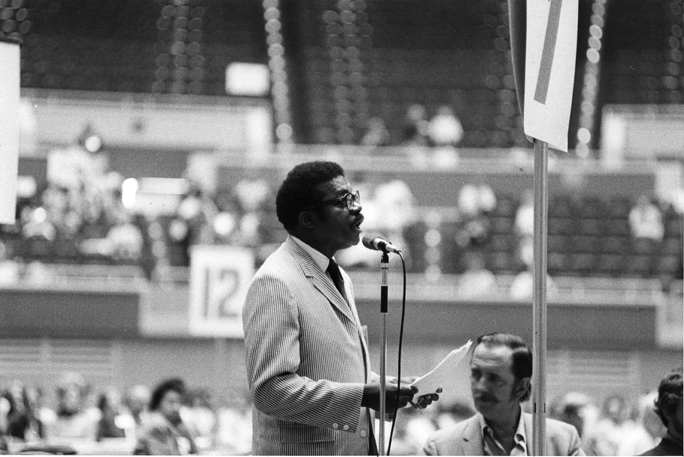
However, the ALA was not consistent in its censure of segregation in library professional organizations. E. J. Josey (later to become ALA’s first Black male president) describes his feelings at the 1964 ALA conference after watching a segregated state library organization be honored:
Since I was actively promoting National Library Week on my college campus, I felt that it was necessary to attend the National Library Week Program. Much to my chagrin, the Mississippi Library Association was honored there for its National Library Week activities. I exploded! I was seething with anger, for I remembered that three civil workers–Andrew Goodman, James Chaney, and Michael Schwerner–had been murdered and lay dead and buried somewhere in Mississippi, their bodies not yet even discovered. I also remembered that the Mississippi Library Association had withdrawn from ALA rather than give membership to Negro librarians. My involvement in the Savannah Freedom Movement and my sense of honor as a human caused me to ask for recognition from the presiding officer, who was Grace Stevenson, Associate Executive Secretary of the Association. She quickly put me in my place by saying that this was not an ALA membership meeting and that, therefore, I was out of order. [11]
The National Library Week Committee did not rescind the award to the Mississippi Library Association or the Louisiana Library Association (who were also awarded regardless of losing their chapter status for segregation), despite Josey’s formally submitted protest.
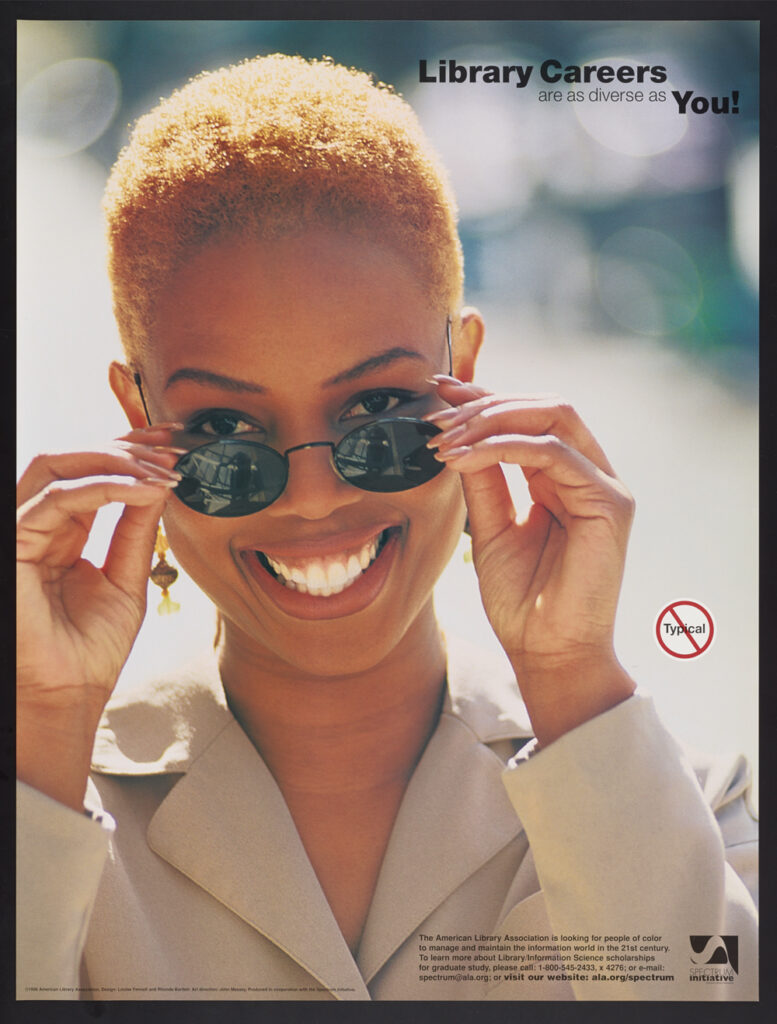
The ALA’s Black Caucus was founded in 1970 to further the needs of Black librarians and, in the words of founder E. J. Josey, to “act [on Black issues], rather than react” [12] The ALA’s first Black president was Clara Jones, who presided for 1975-76. She had previously run and lost in the ’74-75 election, and had to be persuaded by colleagues to run again the next year. [13] Her election was particularly poignant as 1976 was ALA’s Centennial year. Since her election 4 Black presidents have followed. Today the ALA furthers the futures of Black librarians through library science education scholarships: the ALA’s Spectrum Scholarships program was started in 1997, while the Black Caucus has awarded the E. J.Josey Scholarship since 1994.
Citations
[1] Josey, E. J. (1969) “Edward Christopher Williams: A Librarian’s Librarian.” The Journal of Library History, Vol. 4, No. 2 (Apr., 1969), pp. 106-122. http://www.jstor.org/stable/25540156
[2] Columbia Civic Library Association. (1937) A Directory of Negro Graduates of Accredited Library Schools, 1900-1936. Digitized from the copy in the University of Illinois Urbana-Champaign circulating collection.
[3] Gunn, A. C. (1986) EARLY TRAINING FOR BLACK LIBRARIANS IN THE U.S.: A HISTORY OF THE HAMPTON INSTITUTE LIBRARY SCHOOL AND THE ESTABLISHMENT OF THE ATLANTA UNIVERSITY SCHOOL OF LIBRARY SERVICE (VIRGINIA, GEORGIA, UNITED STATES) Doctoral thesis. Retrieved from http://search.proquest.com/docview/303528958
[4] American Library Association: Board of Education for Librarianship. (1939) “Memorandum on the Need in the South for a Library School or Schools for Negroes.” From RS 20/50/4, Board of Education for Librarianship Publications, 1929-1956, Box 1, American Library Association Archives.
[5] Ibid.
[6] Ibid.
[7] Lipscomb, C. E. (2004) “Race and librarianship: part I.” Journal of the Medical Library Association, 92(3), 299–301. http://www.ncbi.nlm.nih.gov/pmc/articles/PMC442167/
[8] Marshall, A. P. (1970) “The Search for Identity.” The Black Librarian in America. ed. E. J. Josey. Scarecrow Press Inc, Metuchen, N. J.
[9] Lipscomb, C. E. (2005) “Race and librarianship: part II.” Journal of the Medical Library Association, 93(3), 308–310. 2005. http://www.ncbi.nlm.nih.gov/pmc/articles/PMC1175796/
[10] Ibid.
[11] Josey, E. J. (1970) “A Dreamer — With a Tiny Spark.” The Black Librarian in America. ed. E. J. Josey. Scarecrow Press Inc, Metuchen, N. J. 1970.
[12] Josey, E. J. (1994) “More than two decades later.” The Black Librarian in America – Revisited. ed. E. J. Josey. Scarecrow Press Inc, Metuchen, N. J. 1994.
[13] Ibid.
This story was first published on the ALA Archives blog February 12, 2015.