150 YEARS STRONG

Newbery: The First Medal

In 1921, Frederic Melcher, a publisher, bookseller, and chairman of the Children’s Book Week Committee, proposed the idea of a medal to be awarded in recognition of children’s literature and for it to be named after John Newbery, an 18th century British bookseller and children’s books publisher. With a growing audience for children’s books, more librarians being trained in children services, and the emergence of children’s book departments in publishing companies, the time seemed right for such an award and the idea gained traction.(1) Melcher paid to have the medal struck, while the Children’s Librarians Section (predecessor to the Association for Library Service to Children) organized the selection of the first winner through a vote of children’s librarians from across the country.
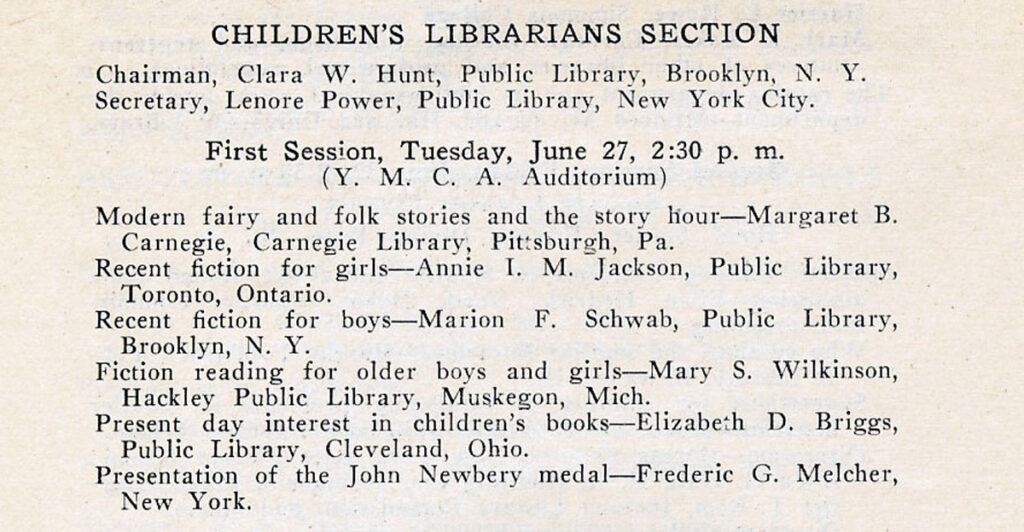
Agenda for the Children’s Librarians Section on June 27, 1922, including the first presentation of the John Newbery Medal.

The first John Newbery Medal was awarded to Hendrik Willem van Loon for his book, “The Story of Mankind,” in 1922 at the ALA Annual Conference in Detroit, Michigan. While the ALA Archives unfortunately does not have many records from the early days of the Newbery Medal, conference records provide an insight into how the first award ceremony went.

The Newbery was presented on June 27, 1922, during the Children’s Librarians Section’s session at the conference and was listed as the last item on the section’s agenda for the day. Despite the lack of a banquet or formal event, the presentation drew a crowd. The conference proceedings on the event open with: “Interest in awarding the John Newbery medal brought a big audience to the first session of the Children’s Librarians Section. The hall was full to capacity, many people were turned away.”(2)

At the ceremony, Clara W. Hunt, chair of the Children’s Librarians Section, expressed the gratitude of the section to Melcher for his donation of the medal:

“I would I had the ability to express adequately the gratitude which we children’s librarians feel for the inspiration which prompted you to make this gift to the cause we love … We feel strong and powerful because you believe in us and you are putting in our hands a weapon, one of the most potent of our times—publicity of the best kind.”(3)

The description of the event closes with: “The enthusiastic applause which greeted Dr. Van Loon gave evidence of the appreciation and interest of the large audience.”(4) As seen from the conference proceedings, the Newbery was instantly well regarded, and the excitement of children’s librarians was obvious. Its initial acclaim was well deserved as the Newbery Medal has proven to be an enduring honor.
150 YEARS STRONG

THE OFFICIAL ANNIVERSARY BLOG

A Long Legacy

While ALA’s founding is technically in October, the staff at American Libraries put on their party hats early to celebrate ALA’s 150th year with a plethora of Association and library history-related stories in the magazine’s May 2026 issue.

ALA posters

Posters of Progress: Mapping ALA’s History Through Library Poster Art

From wartime appeals to celebrity-studded reading campaigns, library posters have long captured the evolving role of libraries in American life. This feature traces ALA’s history through some of its most iconic visuals. Together, these images chart a story of the profession’s unflinching ideals of access, literacy, and intellectual freedom, showcasing how libraries continue to reimagine their place in public life.

An index card tracking an ALA conference exhibition hall exhibitor from 1924-1947.

The Heartbeat of the Hall: 150 Years of Exhibitors Who Shaped Our Conference

Every year as the doors of ALA’s Annual Conference and Exhibition swing open, the exhibition hall comes alive. It is a ritual that has been repeated, refined, and reimagined throughout ALA’s 150-year history. And at the center of it all, providing the innovations, solutions, and partnerships that have propelled our profession forward, are the exhibitors. To mark this milestone, we look back at the rich history of exhibitors at the conference—where it began, how it grew, and why, 150 years on, the exhibition floor remains one of the most vital spaces in our professional world.

Librarian at the Reference Desk in Camp Johnston Library, from the ALA Archives.

Charles R. Green at Camp Johnston: ‘We Can Find Such a Man’

During the summer of 1918, Charles Green, a librarian from the Massachusetts Agriculture College, served as the Acting Librarian for Camp Johnston in Jacksonville, Florida. While his tenure was brief, the Charles R. Green Papers in the American Library Association (ALA) Archives reveal Green’s rapid appointment and promotion. It also shows how quickly circumstances could change within the ALA’s Library War Service and the adaptability of its volunteers.

Detail of letter from Lynn Blaylock to the Intellectual Freedom Committee.

‘Nothing Could Have Astonished Me More’: The Challenge of Consumer Reports

Due to communist hysteria before and after World War II, many organizations and publications were under suspicion of being affiliated with or promoting the Communist party, including Consumers Union, publisher of Consumer Reports, the product testing and consumer advocacy magazine. As a result, Ohio schools banned the use of Consumer Reports in the classroom. While the ban was short-lived, the questions about it were not and the ALA Intellectual Freedom Committee noticed the attempts to ban the publication.