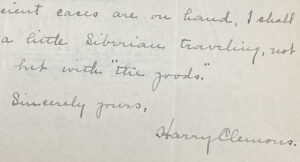
In 1926, during the 50th anniversary of the American Library Association (ALA), the Boston Public Library presented ALA with a scrapbook of letters, postcards, and documents tracing the origins of the Librarians’ Conference of 1876, the start of the association. The letters were kept by Melvil Dewey and Justin Winsor, prominent organizers of the conference, and later assembled into a scrapbook by someone at the Boston Public Library (BPL) in 1877, where Winsor had served as superintendent.[1] Preceding ALA’s 50th anniversary, Charles Belden, then director of BPL, convinced the BPL trustees to have the scrapbook rebound and transferred to ALA during its anniversary celebrations, for which Belden was the presiding president.[2]
The scrapbook remained with ALA Headquarters and served as key historical source for the beginnings of ALA. Professor Edward G. Holley, librarian and library historian, was tipped off to the existence of the scrapbook by William L. Williamson, who used it for his biography of librarian William F. Poole. Apparently, Williamson had told Holley that “access to the room where [the scrapbook] was kept was through the men’s room in the old Cyrus McCormick mansion, then the A.L.A. headquarters.” Though Holley noted that the scrapbook was in an exhibit case when he visited headquarters to use it in the 1960s and in a 1968 memo, ALA staff placed the scrapbook in a safe within the accounting department.[3] Holley borrowed the scrapbook from Headquarters, taking it to him to Texas, and transcribed many of the letters, including shorthand notes, in his 1967 book, Raking the Historic Coals: The ALA Scrapbook of 1876.
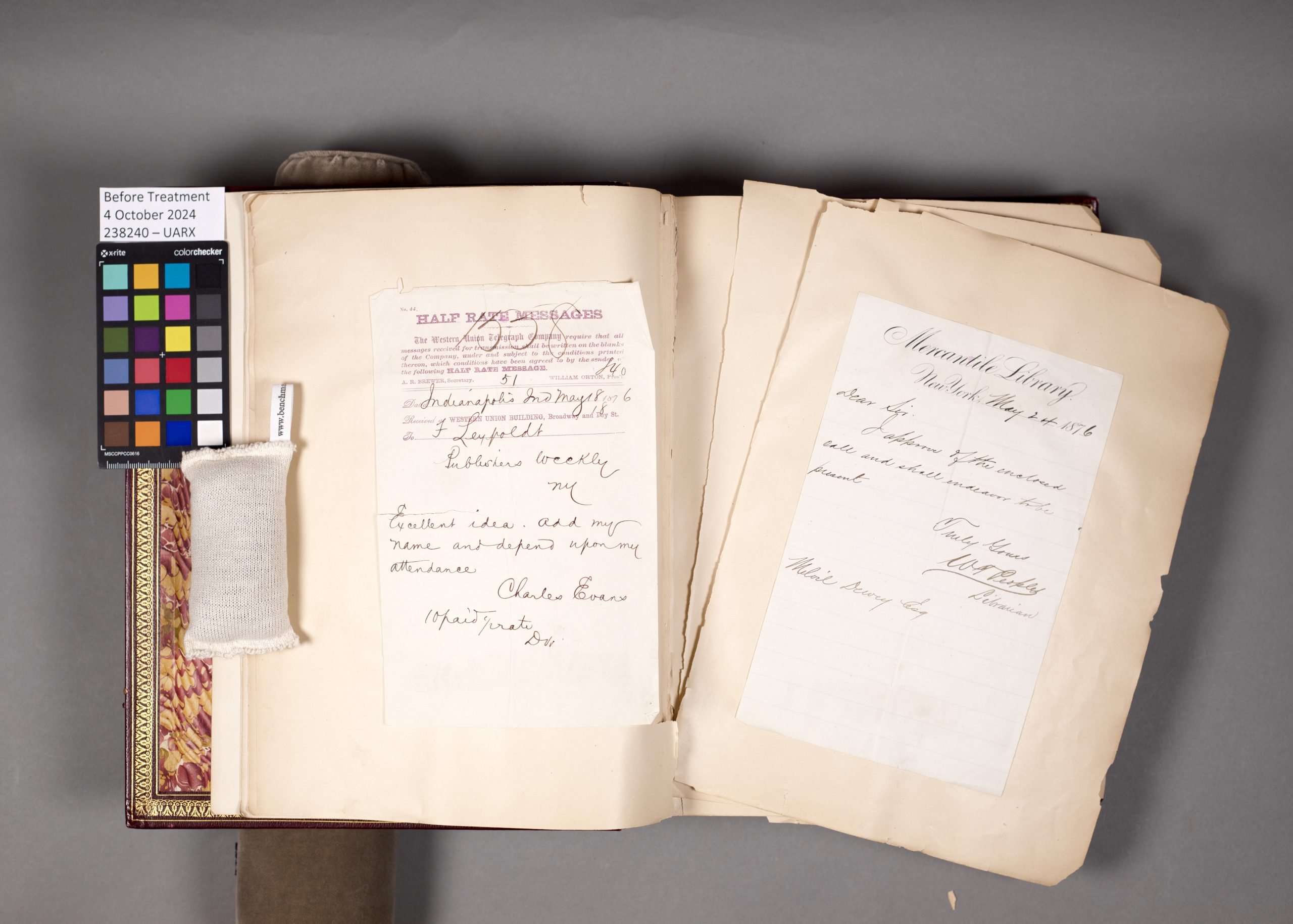
After Holley returned the scrapbook, it remained at ALA Headquarters until 2013, when it was transferred to the ALA Archives at the University of Illinois. This piece of ALA history has largely been inaccessible due to the deteriorating condition of the object with pages becoming detached from its binding and past repairs failing. A former archives assistant observed the condition of the item and the various conservation interventions it had gone through:
[The scrapbook] provides tangible evidence of the history of preservation/conservation in library science. When the letters were first glued into a bound volume in 1926 that represented the best practice in preservation/conservation at the time, and there are many instances of attempting to repair the papers with scotch tape, showing even experts didn’t know the damage it would do; and when the book was microfilmed that represented the best method of preserving information at that time.[4]
The ALA Library and Archives attempted to outsource the scrapbook for conservation treatment, but the cost was prohibitive, and the project never got off ground.
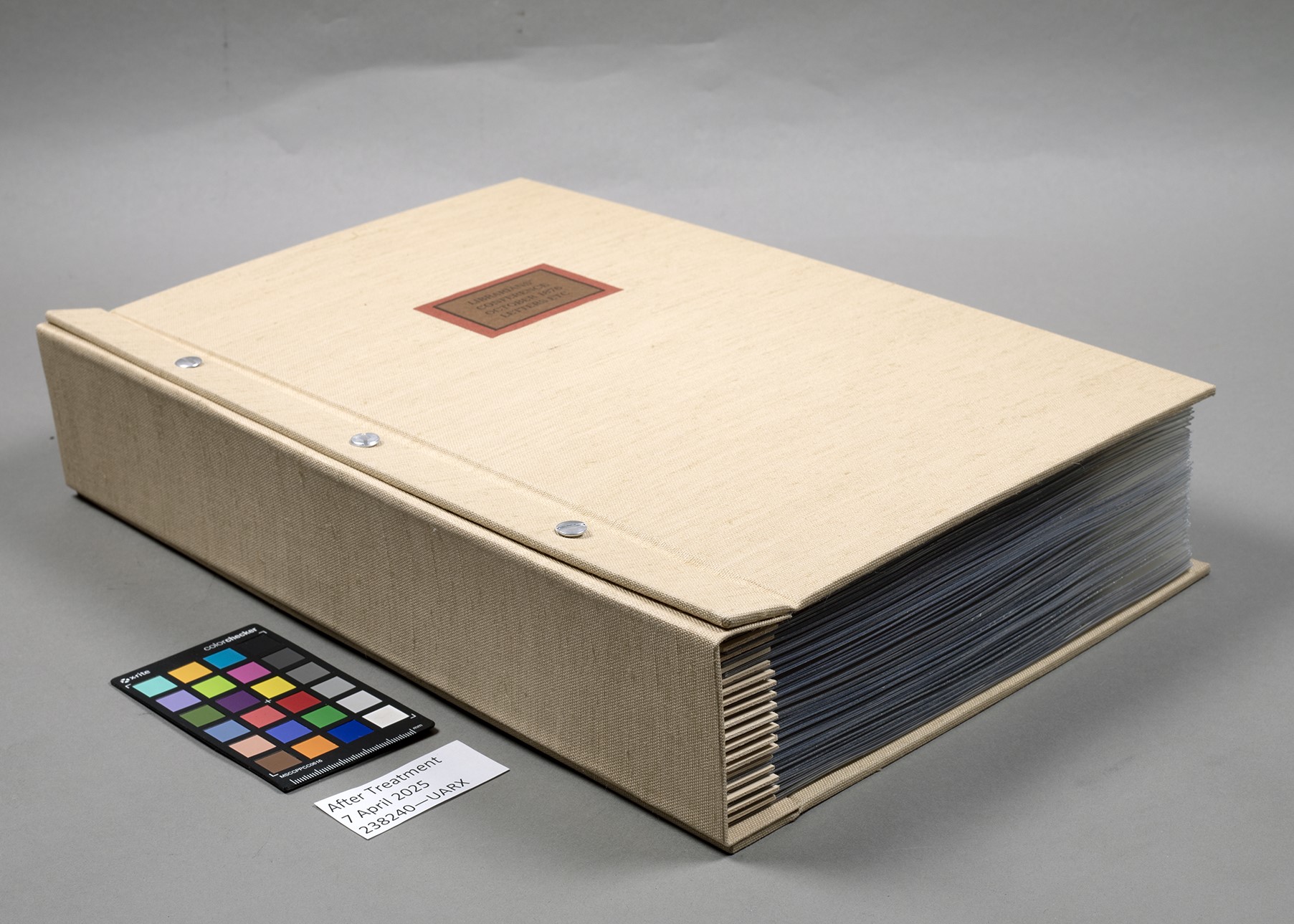
In 2023, the ALA Archives and the Conservation Unit at the University of Illinois Library initiated discussions about getting the scrapbook treated. The conservation staff decided to take up the challenge of treating the nearly 150-year-old scrapbook. In the summer of 2024, a conservation treatment plan was agreed upon, and work could start on the scrapbook. The project was led by conservator Jody Waitzman and over 26 hours of labor was spent cleaning, mending, encapsulating, and rebinding the scrapbook pages.[5] While the contents of the scrapbook could not remain in the 1926 binding, both the original binding and slipcover were retained as separate objects for research purposes.
Once the conservation treatment for the scrapbook was completed in the spring of 2025, it was transferred to the University Library’s Digitization Services, where digital imaging specialist Rachael Johns took the lead in digitizing the scrapbook. With the pages now in a detachable binding, the documents could be safely photographed without further damaging them.
The result of all this effort is a scrapbook that can be safely handled and a high-quality digital copy available to the public in time for ALA’s 150th anniversary. Holley’s book, Raking the Historic Coals, remains an important resource in putting the materials in their historic context and transcribing some very intimidating looking shorthand writing.
The ALA Archives staff are grateful for the hard work of the University Library’s Conservation Unit and Digitization Services, particularly Jody Waitzman and Rachael Johns. Without their skills and expertise, the original documents would have remained inaccessible.
The scrapbook is available online in the University Library’s Digital Library.

[1] Edward G. Holley, Raking the Historic Coals: The ALA Scrapbook of 1876, (Beta Phi Mu, 1967), x.
[2] Ibid, x-xi
[3] Ibid, xi and Ruth M. White to David Clift, January 24, 1968, found in Subject File, 1928-2018, RS 18/1/5, Box 2, Folder: ALA Archives, Reports Concerning, 1948-1971, American Library Association Archives.
[4] Denise Rayman to Karen Muller, email, July 11, 2014.
[5] “Treatment Report – Librarians Conference Scrapbook, May-October 1876,” April 2025, University of Illinois Library, Conservation Unit.
This story originally appeared on the American Library Association Archives blog on October 13, 2025.