150 YEARS STRONG

Call for Proposals: Shape ALA’s 150th Anniversary Conference

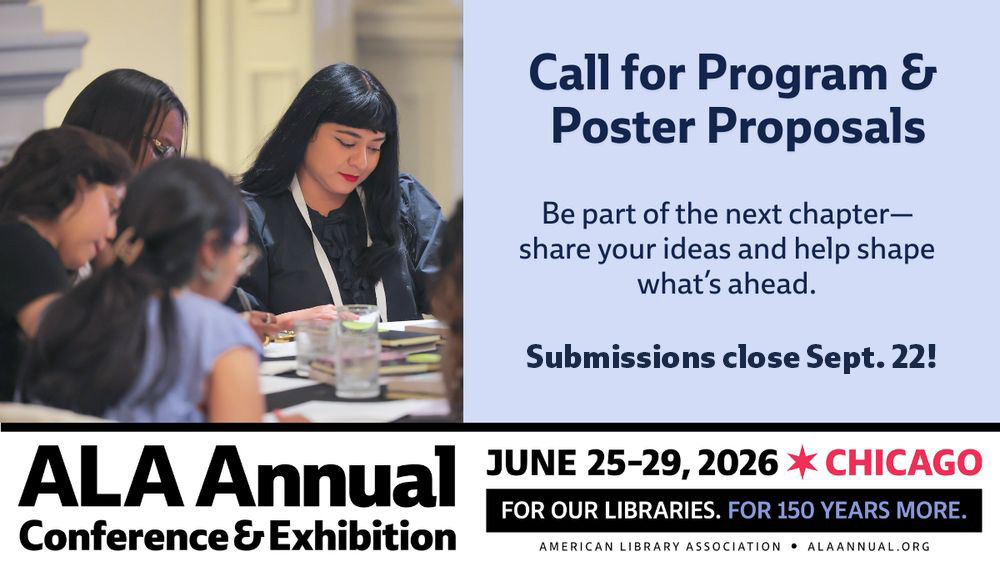
Promotional image for the ALA Annual Conference & Exhibition in Chicago, showing several attendees at a discussion table. Text invites submissions for program and poster proposals, with a deadline of September 22. The conference dates are June 25-29, 2026, celebrating 150 years of the American Library Association.

The ALA 2026 Annual Conference & Exhibition, June 25–29, 2026, in Chicago, Illinois will be a milestone event marking ALA’s 150th Anniversary. The Annual Conference explores key challenges and opportunities facing libraries, with professional development rooted in timely research, innovation, and best practices. For the 2026 conference, programming will include a broad variety of perspectives that celebrate, commemorate, or educate about the impact that ALA and our affiliate partners have made on the profession and on libraries nationally and internationally over the last 150 years – or will make in the next 150 years. An ALA 150th tag will be used to designate programs that fall into this content category.

Opportunities to contribute to Annual programming include proposing education programs or posters, organizing preconferences, in partnership with an ALA office or division, coordinating President/Chair programs, and more. ALA accepts a wide variety of program, meeting and event submissions for Annual Conference.

We invite member groups to discuss opportunities to engage around the 150th anniversary and consider submitting ideas to enhance our programming. There are two engagement opportunities currently open: education programs and posters.

Education programs are 60 minutes in length, which may include 10-15 minutes of Q & A. There are nine proposal juries to choose from when submitting a proposal: one of ALA’s eight Divisions or the ALA jury (which includes representation from Round Tables, Offices, and Affiliates).

Poster sessions include six poster categories, and poster presenters share their posters as part of a 90-minute session.

Visit the ALA 2026 Annual Conference website for more information, including submission guides and links to the submission sites.

Both submission sites will close on Monday, September 22 at 11:59PM Eastern.

Be on the lookout in November for other ways to participate, including Meetings and Events, Ticketed Events (includes preconferences and tours), President/Chair Programs, and Now Showing films.


150 YEARS STRONG

THE OFFICIAL ANNIVERSARY BLOG

Colleen Barbus, librarian and archivist for the ALA Library in Chicago. Photo: Lauren Ehle

A Library for Librarians

Since ALA headquarters moved in 2020 to its present location at Chicago’s 225 North Michigan Avenue, ALA Librarian Colleen Barbus has presided over a completely reimagined in-house library.

A library worker helps a patron at the reference desk of Detroit Public Library, circa 1976. From the ALA Archives.

The Librarians’ and Library Workers’ Bill of Rights

During the American Library Association’s (ALA) 2026 Annual Conference in Chicago, ALA Council passed a resolution calling for the adoption and recognition of the Librarians’ and Library Workers’ Bill of Rights, a landmark framework affirming the dignity, safety and professional rights of library workers across all sectors.

Linderfelt

Mr. Linderfelt’s Trouble, Part One: ALA’s Lost President

In 1892, Klas August Linderfelt, the first librarian of Milwaukee Public Library (MLP), was arrested for embezzling $4,000. The arrest came as a shock to the library profession. Not only was Linderfelt the head of MLP, but he was also the president of both the American Library Association and the Wisconsin Library Association. And that’s just the beginning of this wild tale.

dList home page

The Future of Librarians: dLIST, a Story the Commons Keeps

The history of the Digital Library of Information Science and Technology (dList), the library field’s first open access disciplinary repository for Library and Information Science scholarship, shows what happens when a profession’s stated values and its institutional choices diverge at a technological inflection point.