Transformational technology, consortia agreements, increasing awareness of social justice issues in the field, and the forging of new services have characterized the last 50 years of librarianship. Librarians filed cards in catalogs in 1976 and now they develop metadata for discovery systems.
Who were the people who facilitated these changes?
The Library History Round Table (LHRT) promotes awareness and discussion of historical issues in librarianship. In service of its mission, members decided to provide an opportunity to reflect on the profession’s history and those who have shaped its mission, values, and legacy.
I began writing tributes about library workers as a series of posts on ALA Connect in fall 2024 to help celebrate the Association’s sesquicentennial with the hope that others would join in doing so. ALA members were asked to submit memorials through ALA Connect.
A LHRT committee coordinated by Brett Spencer, editor of LHRT News and Notes, formalized the “Librarians We Have Lost Initiative (1976–2026): A Sesquicentennial Memorial Project” as a crowd-sourced initiative developed to honor the memory, service, and professional contributions of librarians, educators, and library workers over the past 50 years.
Dozens have done so. A digital memorial site collecting these tributes was posted at LHRT News and Notes.
Because the project attracted such great interest, LHRT committee member Dr. Anita Coleman authored a resolution submitted to ALA Council that was passed at the 2025 ALA Conference recognizing the “Librarians We Have Lost initiative” as an integral part of ALA’s Sesquicentennial commemoration (ALA CD 54 Resolution to Honor the Contributions of Librarians Commemorated.pdf).
The committee worked with ALA Archivist Cara Setsu Bertram, ALA Librarian and Archivist Colleen Barbus, and ALA Interim Associate Executive Director, Institutional Advancement, Programs, and Partnerships Melanie Welch to create a permanent site at the ALA Institutional Repository. LHRT Chair Jennifer Schatz Bartlett provided support and counsel.
At this writing more than 100 memorials have been contributed, and we will continue adding to this memorial. These tributes to our professional forebearers have timeless, intrinsic value. The tributes also help us find our way through the present and into the future. As William Faulkner wrote, “The past is never dead. It’s not even past.” The librarians of the past actively shape libraries today and, as the future unfolds, we can join with them in memory to advance our field.
- We can join with E.J. Josey, who fought against segregation, as we go about social justice work.
- We can join with Henriette D. Avram at the Library of Congress who replaced ink-on-paper card catalogs and revolutionized cataloging systems at libraries worldwide.
- We can join with William Katz, who authored the textbook that generations of reference librarians studied, by applying and expanding his theories and practices of reference service into new digital realms.
- We can join with director of the Research Libraries at New York Public Library, Paul Fasana, who in retirement was chief archivist of the Stonewall National Museum and Archives in Fort Lauderdale, Florida.
- We can join with Carma Russell (Zimmerman) Leigh, State Librarian of California, who lobbied Congress for federal funding of public libraries.
The Library History Round Table, “Librarians We Have Lost:(1976–2026): A Sesquicentennial Memorial Project” Committee is proud to participate in ALA’s 150th celebration. We invite you to submit a tribute about an inspiring library worker who passed away in the past 50 years by completing the form at https://lhrt.news/librarians-we-have-lost-sesquicentennial-memories-1976-2026-2/.
Questions or comments can be directed to me (klmccook@gmail.com) or Brett Spencer (dbs21@psu.edu).
The Committee: Anita Coleman, Susan K. Martin, Kathleen de la Peña McCook, and Brett Spencer.
Kathleen de la Peña McCook is Distinguished University Professor of Librarianship at the School of Information, University of South Florida.
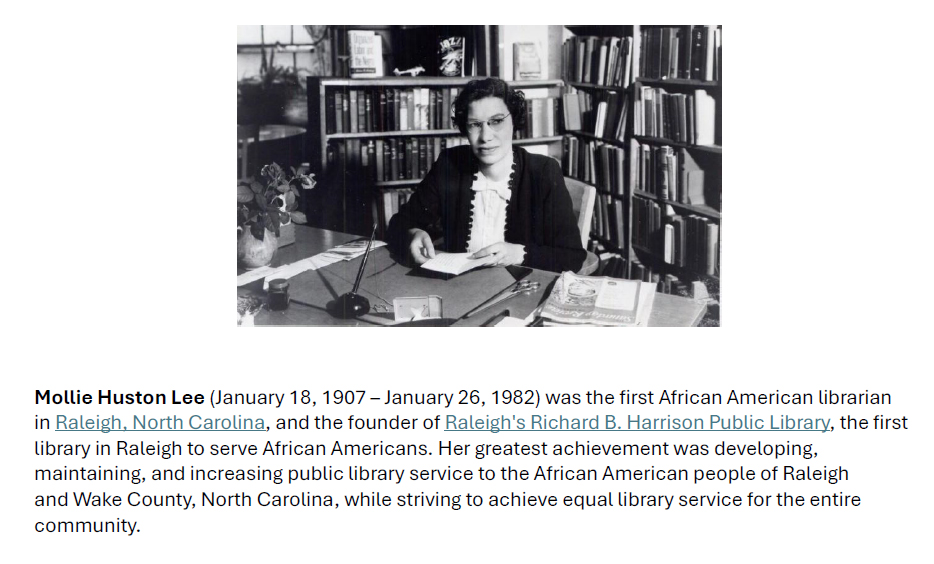
Photo: Librarian Mollie Huston Lee, from the ALA Archives.