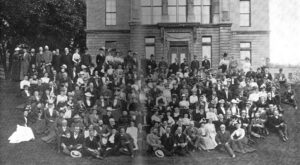
The convergence of women’s history and library history at the 1893 World’s Columbian Exposition heralded the beginnings of a tradition of advocacy that would shape our profession for the next 100 years and beyond. As American women entered librarianship in the late 19th century, they focused on issues of professional equity, on services to women among the general public, and on the importance of preserving the history and writings of women themselves.
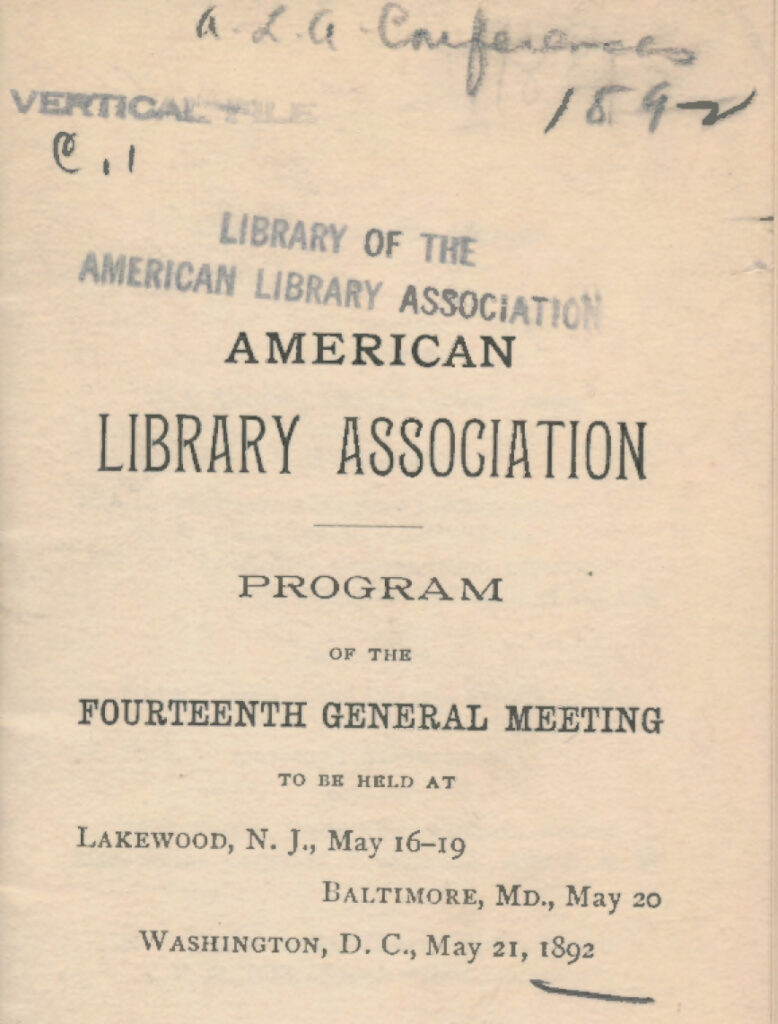
We may think this activism began in the 1970s. Some may assume it began during the Progressive Era of the 1920s. But, in fact, this advocacy is documented at least as early as 1892, thanks to a wonderfully prescient article in the August 1892 Library Journal that describes a “woman’s meeting” at the 14th American Library Association (ALA) conference in Lakewood, New Jersey, likely motivated by the work already underway for the Woman’s Building Library. Belying the stereotype some may have of those early women librarians as complacent, those proceedings note that Mary Cutler presented the results of a salary survey she had undertaken, concluding that “women rarely receive the same pay for the same work as men.” As Lakewood conference drew to a close, a resolution was passed to appoint a committee to organize a Woman’s Section of the ALA. This strategy was as controversial then as it was decades later: Librarian Tessa Kelso wrote in November 1892 to object strongly to such a unit.
For whatever reasons, the movement to organize around women’s issues in ALA would not come to fruition until the second wave of the women’s movement in the late 1960s and early 1970s. By that time, an outpouring of feminist publishing and organizing was occurring in the United States and Great Britain, and the role of women in the professions took a definitive turn. Perhaps the signal event within ALA was the founding of the Task Force on Women (TFW) in 1970. The TFW became the incubator and instigator for a host of other committees and units across the Association that focused on such issues as professional status and employment equity, pay equity legislation, women administrators, services for women library users, racism and sexism in subject headings, collection development for the growing field of women’s studies, and women in technology. With the establishment of the Council-level Committee on the Status of Women in Librarianship in 1976, the TFW could declare a more activist role and renamed itself the Feminist Task Force. It continues to this day with a broad agenda that addresses women’s professional and political concerns across all types of library work.
The internationalism of the Woman’s Building in 1893 also marked a permanent trend in the profession generally, and in the organizing of women librarians specifically. ALA sought engagement with librarians in other countries from its earliest days, as did (separately) the American women’s movement. The international focus for women librarians continued to develop and went beyond simply working on individual projects and exchanges. This became most evident by the mid-1980s, when an array of women’s libraries were in existence and various national associations held recurring programs on related topics. The Round Table on Women’s Issues in the International Federation of Library Associations and Institutions was created in 1990, and currently IFLA’s Women, Information, and Libraries Special Interest Group promotes a strategic framework formed by the UN treaties, programs, and initiatives related to women and information to create a fruitful link between IFLA and relevant international organizations.
The Woman’s Library at the World’s Columbian Exposition achieved a milestone and was an impressive harbinger for the intersection of librarianship, women’s history, community service, public policy, and international relations.
This story was first published in American Libraries on February 29, 2012.
Sarah M. Pritchard, retired, was dean of libraries and Charles Deering McCormick University Librarian at Northwestern University in Evanston, Illinois.
Image from the ALA Archives.