An unabridged version of this post is available on the ALA Archives blog, and was originally published on November 18, 2024.
Almost 60 years ago, the Intellectual Freedom Committee (IFC) of the American Library Association needed a partner in their fight for intellectual freedom. The 1960s brought concerns about censorship, freedom of the press, the freedom to read – and the impact on librarians who sought to uphold the values within the Library Bill of Rights and the Freedom to Read Statement. The creation of ALA’s Office for Intellectual Freedom (OIF) became the solution, providing support and education on intellectual freedom to librarians and the public. Little did they know how vital the OIF would become to the fight against book challenges and censorship, and to the support of librarianship and the freedom to read everywhere.
At the 1965 ALA Midwinter Meeting, the IFC recommended the creation of an office devoted to furthering the ALA’s intellectual freedom activities and “…[supporting] the Library Bill of Rights with a special emphasis on defense against censorship action.” The proposal to create the Office for Intellectual Freedom was approved by the ALA Executive Board in June of that year, but the office didn’t open until December 1, 1967 due to funding issues. The extra time allowed for a clear set of duties and functions to be established for the office, and for a strong and visionary first director to be found.
Little did they know how vital the OIF would become to the fight against book challenges and censorship, and to the support of librarianship and the freedom to read everywhere.
The original proposal envisioned full-time legal counsel as part of OIF staff, to provide services to libraries on all levels in legal issues of intellectual freedom and censorship. While the actual initial staffing included just the director and her secretary, this legal support service did not disappear; rather, it became one of the core functions of the office. Other primary objectives included providing advisory services and disseminating information on intellectual freedom issues, liaising with the IFC and other related organizations, and assisting with tenure investigations related to intellectual freedom. The director was to assume a long list of responsibilities, chief among them to be “responsible for developing an information/education program to bring recognition to the ALA intellectual freedom position.”
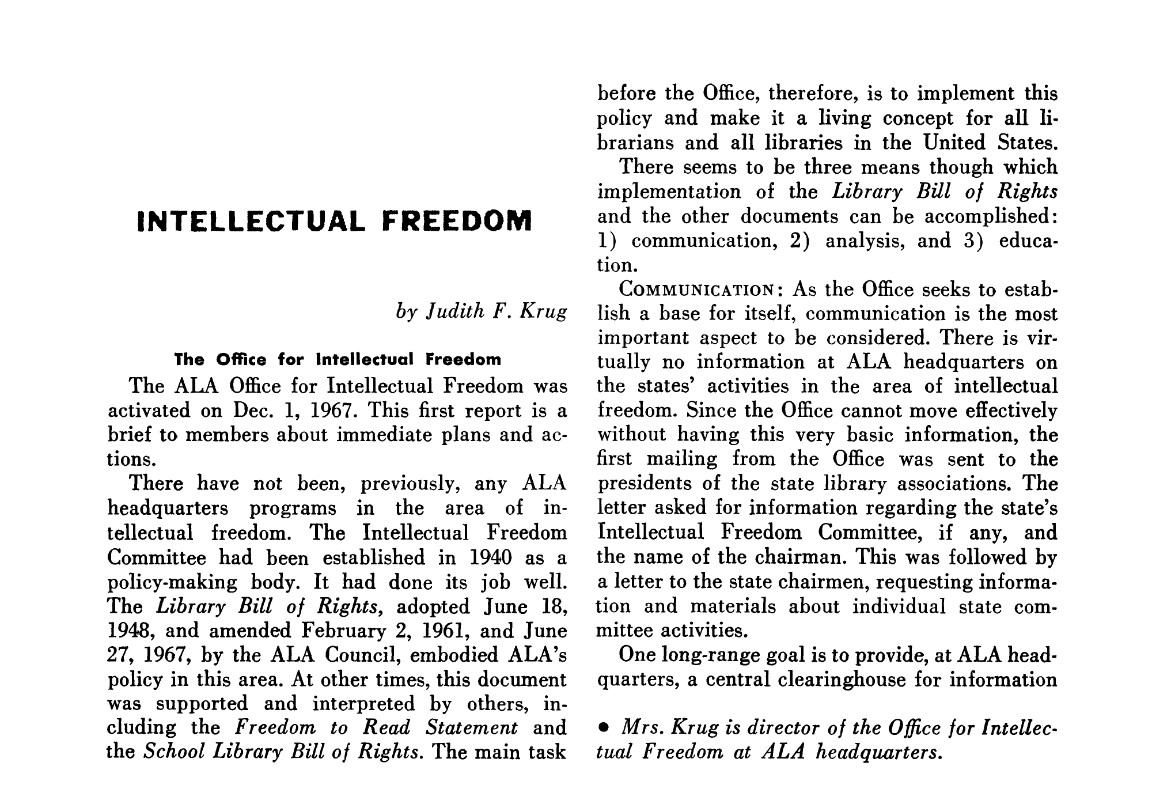
The first director of the OIF not only took on these responsibilities but also created the vision for what the intellectual freedom arm of the ALA is today. Judith Krug – originally a reference librarian and cataloger in Chicago, before becoming a research analyst for the ALA – was chosen to head the new unit in December 1967.
Becoming the OIF director at only 27 years old, Krug would go on to change the landscape of intellectual freedom in libraries. She served as executive director of the Freedom to Read Foundation from its inception in 1969, published numerous educational materials on intellectual freedom, fielded thousands (if not tens of thousands) of requests for consultation on censorship issues, and helped to establish ALA’s Banned Books Week.

In October 1967, the Presidential Commission on Obscenity and Pornography was created to evaluate the effect of obscene and pornographic materials on the public and provide recommendations on the regulation of such materials. The OIF, once established, was able to disseminate information about this commission to librarians. They connected with state library associations to urge bills on censorship of materials deemed obscene to be tabled in state legislatures, before the commission completed its study. Judith Krug wrote about similar bills and the ALA’s position on censorship in the monthly Intellectual Freedom column in the ALA Bulletin, providing current intellectual freedom news and resources to librarians across the country and highlighting that “the Association does not believe that any political or governmental body is qualified to determine what one person should or should not read.”
“The Association does not believe that any political or governmental body is qualified to determine what one person should or should not read.”
From its earliest days, the OIF shared information and assisted in policy creation on censorship issues, such as book challenges. By 1969, the office was receiving over a hundred requests for assistance with book or service challenges every month. It served as the administrative arm of the IFC, assisting with policy development and supporting and creating activities and publications – such as the Newsletter on Intellectual Freedom – in line with the committee’s goals. The office also connected with the intellectual freedom committees of 50 state library associations, providing them with news and resources in their monthly OIF Memorandum.
Starting out as a solution to a timely issue, the Office for Intellectual Freedom has developed for almost 60 years into a multifaceted and vital unit of ALA, providing support, education and resources to continue the fight for intellectual freedom in libraries.