Due to communist hysteria before and after World War II, many organizations and publications were under suspicion of being affiliated with or promoting the Communist party. One curious suspect of this scrutiny was Consumers Union, publisher of Consumer Reports, the product testing and consumer advocacy magazine. In the late 1930s, Consumers Union faced unsubstantiated accusations of communism.[1] Despite the fruitless claims, Consumers Union was placed on a list of subversive organizations by the House Un-American Activities Committee in 1944.
In 1951, representatives from the Better Business Bureaus drew attention to Consumer Union’s status on the House Committee’s list. As a result, Ohio schools banned the use of Consumer Reports in the classroom.[2] While the Ohio schools ban of the magazine was short-lived, the questions about it were not and the ALA Intellectual Freedom Committee (IFC) noticed the attempts to ban the publication.
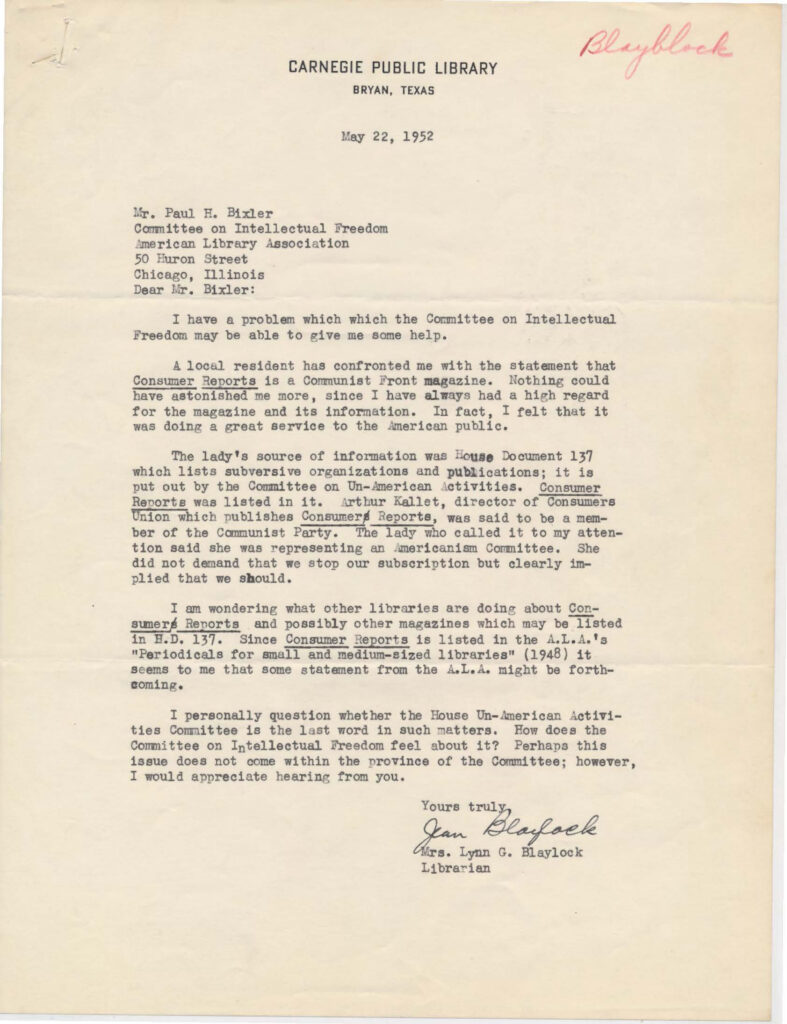
Lynn G. Blaylock, a public librarian in Bryan, Texas, was shocked when a patron confronted her about the supposed communist magazine. In 1952, she wrote to the IFC about the patron, who identified herself as a representative of an “Americanism Committee,” telling her that Consumer Reports was a Communist front. Blaylock noted, “Nothing could have astonished me more, since I have always had a high regard for the magazine and its information. In fact, I felt that it was doing a great service to the American public.”[3] Blaylock asked for more information about Consumers Union from the IFC as the patron took her complaint to the library board.
The IFC received inquiries from librarians from as far away as Hawaii, asking about the supposedly communist Consumer Reports. The committee provided librarians with information outlining the facts of the accusations against Consumers Union, concluding that “the case against Consumers Union is, at best, tenuous and without evidence of subversion.”[4] This wasn’t an endorsement of the publication, and the committee urged that library materials should be selected to fit local needs, recommending that “all librarians should resist the pressures of those who want to prevent American citizens from being informed.”[5]
In 1954, Consumers Union was successful in getting the House Un-American Activities Committee to remove them from the list, but questions about Consumers Union persisted. The IFC received a letter in 1956 from a high school librarian, Doris Carson, in McPherson, Kansas, about the publication. Carson wrote, “My vice-principal felt we might receive criticism if we were to continue to subscribe to Consumer Reports if Consumers Union is communist.”[6]
After the IFC reassured the high school librarian of the House Committee’s withdrawal of the Consumers Union from its list, Carson wrote back, “It is gratifying to us in the field to know we do not stand alone in problems of this sort, among others, but are sustained by the American Library Association through the good work of its committees.”[7]
Sources:
[1] ALA Committee on Intellectual Freedom, “Consumers Union Reports,” American Libraries 45, no. 9 (October 1951): 311-312.
[2] Paul Bixler, “Letter to Ohio Librarians on Intellectual Freedom,” August 10, 1951,
[3] Lynn G. Blaylock to Paul H. Bixler, May 22, 1952, series 69/1/5, Box 2, File: Correspondence, BA-BZ, 1952-56, folder 2, American Library Association Archives.
[4] “Consumers Union Reports,” 312.
[5] “Consumers Union Reports,” 312.
[6] Doris M. Carson to American Library Association, March 16, 1956, Box 2, File: Correspondence, CA-CZ, 1952-56, American Library Association Archives.
[7] Carson to ALA, March 16, 1956.
This story first appeared on the ALA Archives blog on March 29, 2024.