
In 1919, Herbert Hoover founded the Hoover War Library at Stanford University in response to the devastation he witnessed in Europe. Today, as archivists at the Hoover Institution Library & Archives, we encounter many collections related to World War I, but the dynamic photographs of librarians distributing reading materials to soldiers in our American Library Association (ALA) War Service records caught our attention and led us on an unexpected and informative journey.
To celebrate the ALA’s 150th anniversary and spotlight this collection, our team digitized these photographs and related pamphlets from our San Francisco Public Library Collection that add to our previously digitized ALA posters. We also curated a small public exhibit in the Hoover Tower Rotunda.
The Library War Service (LWS) was a brief but compelling chapter in ALA history. In a few short years, it organized book drives and fundraisers, built camp and hospital libraries, and mobilized librarians and reading materials to support the war effort at home and abroad. It also laid the foundation for library services and educational programs that continued long after 1918.
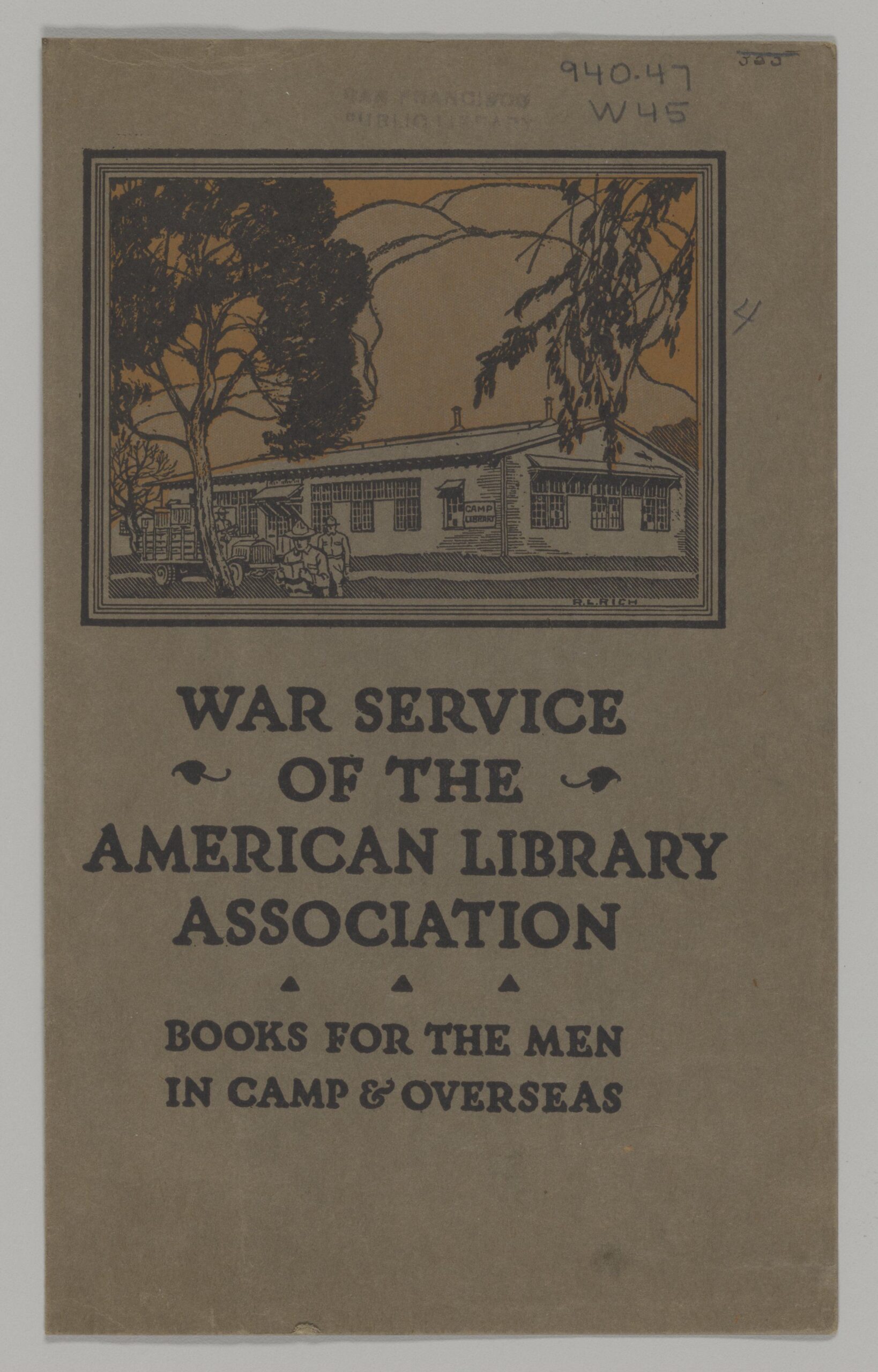
ALA librarian Theodore Wesley Koch (1871-1941) published on the ALA’s wide-ranging activities, including the 1918 pamphlet, “War Service of the American Library Association: Books for the Men in Camp & Overseas,” which we digitized for this project. In the expanded 1919 work, “Books in the War: The Romance of Library War Service,” Koch neatly summed up the LWS mission:
“In short, it has been the aim of the Library War Service to provide books and library facilities for American soldiers and sailors wherever they might be – at home, abroad, in camp, in the hospital, on shipboard, in out-of-the-way corners of the world, everywhere.”
In digitizing the ALA War Service records, we were amazed at the ALA’s far-reaching impact as it sent books across the United States and to all “corners of the world.” This blog highlights some of our key takeaways and favorite tidbits that we gathered along the way.
Military Hospital Libraries
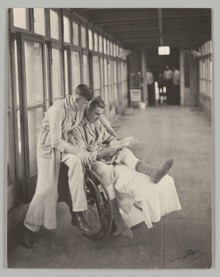
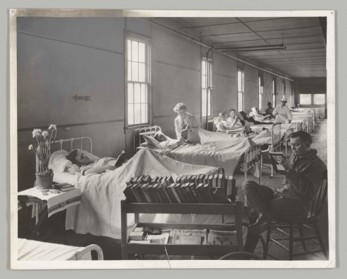
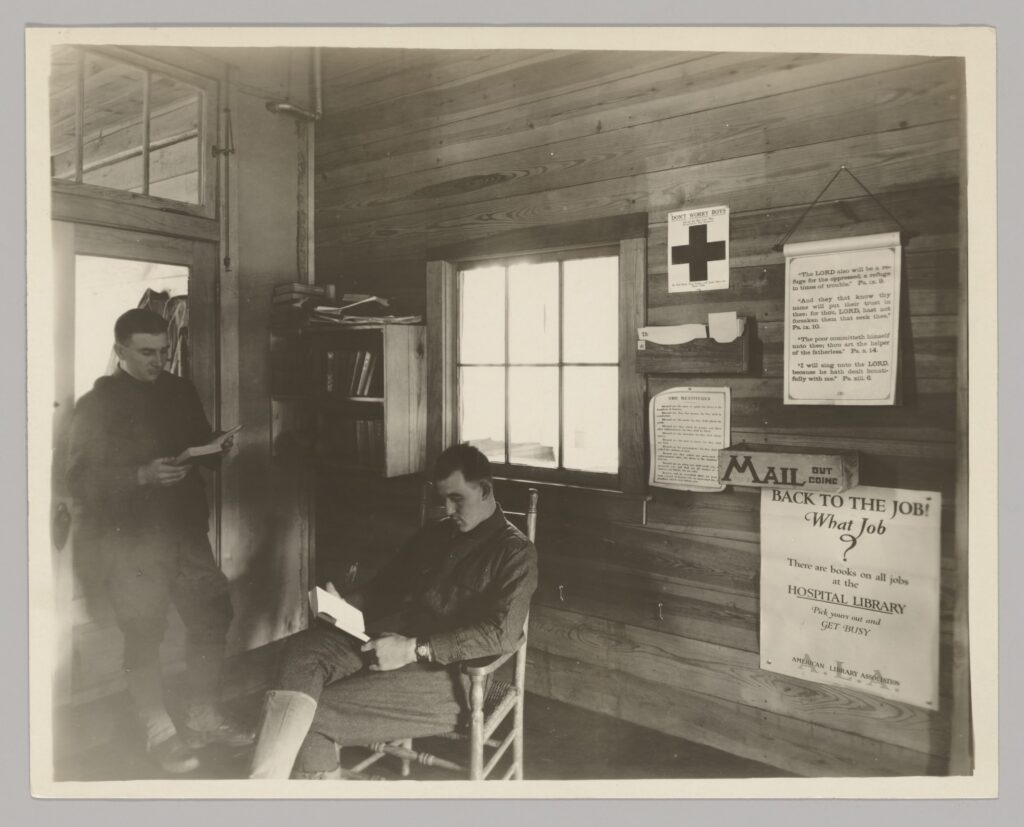
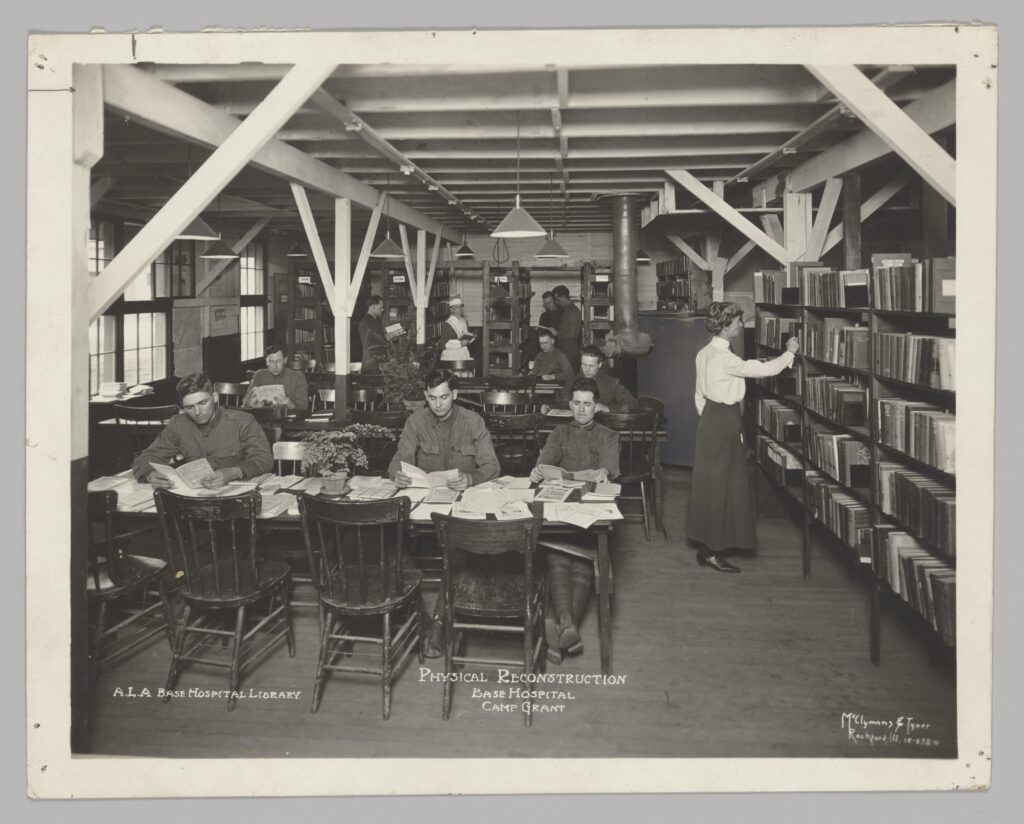
Beginning in 1918, the ALA worked with the Surgeon General’s Office, Department of the Navy, and Red Cross to support libraries in military hospitals. Previously, military hospitals received books from camp libraries and charitable organizations but lacked dedicated staff or resources to manage them. By 1920, the ALA sent full library collections to over 500 locations, including many military hospitals. Along with entertainment, many hospital libraries offered educational opportunities including basic literacy courses, technical or vocational training, and new Braille services to wounded soldiers, paving the way for future library programs.
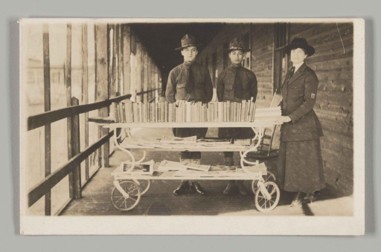
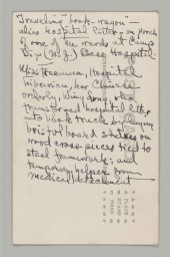
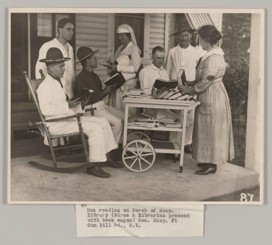
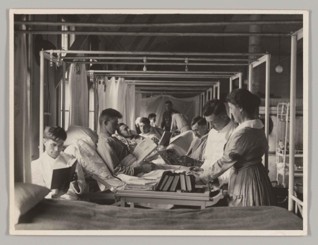
Military hospitals were primarily staffed by professional or volunteer women serving as librarians and nurses who had to improvise when it came to distributing reading materials. As they moved from bed to bed and ward to ward, librarians repurposed teacarts, children’s wagons, or shopping bags to bring books, newspapers, and magazines to patients who could not otherwise browse the shelves themselves. The handwritten note on a postcard featuring Marilla Waite Freeman (1871-1961) and hospital orderly Wing Dong in their ALA uniforms, for instance, explains that the latter resourcefully converted a hospital litter into a “traveling book wagon.”
Freeman was a professional librarian who joined the ALA in 1893 and later served as Head Librarian of Cleveland Public Library. In Books in the War, Freeman described one of her many memorable experiences as hospital librarian at Camp Dix:
“‘My ward visiting for the day was supposed to be over, but the rumor ran through the corridors that our first detachment of overseas wounded had at last arrived….One of the grand and glorious compensations of a busy hospital librarian is that she is welcome in any ward at all hours, so I couldn’t resist slipping over and into [Ward] 23. There they were, sure enough, many of them hobbling about in their overseas caps, trying to orient themselves. All kinds of crutches, canes, and slings limped up and gathered around, interested in my Library War Service uniform, new to them, though they all assured me they had had A.L.A. books in France. I told them how glad we were to see them back, and how happy that they had come to our particular hospital; showed them the books and magazines in the little ward collection, and promised to come back in the morning with a truckful of new books and papers.’”
This encounter underscores the impact that librarians and reading materials had on soldiers in military hospitals at home and stationed abroad.
ALA Books Overseas
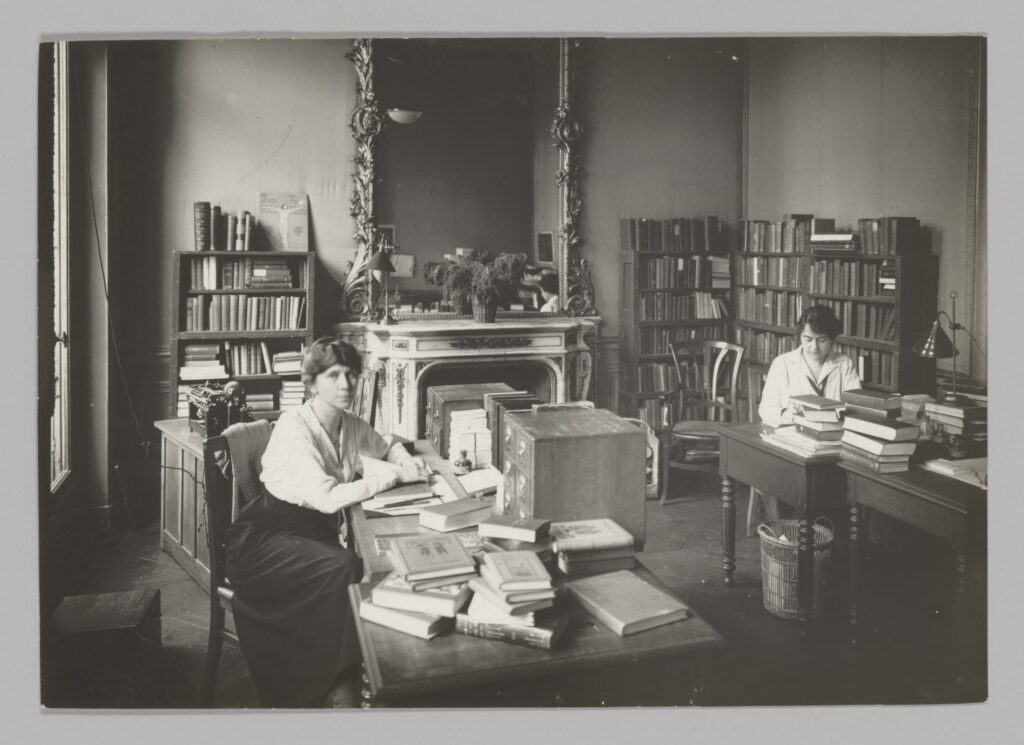
ALA books had a wide impact, even reaching soldiers in European trenches. In April 1918, the LWS opened its Paris headquarters, future American Library, under the direction of ALA librarian Burton Stevenson (1872-1962), who previously managed Camp Sherman library. By February 1919, the ALA had shipped 1.8 million volumes to France and created over 730 library centers in Europe. More than 50 ALA staff members working overseas rerouted books and magazines to hospitals, trenches, reserves, shelters, and training camps across France, England, Italy, Russia, and even POW camps in Germany.
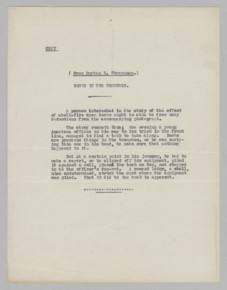
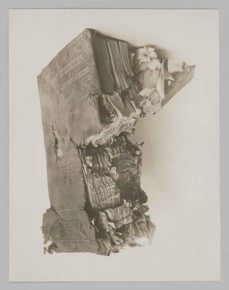
In a letter sent from France, Stevenson explained that reading materials were “precious things in the trenches,” and described the fate of one such book hit by a mortar shell when left in a trench by an American officer.
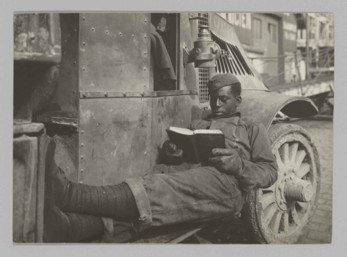
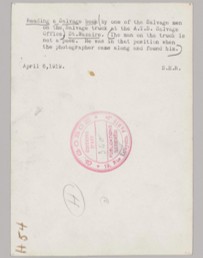
Journalists reported on soldiers in camps and trenches reading during moments of respite. An inscription on one photograph of an American soldier in St. Nazaire, France, emphasized that: “The man on the truck is not a pose. He was in that position when the photographer came along and found him.”
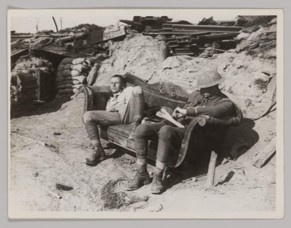
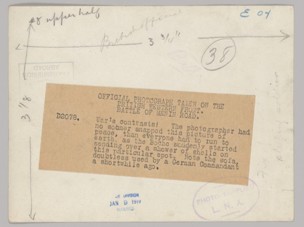
British soldiers also benefited from the ALA’s reading materials. One inscription describing British soldiers reading in a trench exclaims: “War’s contrasts! The photographer had no sooner snapped this picture of peace, than everyone had to run to earth…”.
While English library materials were prized by American and British soldiers in Europe where such materials were scarce, the ALA also circulated foreign-language materials in American libraries. As Freeman distributed reading materials in Ward 23, she noted that soldiers eagerly took everything until she was left with only “two old Greek newspapers.” A young soldier spotted them, exclaiming:
“‘Well, Greek is my language,’ said he, ‘and it’s a long time since I’ve seen a word of it. May I have them?’ And as he sank into the nearest chair and lost himself in the precious papers he murmured rapturously, ‘First Greek words I’ve seen in six months.’ This little incident… brought home to [her], as nothing else had, a realization of how many nationalities have gone into the making of America, and have poured out their blood, as stanch [sic] Americans, upon the fields of France.”
Reading for the Future
In “Books in the War,” Koch recapped the ALA’s contributions and interviewed librarians like Freeman and Stevenson to record their stories. His final chapter, “Reading for the Future,” then addressed what the Armistice could mean for the ALA’s future, for returning men and women who needed vocational training and employment support, for refugees seeking a fresh start, for underserved rural communities, and for the millions of books and dollars raised for the war effort. In short, he argued that these resources should now go to improving lives and libraries across the nation.
To emphasize this point, Koch concluded with a quote from Estonian labor journalist, scholar, and immigrant to the United States, Dr. Peter Speek:
“‘Who is going to lead such an extension of the libraries…? The national and state-wide library associations. As they have succeeded in extending the American library to the battle-fields of Europe, so without doubt they will succeed in the extension of the library to the firing-line in our own country– to the line where the future America is in the making.’”
As the ALA sought to redefine its purpose in 1919, Herbert Hoover was creating his War Library. Forty years later in 1959, Hoover shared his own vision for the future of the Hoover Institution Library & Archives, stating:
“The overall mission of this Institution is, from its records, to recall the voice of experience against the making of war, and by the study of these records and their publication, to…constantly and dynamically point the road to peace.”
Preserving and sharing the ALA Library War Service records represents this intersection between serving soldiers during the war, supporting the marginalized in its aftermath, and hoping to foster peace in the future.
What began as a casual interest in some compelling World War I photographs of librarians in military hospitals and soldiers reading in trenches led to a digitization project, a public exhibit, and a deeper understanding of the ALA’s impact on modern public library services. Although these LWS activities took place over a century ago, they continue to resonate with the ALA’s modern mission: “Empowering and advocating for libraries and library workers to ensure equitable access to information for all.”
Bibliography
All photographs are part of the American Library Association War Service records, Hoover Institution Library & Archives, unless otherwise noted. For a complete list of available photographs arranged by geographic location, please see our finding aid. This collection is digitized and is available online.
“ALA 150 Timeline: 1917,” ALA, accessed October 26, 2026, at https://ala150.org/.
“ALA Mission Statement,” ALA, accessed October 26, 2026, https://www.ala.org/aboutala/missionpriorities.
“The Hoover Story,” Hoover Institution Library & Archives, accessed November 7, 2026, https://www.hoover.org/about/hoover-story.
Cramer, C.H. “Open Shelves and Open Minds: A History of the Cleveland Public Library.” Cleveland: The Press of Case Western Reserve University, 1972. Accessed from Internet Archives, https://archive.org/details/openshelvesopenm0000cram/mode/2up.
Koch, Theodore Wesley. “Books in the War: The Romance of Library War Service.” New York: Houghton Mifflin Company, 1919. Accessed from Internet Archives, https://archive.org/details/booksinwarromanc00kochiala/mode/2up.
Koch, Theodore Weseley. “War Service of the American Library Association: Books for the Men in Camp & Overseas.” Washington D.C.: A L.A. War Service, Library of Congress, 1918. Accessed from San Francisco Public Library collection, Hoover Institution Library & Archives, Box 6 : Folder 5, digital: https://n2t.net/ark:/54723/h3h12vn01
Young, Arthur P. “Books for Sammies: The American Library Association and World War I.” Pittsburgh, Pa.: Beta Phi Mu, 1981.
Woirol, Greg. “Peter Speek and Migratory Labor: An Estonian Revolutionary Finds the Real America.” The Journal of the Gilded Age and Progressive Era 4, no. 3 (2005): 293–313.
Amanda Robb is a Chinese Language Materials Archivist and Sarah Ainsworth is an Archivist at The Hoover Institution Library and Archives at Stanford University.