150 YEARS STRONG

Call for a Library Conference: The 1876 ALA Conference

In March 1876, an anonymous letter was sent to the London publication, Academy, noting that it was strange “that no attempt should have been make to convene a Congress of librarians.” The letter was then reprinted in Publishers’ Weekly by Frederick Leypoldt and mentioned again in an issue of the Nation. From there the idea picked up momentum, drawing the attention of highly regarded librarians such as Melvil Dewey.

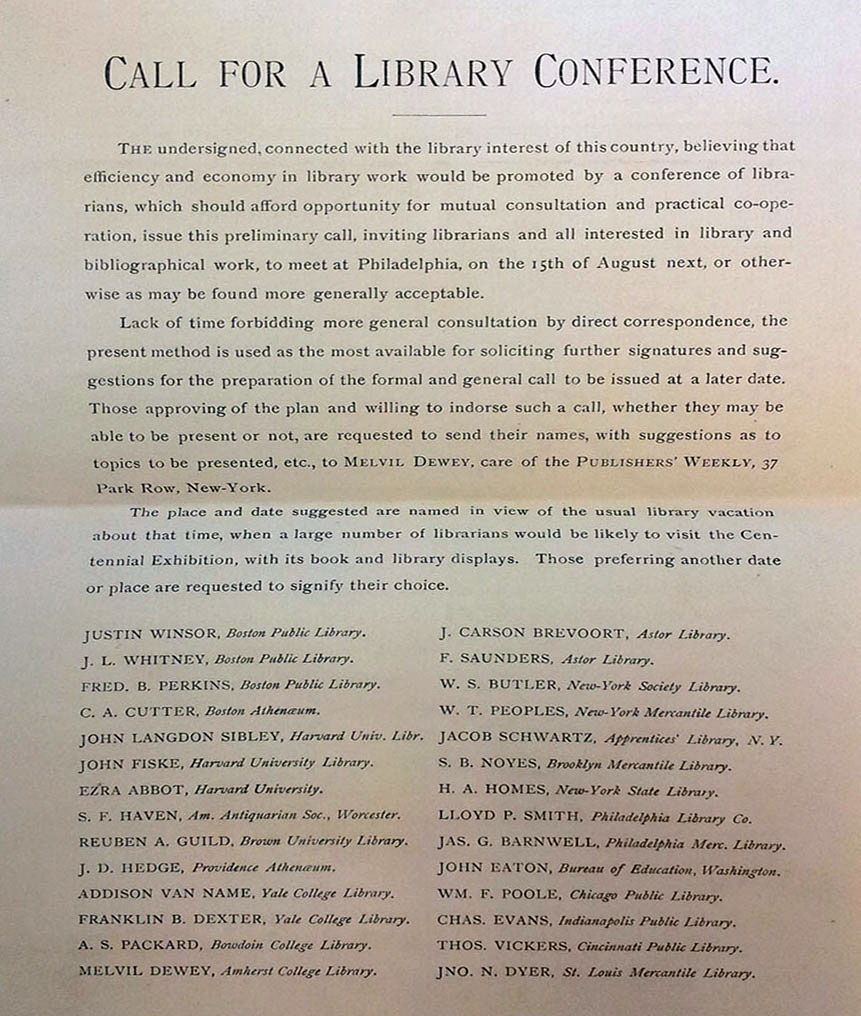
Conference organizers placed a “Call for a Library Conference” in various journals. Although the first call was met with varying degrees of support, by the time a second call was circulated in July, the idea garnered more enthusiasm and prominent librarians – initially hesitant to add their names – threw in their support.

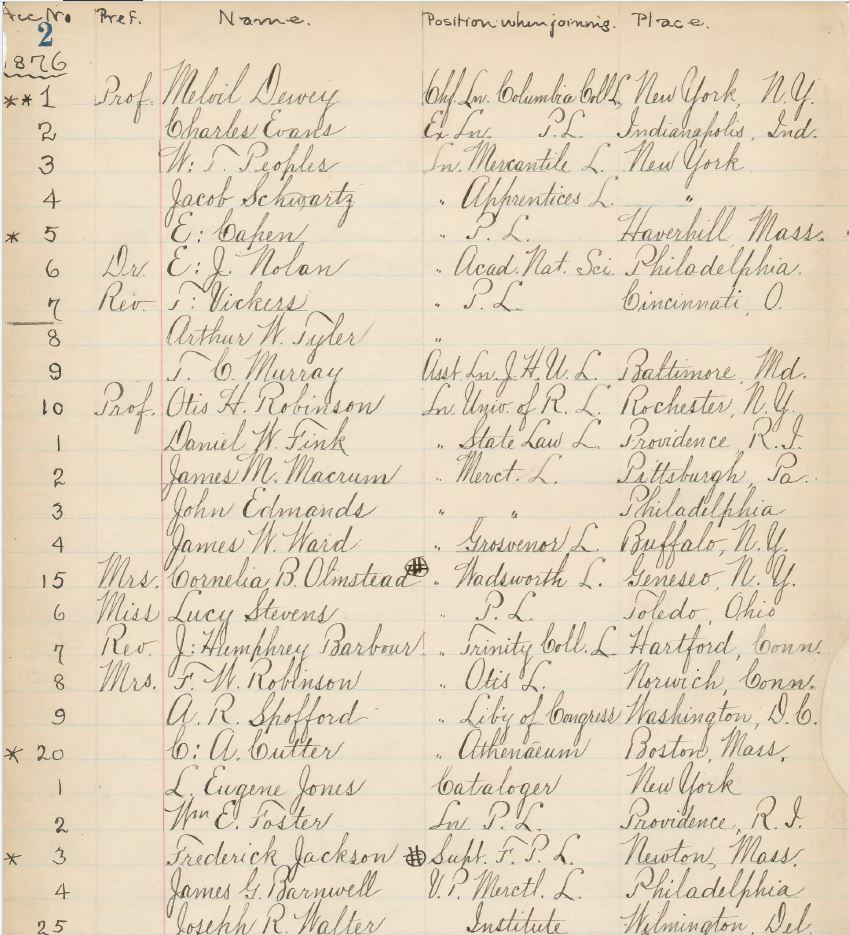
The conference was held October 4-6, 1876, at the Historical Society of Pennsylvania in Philadelphia. Hosted during Philadelphia’s Centennial Exposition, the conference boasted 103 librarians in attendance and provided an opportunity for librarians to exchange ideas. Dewey introduced his cataloging system, Samuel S. Green advocated for closer relationships between librarians and the public, and Lloyd P. Smith lauded the qualifications of a librarian, “A librarian should be a veritable helluo librorum, a devourer of literature from his youth up, consumed by an insatiable thirst for knowledge, and interested in a wide range of subjects.”

“A librarian should be a veritable helluo librorum, a devourer of literature from his youth up, consumed by an insatiable thirst for knowledge, and interested in a wide range of subjects.”

A resolution was passed to form the American Library Association on the final day of the conference, and a Committee on Permanent Organization put forth a constitution for a permanent association. James Barnwell, director of the Mercantile Library Company of Philadelphia, motioned for the following preamble to be added to the constitution:

“For the purpose of promoting the library interests of the country, and of increasing reciprocity of intelligence and good-will among librarians and all interested library economy and bibliographical studies, the undersigned form themselves into a body to be known as the American Library Association.”

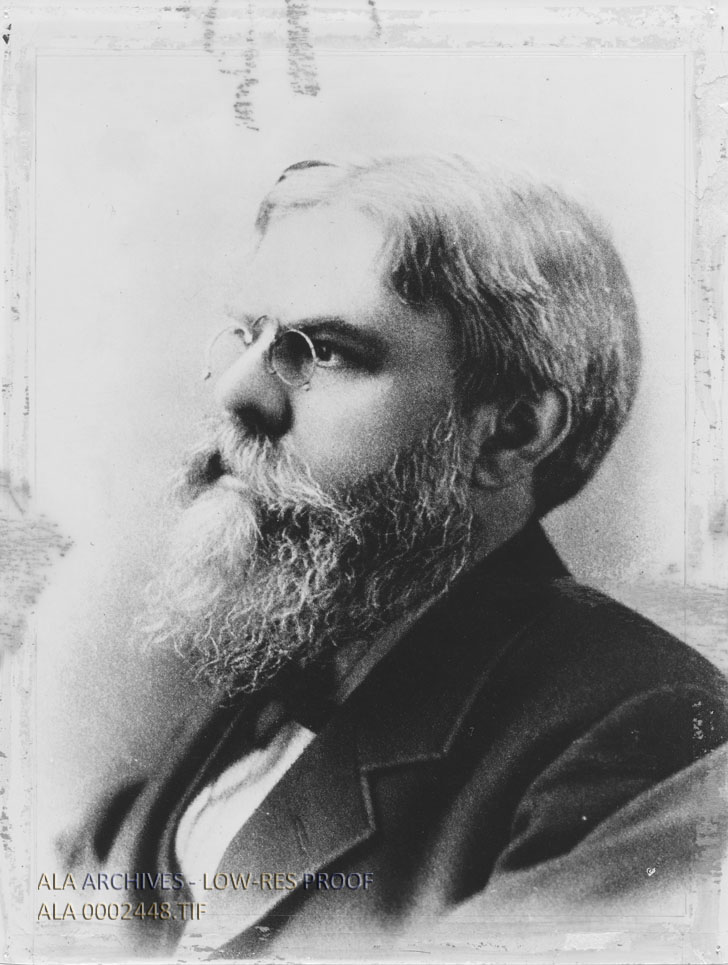
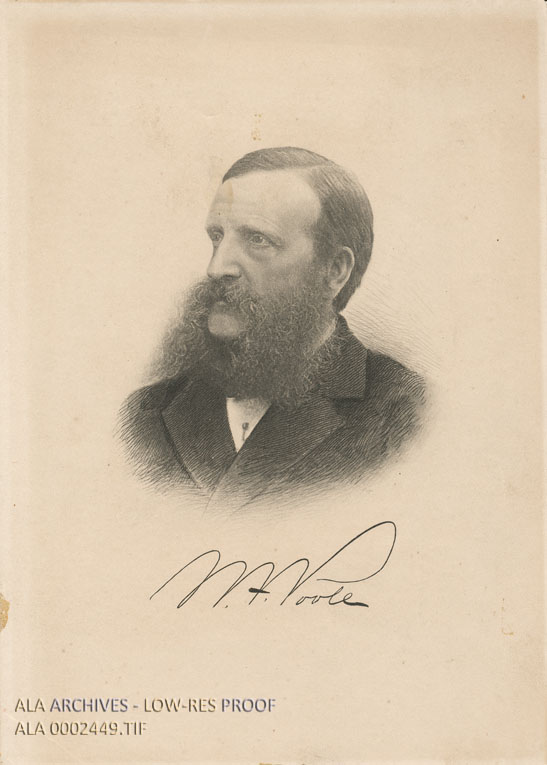
A list of officers was established for the new association, with Justin Winsor as the first ALA president; A.R. Spofford, William Poole, and Henry Homes as the vice-presidents; and Melvil Dewey was named as secretary and treasurer. Their primary function was to organize and call future meetings, though one of the first things Winsor did as president, on the behest of Dewey, was establish a Committee on the Size of Books.

The proceedings of the 1876 conference concluded with, “And thus ended, with pleasant words and good cheer, the Centennial Conference of Librarians.”[5] With this optimistic conclusion to the conference, the founding members of the ALA achieved what the attendees of the 1853 Librarians’ Convention had failed to do; create a permanent professional library association. Still, in 1876, these librarians could not have imagined the enormity of their actions or even that the association would persist 150 years later.

An unabridged version of this post is available on the ALA Archives blog, and was originally published on June 24, 2016.

150 YEARS STRONG

THE OFFICIAL ANNIVERSARY BLOG

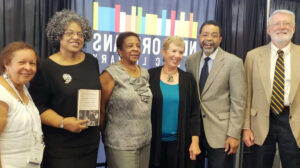
(Left to right) Teri Moncure Mojgani, Joan Mattison Daniel, Ethel Adolphe, Shirley Wiegand, Ibrahim Mumin, and Wayne Wiegand at the panel discussion on “Hidden Figures in American Library History: The Desegregation of Public Libraries in the Jim Crow South,” New Orleans Public Library, June 24, 2018.

Desegregating Public Libraries: The Untold Stories of Civil Rights Heroes in the Jim Crow South

On Sunday, June 24, 2018, the governing Council of American Library Association passed a historic resolution that “apologizes to African Americans for wrongs committed against them in segregated public libraries” and commends those “who risked their lives to integrate public libraries for their bravery and courage in challenging segregation in public libraries and in forcing public libraries to live up to the rhetoric of their ideals.”
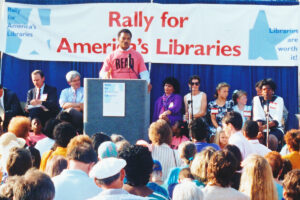
Jesse Jackson speaking at the Rally for America's Libraries in front of a large crowd

Jesse Jackson and a Legacy of Library Activism

Throughout his life of activism and public service, Rev. Jesse Jackson consistently championed libraries as centers of knowledge where individuals and communities can learn about their past, present, and future.
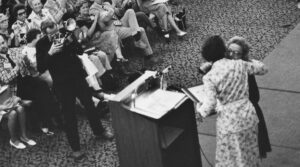
Clara Jones embracing Virginia L. Jones, after V. Jones received an Honorary Membership of ALA during the 1976 ALA Conference.

Clara S. Jones: ‘Awareness is Not Burdened with Repression; It Is Liberating’

During the 1975 American Library Association Annual Conference, Clara Stanton Jones was announced as the vice president and president-elect of the American Library Association. Her term as president would start during ALA’s 1976 Centennial Conference, a fitting celebration for the first African American President of the Association.
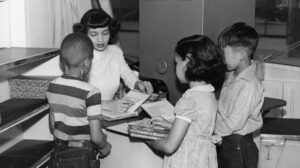
Action, Not Reaction: Integrating the Library Profession

In the midst of the Civil Rights era in America, librarians were battling for and against segregated libraries in the South, however they were also battling over integration within their own ranks. Integration of the library profession was a long process that started in the early 20th century.
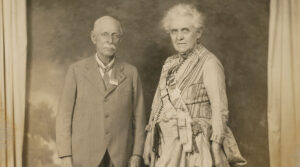
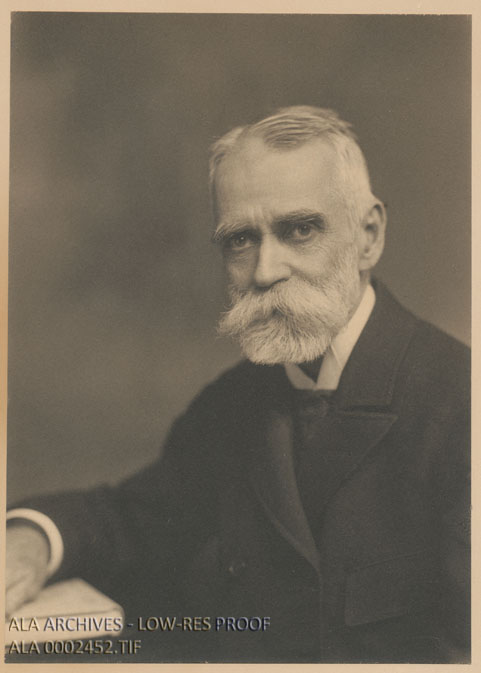
Henry and Edith Carr

Henry and Edith Carr, ALA’s Golden Couple

With Valentine’s Day approaching, we remember possibly the most famous ALA couple of all time, Henry and Edith Wallbridge Carr. Married for 43 years and active in ALA for even longer, the Carrs were well-known within the library community of the late 19th and early 20th century. Where did their romance begin? At an ALA conference, of course!