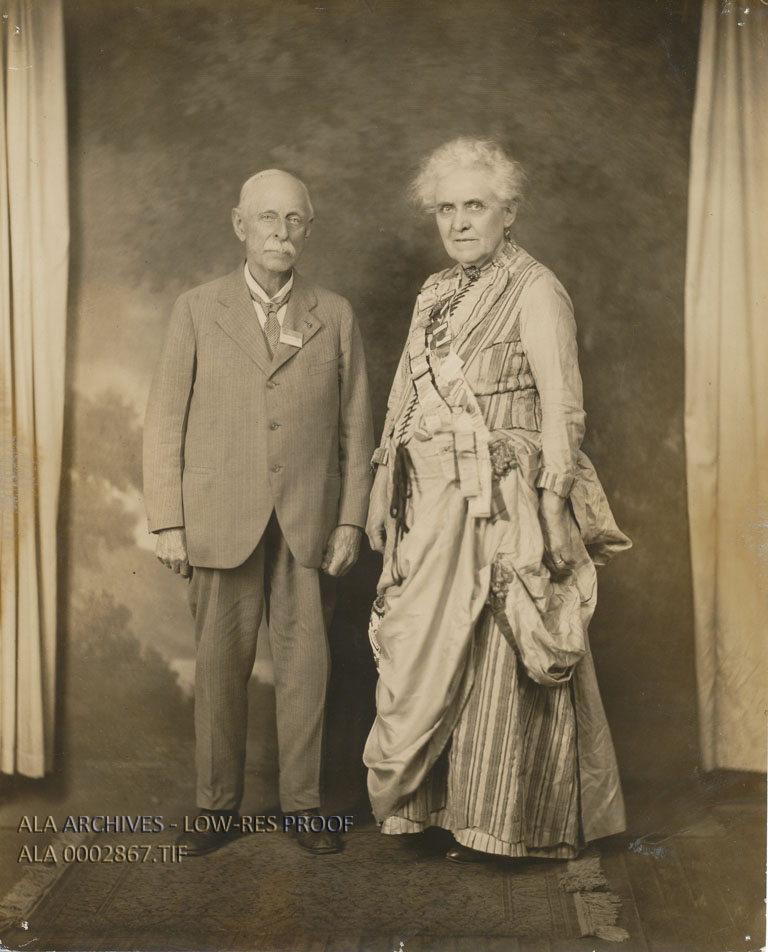
With Valentine’s Day fast approaching, we can’t help but think of love. The spirit of the holiday compels us to remember possibly the most famous American Library Association (ALA) couple of all time, Henry and Edith Wallbridge Carr. Married for 43 years and active in ALA for even longer, the Carrs were well-known within the library community of the late nineteenth and early twentieth century. Where did the romance of these two librarians begin? At an ALA conference, of course!
Henry J. Carr did not begin his career as a librarian. However, while studying law at the University of Michigan, Carr attended library courses. He must have been taken with the field, as he became member 215 of the American Library Association in 1879, the same year that he was admitted to the bar. He continued attending ALA conferences in the years following, while working as an accountant, and did not start his career in librarianship until 1886.[1]
D. Edith Wallbridge, just three years after graduating from Hillsdale College, was appointed as the first Assistant State Librarian of Illinois (today, this is the Director position). She became ALA member 448 in 1882. Upon marriage, Mrs. Carr resigned from her position with the state of Illinois but remained active in the library community and professional organizations for the rest of her life.[2]
The first ALA Annual that both Henry Carr and Edith Wallbridge attended was in 1883.[3] There was no conference in 1884, but both attended the 1885 conference.[4] By the next conference they were a married couple: the Carrs were married on May 13, 1886, in Sangamon, Illinois. The story goes that the two met at one of these early conferences and soon fell in love. One contemporary source credits Edith Wallbridge, “whom Mr. Carr first met as he strayed into a library conference,” with bringing Henry Carr into the profession and encouraging his loyal service in the ALA, while retaining her own agency to continue her activities in the field.[5] The president of the ALA in 1924, Judson Toll Jennings, told a slightly different story. He said of the conference meeting, “several young men found a certain young lady so attractive that Mr. Carr considered it advisable to close a contract there and then.”[6]
Around the time of their marriage, Henry Carr became librarian of the Grand Rapids Public Library. He facilitated the opening of the St. Joseph (Missouri) Public Library in 1891, before the couple moved east to Scranton, Pennsylvania. Carr assisted in the establishment of the Albright Memorial Library, where he served as the first librarian until his death in 1929.[7]
For decades, Mr. and Mrs. Carr served ALA with distinction. Henry Carr served as treasurer (1886-93), recorder (1893-95), vice-president (1895-96), secretary (1898-1900), and president (1900-01) – every position that someone could fill in the ALA at the time.[8] He held the record for number of conferences attended, 42, at the time of his death in 1929.[9]
Edith Carr was the unofficial statistician and antiquarian of the ALA, having prepared the Honor Roll of Attendance at Conferences from 1876 to 1940 and the necrology of members for annual publication.[10] Evidence of her good recordkeeping still exists in the American Library Association Archives, such as the Carr Conference Record Book, 1886-1940 (RS 5/1/23). She was additionally involved in many genealogical organizations and compiled two genealogical reference works. For her dedication and over half a century of service to the field of librarianship, Edith Carr is known as the “great-grandmother of the ALA.”[11] She attended 42 conferences in her lifetime and was the oldest member of the ALA when she passed away in 1940.[12]
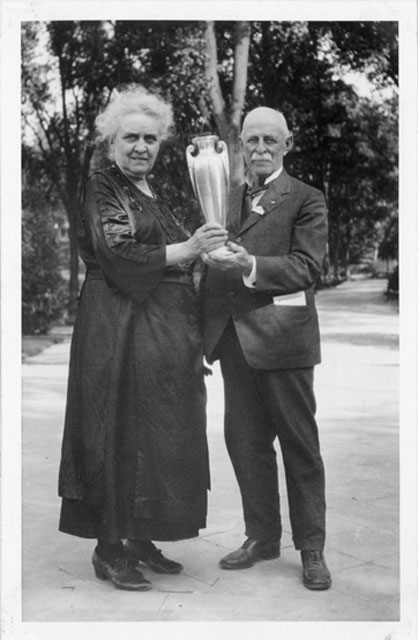
The couple was honored by the ALA in 1924 with a loving cup, with an inscription that read: “To Mr. and Mrs. Henry J. Carr, in admiration of lasting loyalty and many years of modest, devoted and helpful service. From many fellow members of the American Library Association.”[13]
[1] Frederick L. Hitchcock, History of Scranton and Its People, (New York City: Lewis Historical Pub. Co., 1914), 254.
“A. L. A. News,” Bulletin of the American Library Association 22, no. 7 (1928): 253, https://www.jstor.org/stable/25686857.
[2] “Edith Wallbridge,” Illinois State Library Heritage Project, Illinois Secretary of State, accessed February 7, 2025, https://www.ilsos.gov/departments/library/heritage_project/home/chapters/a-look-at-the-early-librarians/edith-wallbridge/.
[3] “List of Persons Present,” Papers and Proceedings of the Sixth General Meeting of the American Library Association (August 1883), Record Series 5/1/2, American Library Association
Archives at the University of Illinois at Urbana-Champaign.
[4] “List of Persons Present,” Papers and Proceedings of the Seventh General Meeting of the American Library Association (September 1885), Record Series 5/1/2, American Library Association
Archives at the University of Illinois at Urbana-Champaign.
[5] [Editorial Notes], Library Journal 49, no. 14 (1924): 679, https://hdl.handle.net/2027/mdp.39015036909672.
[6] “General Sessions—Proceedings,” Bulletin of the American Library Association 18, no. 4A (1924): 144, http://www.jstor.org/stable/25686291.
[7] Frederick L. Hitchcock, History of Scranton and Its People, (New York City: Lewis Historical Pub. Co., 1914), 254.
[8] [Handbook], Bulletin of the American Library Association 4, no. 4 (1910): 535–6, http://www.jstor.org/stable/25684905.
[9] “A. L. A. News,” Bulletin of the American Library Association 23, no. 7 (1929): 213, https://www.jstor.org/stable/25687014.
[10] Cora M. Beatty, “Mrs. Henry James Carr,” ALA Bulletin 35, no. 1 (1941): 22, http://www.jstor.org/stable/25690657.
[11] “Edith Wallbridge.”
[12] “Around the State,” Illinois Libraries 22, no. 10 (1940): 6, http://www.idaillinois.org/digital/collection/p16614coll20/id/5263.
[13] “General Sessions—Proceedings,” 145.