
150 YEARS STRONG

ALA’s 150 in United States’ 250: Democracy in the Making

ALA’s sesquicentennial history, as a part of the United States’s semiquincentennial, reflects the striving of people committed to libraries and democracy. Our history reflects how we as an association have grappled with, sometimes faltered, and at other times made inroads toward being a more inclusive ALA. 

There was a persistence of pervasive segregation and discrimination in the decades prior to the Civil Rights Movement in the 1950s. We failed in 1936, when ALA’s Annual conference was held in segregated Richmond, Virginia, which caused 25 Black librarians to be subjected to serious racial discrimination. But by the end of the decade ALA had begun to address the issue through the formation of its Committee on Racial Discrimination. The work of such pioneers as Dr. E.J. Josey, Eric Moon, Effie Lee Morris, Clara Stanton Jones (ALA’s first African American President, 1976–1977), and many others paved the way for broadening democratic values over the decades through policy work and modifications of crucial documents such as the Library Bill of Rights. In 2020, ALA issued a press release that acknowledged its role in upholding unjust systems of racism and discrimination against Black, Indigenous, and People of Color (BIPoC) within the association and the profession. We subsequently made inroads to build a more inclusive Association with the foundation of the ALA Spectrum Initiative in 1998. 

Maria McCauley
Maria McCauley, Director of Libraries at Cambridge (Mass.) Public Library and ALA President.

Through the vision of ALA Executive Director Elizabeth Martinez (1994–1997) and ALA President Dr. Betty Turock (1995–1996), 27 years ago, ALA launched its Spectrum Scholars program, and since then, more than 1,600 diverse masters’ and doctoral students have been able to pursue library fields as a career. Graduates of this program include Tracie Hall, ALA Executive Director (2020–2023), Cindy Hohl, ALA President (2024–2025), who was the first ALA presidential Spectrum Scholar alumna, me as ALA President (2026–2027), and President-Elect Tamika Barnes (2027–2028 presidential term). This history is vital to acknowledge as we continue to stretch toward our mission of empowering and advocating for libraries and library workers to ensure equitable access to information for all.

Similar to the many libraries our members serve, ALA is an essential organization that is fundamental to upholding our nation’s democracy. When we uphold our mission and values, we preserve and make accessible our diverse histories, safeguard the American people’s right to government information and patron privacy, fight for net neutrality, support fair use and balanced copyright protections, and protect First Amendment and human rights. Our history also includes being one of the founders of the International Federation of Library Associations and Institutions (IFLA) in 1927. Over the past couple of years, through deliberative, member-led work, we have updated our core values: access, equity, intellectual freedom and privacy, public good, and sustainability.

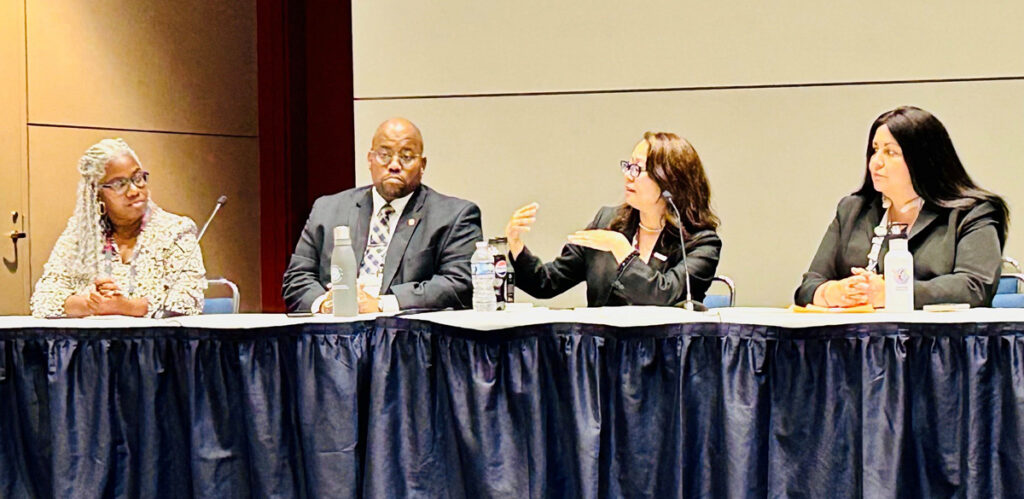
Tamika Barnes, Associate Dean, Perimeter Library Services at Georgia State University; Aaron Wilson, Serials/Government Information Cataloging Librarian at University of Maryland; Maria McCauley; and Cindy Hohl, ALA Immediate Past President, at the “Spectrum Scholar Alumni Share Leadership Stories” panel at the 2026 ALA Annual Conference in Chicago.

As a membership body, ALA will continue to debate how we interpret and undertake our priorities and advance our work. Beyond ALA’s current strategic plan, it will be vital to imagine ALA’s future, the future of libraries, and the future of LIS education. We need to consider how ALA’s work connects and maps with other organizations that are advancing libraries. While we no longer have the Center for the Future of Libraries, sources of inspiration may be found in these reports: “New EU report: the multiple roles of public libraries should be recognised and reinforced,” “The future of futures in libraries: Updated Trend Report,” and “Libraries 2045: What Will the Next 20 Years of Libraries and AI Look Like?”

ALA’s deliberative process is aspirational, important, imperfect, and makes for an evolving association. ALA’s work at 150 is inextricably intertwined with the work of advancing the United States of America’s 250 and libraries across the globe. We are a vital part of democracy in the making.

150 YEARS STRONG

THE OFFICIAL ANNIVERSARY BLOG

Harry Clemons signature.

Harry Clemons: The ALA in Siberia

During World War I, most ALA-operated libraries were stationed in U.S.-based military camps. However, a small number of librarians were sent overseas to help distribute books and run libraries. Harry Clemons was one such librarian.

Colleen Barbus, librarian and archivist for the ALA Library in Chicago. Photo: Lauren Ehle

A Library for Librarians

Since ALA headquarters moved in 2020 to its present location at Chicago’s 225 North Michigan Avenue, ALA Librarian Colleen Barbus has presided over a completely reimagined in-house library.

A library worker helps a patron at the reference desk of Detroit Public Library, circa 1976. From the ALA Archives.

The Librarians’ and Library Workers’ Bill of Rights

During the American Library Association’s (ALA) 2026 Annual Conference in Chicago, ALA Council passed a resolution calling for the adoption and recognition of the Librarians’ and Library Workers’ Bill of Rights, a landmark framework affirming the dignity, safety and professional rights of library workers across all sectors.