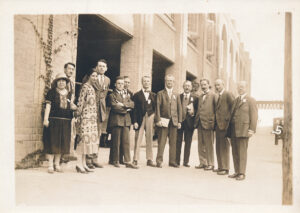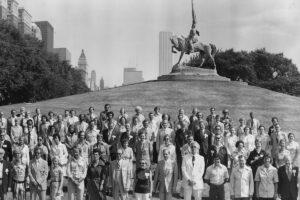
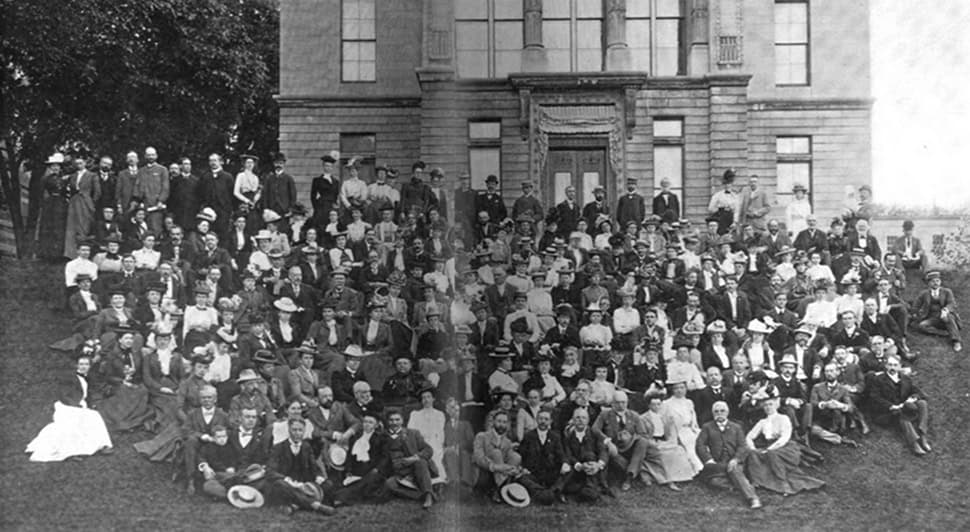
Attendees of the American Library Association (ALA) Annual Conference in Montreal, Canada, visited the campus of McGill University on June 9, 1900. It was the first ALA conference held outside the United States. Among its accomplishments were the establishment of an informal Club of Children’s Librarians, which laid the groundwork for a Children’s Section that was the forerunner of the Association of Library Services to Children division; and the formation of a Canadian Library Association, which ultimately became the Ontario Library Association.
In 1899, Melvil Dewey, a founder of ALA and the director of the New York State Library, gave a gender-bending address at an international library conference on “The Ideal Librarian.” He said a great librarian should “have a head as clear as the master in diplomacy; a hand as strong as he who quells the raging mob or leads great armies on to victory; and a heart as great as he who, to save others, will, if need be, lay down his life.” Dewey concludes, “when I look into the future, I am inclined to think that most of the men who will achieve this greatness will be women.”
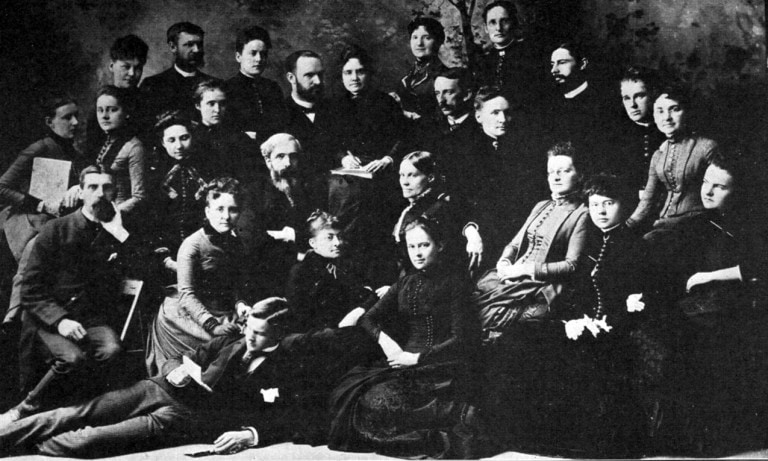
Dewey had established the world’s first school of library instruction anywhere at Columbia College (now Columbia University) in 1887. The day before it opened on January 5, administrators informed Dewey that he could not use classrooms for co-ed instruction, as it was not permitted, so he cleared a storeroom in the library to use as an instructional space. The first class enrolled 20 students (17 women, 3 men). The photo on the right shows the students and faculty from that first class. Top row: Annie Eliza Hutchins, Eliza S. Talcott. Second row: Kate Bonnell, Frank Chauncey Patten, Janey Elizabeth Stott, Melvil Dewey (faculty), Florence Woodworth, George H. Baker (faculty), Frances S. Knowlton, Walter Stanley Biscoe (faculty), Lilian Howe Chapman, Lillian Denio. Third row: Mary Salome Cutler (faculty), Harriet Sherman Griswold, Annie Brown Jackson, May Seymour, Richard F. Armstrong (honorary), Mrs. George Watson Cole (honorary), Mrs. Annie Dewey (honorary), Eulora Miller, Harriet Converse Fernald. Fourth row: George Catlin, Mary Wright Plummer, Martha Furber Nelson, Harriet P. Burgess. Reclining: George Watson Cole.
In 1884, the Albany (N.Y.) Young Men’s Association paid for its return-notice bookmarks by putting ads on them. ALA’s Library Journal commented: “It may be a question of whether the library does not do more harm by circulating advertisements of candy than it does good by the issue of books.”
ALA held its first conference on the West Coast in San Francisco, October 12–16, 1891. It was the 13th Annual Conference, and ALA’s Library Journal called it the least effective of any of its previous annual meetings. ALA President Samuel Swett Green, who had stepped in to replace an ailing Melvil Dewey, said that there was so much entertainment the members were not fit to do any work. He suggested that future conferences be held at quiet, “less seductive places.” For many librarians who lived in the east, the San Francisco conference was an opportunity to tour the country. The Pennsylvania Railroad Company carried many attendees west, providing sleeping cars, a dining car, and a composite smoking car and barber shop. A tourist agent led the group, assisted by an “experienced lady as chaperone.” The tour book set an itinerary for the long journey, leaving from Boston and stopping at Denver, Colorado Springs (where Boston Athenaeum Librarian Charles Ammi Cutter almost missed the train), and Sacramento. ALA members also took excursions to San Francisco’s Cliff House and the pre-bridge Golden Gate. Library Journal made the first use of “ALA left behind” in its October issue, denoting those who could not join the transcontinental excursion to the San Francisco conference.
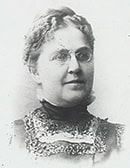
For the ALA Annual Conference in Cleveland, September 1–4, 1896, members were asked to submit suggestions for a list of “do’s” of librarianship. Cats and plants featured prominently. The list was in contrast with the 1894 Annual Conference in Lake Placid, New York, which collected “don’ts,” or things that librarians should not do. One of them was: “Don’t fail to attend the ALA meetings unless you have good reasons for staying away.”
At the 1892 Annual Conference in Lakewood, New Jersey, held May 16–19, ALA included a Women’s Meeting in which Ellen M. Coe of the New York Free Circulating Library was elected chair. At the meeting, Mary Salome Cutler (1855–1921), a teacher at the New York State Library School in Albany (where Dewey moved his Columbia classes to in 1889) reported that the 15 highest salaries paid to women librarians averaged $1,090. The 24 men filling similar positions averaged $1,450.
With the help of funding from Andrew Carnegie, ALA hosted an exhibition at the Exposition Universelle in Paris, April 15–November 12, 1900, organized by Florence Woodworth, showing the progress and condition of US libraries. Librarians Mary Wright Plummer and Joseph Harrison were sent to Paris to explain the exhibit, which was housed in the Social Economy building.
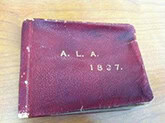
Frederick Winthrop Faxon (1866–1936) was the early bard of the American Library Association. An avid photographer, Faxon documented each conference he attended, from austere portraits of ALA presidents to informal swimming excursions. Afterwards, he annotated and bound the photographs into pocket-sized volumes and circulated them among his friends. The ALA Archives has several of these traveling conference photo albums.
This story first appeared in American Libraries, February 11, 2016.